


We remove air from the system with the engine not running, first from one circuit, and then from the other in the following sequence:
- brake mechanism of the right rear wheel;
- left front wheel brake mechanism;
- brake mechanism of the left rear wheel;
- brake mechanism of the right front wheel.
If air gets into one of the circuits, it is enough to bleed only this circuit, and not the entire hydraulic drive. Before bleeding, check the level of the working fluid in the reservoir of the hydraulic drives of the brake system and clutch. If necessary, top up the fluid. Bleed the brakes with an assistant. Clean the bleed nipple of the brake mechanism of the right rear wheel from dirt..
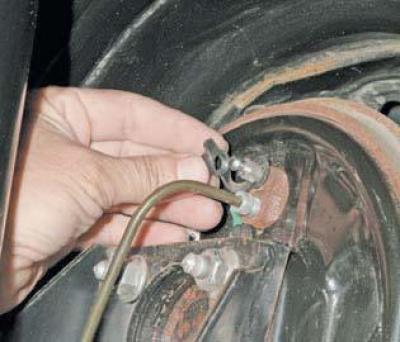
…and remove the protective cap from it.
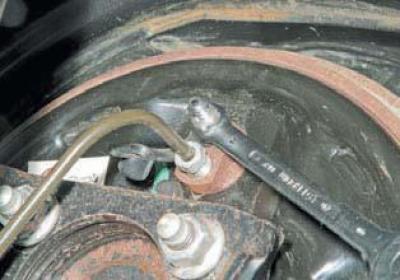
Using a 9 mm open-end wrench, loosen the bleed nipple.
We put a hose on the fitting and immerse its free end in a container partially filled with working fluid.
The assistant should vigorously press the brake pedal all the way down 4–5 times and hold it pressed.
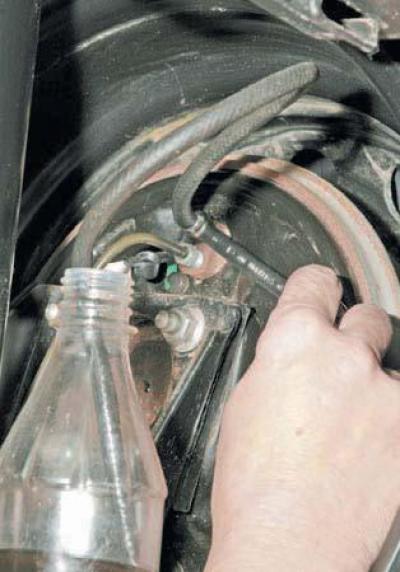
Using a 9 mm spanner, loosen the bleed nipple by 1/2–3/4 of a turn.
In this case, liquid with air bubbles will flow out of the hose, and the brake pedal should be pressed all the way down.
As soon as the liquid stops flowing out of the hose, tighten the nipple, and only after that can the assistant release the pedal.
Repeat bleeding until no more air bubbles appear in the liquid coming out of the hose. Remove the hose, wipe the bleeding nipple dry and put the protective cap on it.
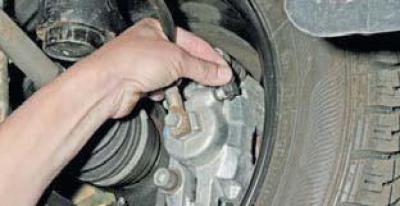
Remove the protective cap from the brake bleed nipple on the left front wheel
We pump it as described above..
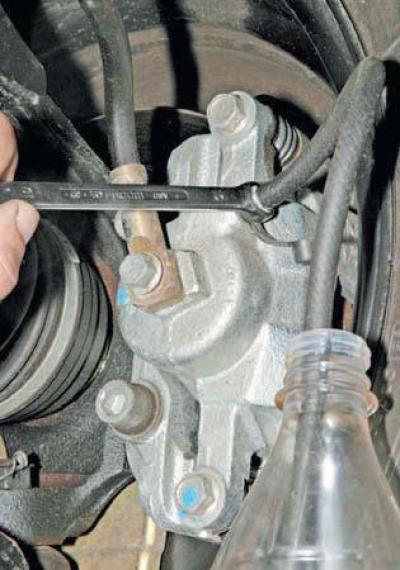
...the brake mechanism of the left front wheel, unscrewing the bleed nipple with a 10 key.
We bleed the brake mechanisms of the other circuit in the same way.
When pumping, you need to monitor the fluid level in the tank and add fluid if necessary.
If the brake pedal feels "soft" and has an increased travel when you press it, it means that there is air left in the system. In this case, repeat bleeding until the pedal becomes "hard", i.e. when pressed, it does not travel more than half the distance to the floor. If the air cannot be removed, check the tightness of the connections, pipes, hoses, master and working cylinders. Tighten leaking connections, replace faulty master and working cylinders (see Brake system).
For details, visit the website «ChevyMan.ru»