
ChevyMan.ru
Mazda Mitsubishi Toyota Land Rover Honda Kia Nissan
English Русский
Български
Беларускі
Український
Српски
Hrvatski
Română
Polski
Slovenský
Magyar
|
Articles | Sitemap | Contacts |


Home   Aveo   Captiva   Cruze   Lacetti   Lanos   Niva   Tahoe   Others  
Lacetti 1 (2002-2009)
  • Home
  • Lacetti
  • J200 (2002-2009)
  • General information
  • Maintenance
  • Bleeding the hydraulic brake system

Bleeding the hydraulic brake system (Chevrolet Lacetti J200)

            0

We bleed the brakes to remove air from the hydraulic drive after it has become depressurized when replacing the master cylinder, wheel brake cylinders, hoses, tubes, and also in the case of replacing the working fluid or when the brake pedal becomes "soft".

We remove air from the system with the engine not running, first from one circuit, and then from the other in the following sequence: - brake mechanism of the right rear wheel; - brake mechanism of the left front wheel; - brake mechanism of the left rear wheel; — brake mechanism of the right front wheel.

If air gets into one of the circuits, it is enough to bleed only this circuit, and not the entire hydraulic drive. Before bleeding, check the level of the working fluid in the reservoir of the brake and clutch hydraulic drives. If necessary, add fluid (see Checking the fluid level in the brake and clutch hydraulic reservoir).

Bleeding the brakes is done with an assistant. We clean the bleed nipple of the brake mechanism of the right rear wheel from dirt..
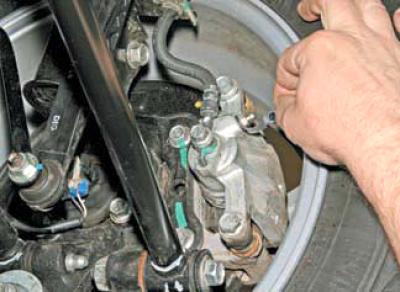
Bleeding the brakes is done with an assistant. We clean the bleed nipple of the brake mechanism of…


…and remove the protective cap from it.
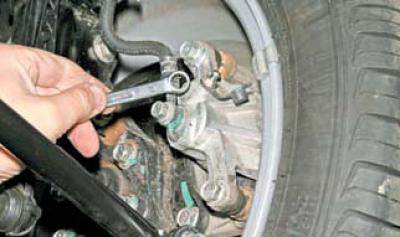
…and remove the protective cap from it.


Using a 10 mm open-end wrench, loosen the bleed nipple.


We put a hose on the fitting and immerse its free end in a container partially filled with working fluid.

The assistant should vigorously press the brake pedal all the way down 4–5 times and hold it pressed.
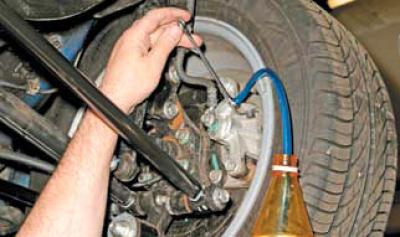
The assistant should vigorously press the brake pedal all the way down 4–5 times and hold it…


Using a 10 mm spanner, loosen the bleed nipple by 1/2–3/4 of a turn.

In this case, liquid with air bubbles will flow out of the hose, and the brake pedal should be pressed all the way down.

As soon as the liquid stops flowing out of the hose, tighten the nipple and only after that can the assistant release the pedal.

Repeat bleeding until no more air bubbles appear in the liquid coming out of the hose. Remove the hose, wipe the bleeding nipple dry and put the protective cap on it.
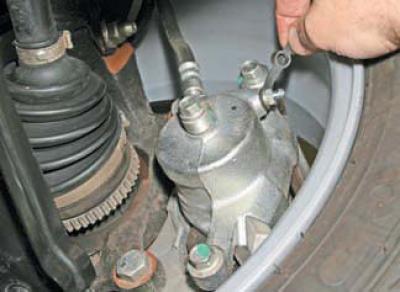
Repeat bleeding until no more air bubbles appear in the liquid coming out of the hose. Remove the…


Remove the protective cap from the brake bleed nipple on the left front wheel.
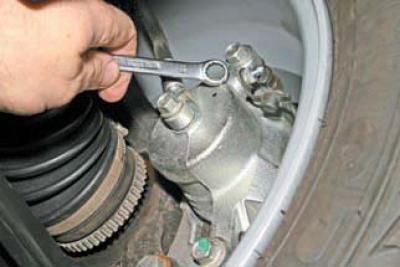


Remove the protective cap from the brake bleed nipple on the left front wheel.


Using a 10 mm open-end wrench, loosen the bleed nipple.

We put a hose on the fitting and immerse its free end in a container partially filled with working fluid.

We pump it as described above..
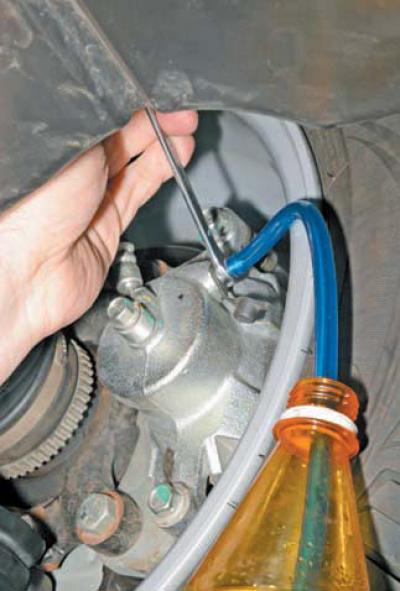
We pump it as described above..


...the brake mechanism of the left front wheel, unscrewing the bleed nipple with a 10 key.

We bleed the brake mechanisms of the other circuit in the same way.

When pumping, you need to monitor the fluid level in the tank and add fluid if necessary.

If the brake pedal feels "soft" and has an increased travel when you press it, it means that there is air left in the system. In this case, repeat bleeding until the pedal becomes "hard", i.e. when pressed, it does not travel more than half the distance to the floor. If the air cannot be removed, check the tightness of the connections, pipes, hoses, master and working cylinders. Tighten leaking connections, replace faulty master and working cylinders (see Brake system).

[The original text can be found on the website «CHEVYMAN.RU»]

The article was checked: Vladimir Romannikov
This article is available at russian, bulgarian, belarusian, ukrainian, serbian, croatian, romanian, polish, slovak, hungarian

Share information:

Previous articles
Lacetti 1: Maintenance
Next articles

Replacing fluid in hydraulic brake and clutch drives
Checking the fluid level in the brake and clutch hydraulic reservoir
Checking the fluid level in the automatic transmission
Checking the level and adding oil to a manual transmission
Replacing the coolant
Checking the level of working fluid in the power steering reservoir
Adjusting the parking brake
Replacement of auxiliary drive belt
Checking the condition and replacing spark plugs
Replacing the fuel filter


See similar articles on the topic of Chevrolet cars:
Bleeding the hydraulic brake system Chevrolet Aveo T300 (2012-2018)
Bleeding the hydraulic brake system (Manual) Chevrolet Captiva 1 (2006-2018)
Bleeding the hydraulic brake system Chevrolet Cruze 1 (2008-2016)
Bleeding the hydraulic brake system Chevrolet Lanos T150 (2002-2009)
Brake system Chevrolet Niva 1 (2002-2016)
Bleeding the brake hydraulic system Chevrolet Tahoe 1 (1992-2000)
Hydraulic brake system — bleeding Chevrolet Trailblazer 1 (2001-2008, petrol)
Link in different formats to this page


Visitor comments

No comments yet


How much will 22 + 22 =


Lacetti 1 (2002-2009) 
  • General information
  • User manual
  • Maintenance
  • Power unit
  • Engine repair
  • Control system
  • Supply system
  • Cooling system
  • Exhaust system
  • Transmission
  • Clutch
  • Manual gearbox
  • Front wheel drives
  • Chassis
  • Front suspension
  • Rear suspension
  • Steering
  • Brake system
  • Body
  • Repair of body elements
  • Heating and air conditioning
  • Electrical equipment
  • Engine electrics
  • Lighting and lamps
  • Equipment and devices
  • Electrical circuits


ChevyMan.ru © 2017-2026 · Mobile version · Feedback · Site search · Interesting to read · Sitemap: EN BG BY UA RS HR RO PL SK HU

Aveo 2003-2008 · Aveo 2006-2011 · Aveo 2012-2018 · Captiva 2006-2018 · Cruze 2008-2016 · Lacetti 2002-2009 · Lanos 2002-2009 · Niva 2002-2016 · Tahoe 1992-2000 · Tahoe 2000-2014 · Lumina 1 1989-1994 · Trailblazer 1 2001-2008 · Orlando 1 2010-2018 ·
🛡️ For your security and to improve our service, this site uses cookies. You can disable them in your browser.