


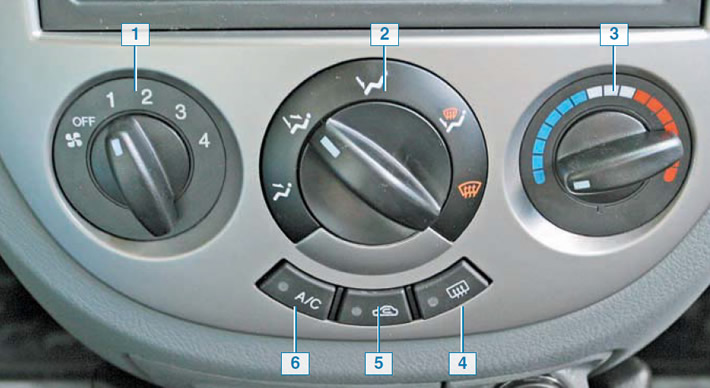
Heating, ventilation and air conditioning system control unit (on cars with manual air conditioning): 1 — fan mode switch; 2 - air flow distribution regulator; 3 - air temperature regulator; 4 — switch for heating the rear window and outside mirrors; 5 — air recirculation mode switch; 6 - air conditioner switch
Regardless of the body type and instrument panel configuration, the vehicle can be equipped with a heating, ventilation and air conditioning system with manual air conditioning or automatic regulation of the air temperature in the cabin (climate control system). Control of any of the heating, ventilation and air conditioning systems is possible only with the engine running. It is not recommended to use the system devices with the ignition on and the engine not running, as this may lead to the battery being discharged.
In a car with manual air conditioning, the fan mode switch changes the air flow from the lowest (position 1) to the highest (position 4). If you turn off the ignition while the fan is on, it will also turn off, and after turning on the ignition, it will turn on in the previously set mode.
The air flow distribution regulator sets the following air flow directions in the cabin:
 — to the head area. The air flow through the deflectors in the instrument panel enters the upper part of the car interior. This mode is recommended for use in clear and dry weather — it allows you to quickly warm up or cool down the interior;
 — to the foot and head areas. Air flows through the deflectors into the upper part of the car interior and through the lower ventilation openings into the foot area of the driver and front passenger. This mode is recommended for use in clear and dry, but very cold or hot weather;
 — to the footwell area. Air flow is directed through the lower vents only to the footwell area of the driver and front passenger. This mode is recommended for use in clear and dry, but moderately cold or hot weather. In this case, in cold weather, the air in the upper part of the cabin (in the driver's head area) will remain relatively cool - this will keep the driver alert and prevent relaxation and sleep on a long journey;
 — to the foot area and to blow the windshield and front door windows. Air flows through the lower ventilation openings to the foot area, as well as to the windshield and front door window blower grilles. Recommended for use in cold and damp weather, when the windows quickly fog up;
 — for blowing the windshield and front door windows. The air flow goes to the windshield and front door window blowing grilles.
Recommended for use in wet weather conditions and for quickly cleaning the windshield if it has fogged up before driving (see below).
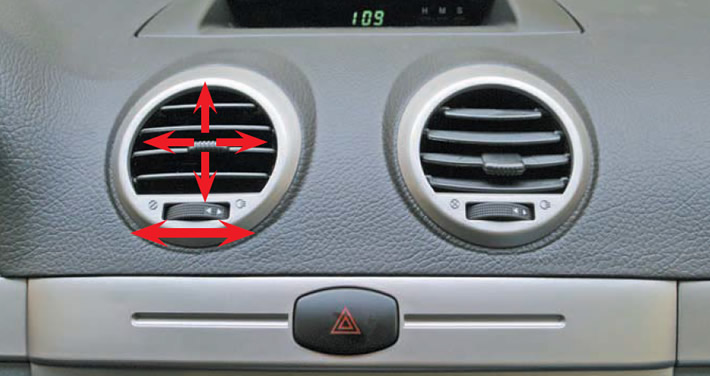
Directions of movement of the central deflector handle (top) and the deflector opening/closing regulator (bottom)
Air flows will be distributed in this way even when the fan is off - when the car is moving due to natural air flow. If the natural air flow is not intense enough for ventilation or heating of the passenger compartment, turn on the fan.
By turning the air temperature control knob, you can change the temperature of the air entering the cabin. To increase the air temperature, turn the control knob clockwise, to the red sector of the scale, to decrease it - counterclockwise, to the blue sector.
When the recirculation mode is turned off, air enters the ventilation and heating system from outside the car. It makes sense to turn on the recirculation mode in the following cases:
- for the fastest possible warming up of the interior of a parked car in winter (when moving, the air flow from outside is more efficient);
- when driving in a highly polluted atmosphere (for example, in long tunnels);
- when driving in dusty areas.
Before turning on the recirculation mode, close all door windows.
It is not recommended to use the recirculation mode for a long time, as this may lead to an increase in air humidity in the cabin and fogging of the windows.
The heating and ventilation system deflectors allow you to change the direction of the air flow. To do this, use the handle located in the center of the deflector. By moving it left and right or up and down, we change the direction of the air flow. The regulator at the bottom of the deflector allows you to open the air flow from this deflector or close it. The photo shows deflectors on the dashboard of cars with hatchback and station wagon bodies. On a car with a sedan body, the ventilation, heating and air conditioning system deflectors have a different shape, but function in the same way.
If your windshield fogs up during warm weather, you can direct cold air at it. To do this:
- using the flow distribution regulator we direct the air to blow onto the windshield
 ;
; - turn on recirculation mode;
- we move the temperature control handle to the blue sector;
- turn on the fan at maximum speed. When the condensate evaporates, reduce the fan speed so that there is no noise in the cabin.
To clear the windshield of ice and snow, and to free the wiper blades frozen to it, direct a stream of air onto the glass
 , we move the air temperature control handle to the red sector and turn on one of the high fan speeds. With this mode of operation of the heating system, the temperature of the air directed to the windshield will increase gradually, which will prevent the formation of cracks on the windshield. After defrosting the glass, we select the desired direction of air flow in the cabin using the air flow distribution regulator.
The air conditioner can also only be used when the engine is running. It is not recommended to turn on the air conditioner when the ignition is on and the engine is not running - this can lead to the battery being discharged.
Before turning on the air conditioner, close the windows of all doors. To turn on the air conditioner, press the A/C button (at the same time, an orange indicator lights up in it) and turn on the fan at the speed you find appropriate. Turn off the air conditioner by pressing its button again (the indicator in it goes out).
The air conditioner is a very effective device that provides high comfort in the car. However, it should be used with some caution. For example, in hot weather, too intensive use of the air conditioner can provoke colds in the driver or passengers, especially children. It is not advisable to turn on the air conditioner when the air flow distribution regulator is in the positions
 or
or  .
.
It is better to choose a position
 . Try not to use the air conditioner with the recirculation mode on - this greatly reduces the air temperature in the car. It is recommended to maintain a moderate, comfortable temperature in the cabin, rather than a low one.
It is not advisable to turn on the air conditioner immediately after starting to drive a car that has been parked in the hot sun for a long time. This can cause a sharp cooling of the heated windshield and the appearance of cracks on it. Pre-ventilate the interior by opening all the windows or directing the air flow onto the glass using a fan (without turning on the air conditioner).
The air conditioner increases the load on the engine when driving. This is especially noticeable when starting from a standstill, when accelerating, and when driving uphill: the engine power decreases, the car's responsiveness deteriorates. In some conditions, this can even lead to engine overheating. Therefore, it is recommended to turn off the air conditioner in difficult driving conditions, and also monitor the coolant temperature gauge arrow.
The air conditioner allows you to quickly eliminate fogging of the glass in damp weather. To do this, turn on the air conditioner and move the air flow distribution regulator to the position
 , while the air temperature regulator is set to the border of the blue and white zones.
It is recommended to turn on the air conditioner at least once a week for a few minutes, even in cases when there is no need for it (for example, in winter). This extends the life of the air conditioning system, as it helps to maintain lubrication on the air conditioning compressor parts and their seals.
Some vehicles may be equipped with an automatic temperature control system in the cabin (climate control system). The driver only needs to set the desired air temperature and air flow direction, after which the system will automatically turn on the heating and ventilation devices or the air conditioner (except for the recirculation system) and will maintain the set temperature in the cabin either until the driver changes the system operating mode manually (see below), or until the system is switched off, or until the ignition is switched off. If the ignition and the climate control system are then switched on, it will start working from reaching the previously set temperature.
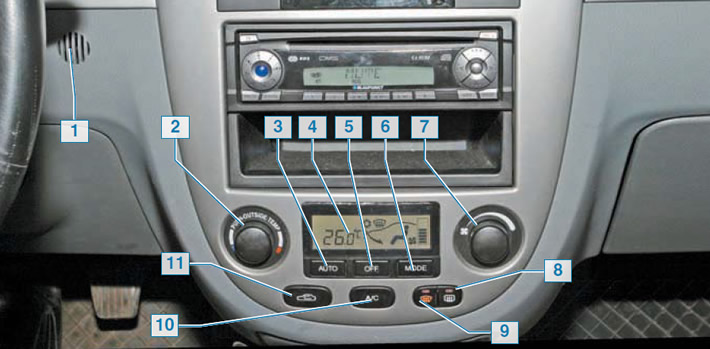
Climate control system control unit on a sedan car: 1 - cabin air temperature sensor; 2 — cabin air temperature control handle; 3 — button for turning on the automatic mode of the climate control system; 4 - LCD display of the climate control system; 5 — climate control system off button; 6 - air flow distribution button; 7 — air supply speed adjustment handle; 8 — switch for heating the rear window and outside rear-view mirrors; 9 — switch for blowing the windshield and front door windows; 10 - air conditioner switch; 11 — recirculation mode switch
To turn on the climate control system, press the AUTO button (3), or the A/C button (10), or turn the temperature control knob (2) until the desired air temperature in the cabin is displayed on the liquid crystal display of the system. The AUTO symbol will appear on the display, and the system will automatically set the required fan speed, which will gradually decrease as the set temperature is reached. If necessary, you can set an increased or decreased fan speed to speed up or slow down the heating/cooling of the air in the cabin, but the AUTO mode will turn off.
Using the temperature controller, you can set the desired air temperature in the cabin from 18 to 32°C with an accuracy of 0.5 degrees. If desired, you can set the temperature measurement on the Fahrenheit scale. To do this, set the temperature controller to the 26°C position and, holding down the AUTO button, press the MODE button (6) three times within 3 seconds - the indication will change to 79°F. To return to the Celsius scale, repeat the procedure.
If the maximum (Hi) or minimum (Lo) temperature values are set using this controller, the climate control fan will start operating at maximum speed and will not change its speed even after the specified temperature is reached.
The temperature controller allows you to set the required temperature inside the car and also determine the outside air temperature. To do this, press the center of the temperature controller knob. The display will show the air temperature outside the car and the OUTSIDE symbol above it. The outside temperature display will change to the inside temperature display when you press the center of the knob again or automatically after about 5 seconds. It should be noted that the outside air temperature displayed on the display is usually slightly higher than the actual temperature (this is due to the location of the temperature sensor).
By successively pressing the MODE button, you can change the air flow distribution modes in the cabin in the following order (in a circle):
 — air supply to the head area. Air flow through the deflectors in the instrument panel enters the upper part of the car interior;
 — to the foot and head areas. Air flows through the deflectors into the upper part of the car interior and through the lower ventilation openings into the foot area of the driver and front passenger;
 — to the footwell. Air flow is directed through the lower vents only to the footwell of the driver and front passenger;
 — to the foot area and to blow the windshield and front door windows. Air flows enter through the lower ventilation openings to the foot area, as well as to the windshield and front door window blower grilles.
All air flow distribution modes are displayed on the climate control system display.
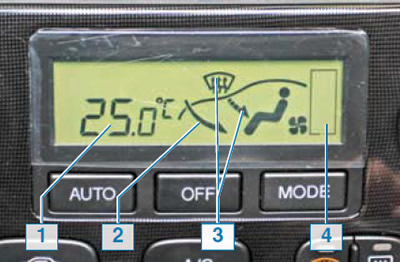
Indication on the liquid crystal display of the climate control system: 1 — set (desired) air temperature in the cabin; 2 — symbol of the system operation when air enters the passenger compartment from outside the vehicle; 3 — symbols of the system operation in the mode of supplying air to the windshield and footwell area; 4 - panel displaying the fan speed (the more horizontal stripes, the higher the rotation speed)
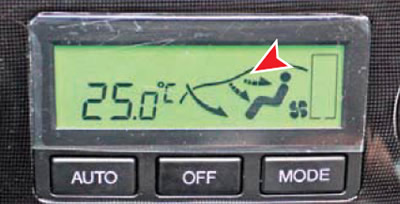
Indication of the system operation in the air supply mode to the head and foot area (the symbol of this mode is shown by an arrow)
The display will also show whether the recirculation mode, windshield defroster and air conditioning are on.
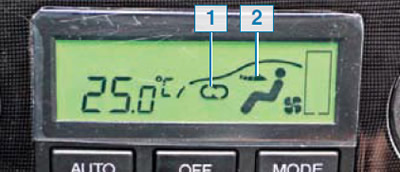
Indication of the climate control system operation in recirculation mode (1) and air supply to the head area (2)
The windshield defroster mode is activated by pressing the button with the icon
 , and the corresponding indicator turns on on the display, the recirculation mode is automatically turned off and the air conditioner turns on. If you want to free the glass from condensation (fogging) without turning on the air conditioner, just press the air conditioner off button - it will turn off, but the glass blowing mode will remain on.
To turn off the windshield defroster mode, press the button again, or turn on the air conditioner, or turn on the air recirculation mode.
Original version of the article on the website «chevyman»