


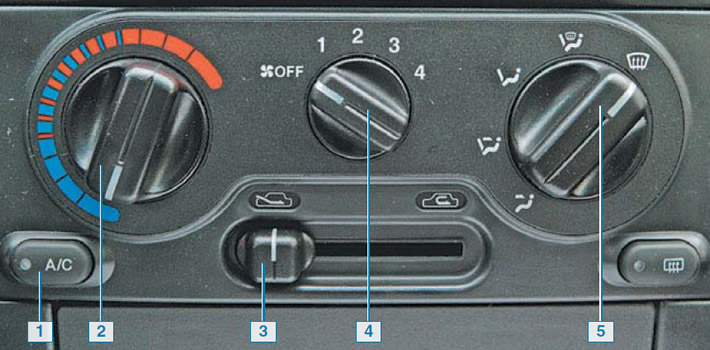
Heating, ventilation and air conditioning control unit: 1 - air conditioner switch; 2 - air temperature regulator; 3 — air recirculation mode control lever; 4 — fan mode switch; 5 — air flow distribution regulator
The intensity of air supply to the passenger compartment is adjusted by turning the fan mode switch handle (with ignition on).
In this case, one of four fan speeds is switched on. By turning the switch handle clockwise, we increase the fan speed. The flow distribution regulator sets the following air flow directions in the cabin:
 — to the head area. Air flow through the deflectors in the instrument panel enters the upper part of the car interior;
 — to the foot and head area. Air flow enters through the deflectors into the upper part of the car interior and through the lower ventilation openings into the foot area of the driver and front passenger;
 — to the footwell. Air flow is directed through the lower vents only to the footwell of the driver and front passenger;
 — to the foot area and to the windshield and front door glass blowing. The air flow enters through the lower ventilation openings to the foot area, as well as to the windshield and front door glass blowing grilles;
 — for blowing the windshield and front door windows. The air flow is directed only to the windshield and front door window blowing grilles.
By turning the air temperature control knob, we change the temperature of the air entering the cabin. To increase the air temperature, we turn the control knob clockwise, to the red sector of the scale, and to decrease the air temperature, we turn it counterclockwise, to the blue sector. To allow outside air to enter the cabin, we move the air recirculation control lever to the extreme left position.
To turn on the air recirculation mode, move the control lever to the far right position.
Air recirculation mode (stopping the supply of outside air to the cabin) it is recommended to use when it is necessary to quickly lower or raise the air temperature in the passenger compartment, as well as when driving in dusty areas or in heavy traffic, to avoid dust or exhaust gases getting into the passenger compartment.
Use the recirculation mode with the door windows up. It is not recommended to use the recirculation mode for a long time, as this may lead to an increase in air humidity in the cabin and fogging of the windows.
Air can enter the passenger compartment through the central or side deflectors of the ventilation, heating and air conditioning system.
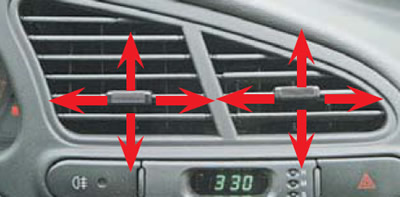
To prevent the windshield and door glass from fogging up in warm weather, it is enough to direct cold air at them. To do this, you need to:
- use the air distribution regulator to direct air through the upper windshield defroster grille and the front door window defroster grilles;
- move the air recirculation control lever to the extreme left position;
- move the temperature control knob to the blue sector;
- turn on the appropriate fan mode.
To clear the windshield from ice and snow, as well as to release the frozen wipers after a long period of parking, turn on the engine and direct the air flow to the glass by moving the air temperature control handle to the red sector and turning on the required fan mode. As the engine warms up, the temperature of the air directed to the windshield will increase gradually. This defrosting mode will help to avoid cracks in the windshield. After defrosting the glass, use the air flow distribution control to select the desired direction of air supply to the passenger compartment.
To speed up the heating of the interior, it is recommended to turn on the recirculation mode when the car is parked, and turn it off when moving.
Using the air conditioner
To turn on the air conditioner, press the "A/C" switch button with the engine running, while the fan mode switch must be moved from the "OFF" position to one of its four positions. When the air conditioner is turned on, the indicator in the button lights up. Press the button again to turn off the air conditioner.
On long climbs or in heavy city traffic, the air conditioner may cause the engine to overheat. Therefore, if the coolant temperature has exceeded the permissible value, the air conditioner should be turned off.
If the car is parked in direct sunlight, open the windows and ventilate the interior before turning on the air conditioner.
To prevent the windows from fogging up in rainy weather, turn on the air conditioner and move the air distribution control to the position
 in this case, it is recommended to set the air temperature regulator on the border of the blue and red zones. If there is no need to turn on the air conditioner, then it should be turned on once a week, for a few minutes, even in the winter period of operation at low negative temperatures. This helps to preserve the lubricant on the compressor parts and seals, which extends the service life of the air conditioning system.
When parked for a long time in the sun in hot weather, the air temperature inside the car is much higher than outside. To quickly cool the car, open the doors for a while to let the hot air out. Then start the engine, turn on the air conditioner in the maximum cooling mode and close the doors. It is best to direct the flow of cooling air upwards, and in no case into the face. This can cause colds and inflammation of the facial nerves.
After parking the car for a long time in hot weather in the sun, when turning on the air conditioner, do not direct the flow of cold air onto the windshield to avoid cracks.
The maximum interior cooling mode is recommended for use in hot weather or after the car has been parked in the sun for a long time. This mode is implemented as follows.
The air recirculation mode is on. The air flow distribution regulator is set to one of its positions; the air temperature regulator is turned to the extreme counterclockwise position; fan mode switch - to position "4"; the air conditioner is on.