


Wheels
Automobile wheels are differentiated by design, manufacturing technology and dimensions, which determine whether the wheel belongs to a given vehicle, as well as the sizes and types of tires that can be used on it.
Wheels for passenger cars are usually made of steel or light alloys. Light alloy cast and forged wheels are made entirely from a single blank. Cast wheels are turned directly from a casting, and forged wheels are turned from a pre-forged blank (forging), which provides them with greater strength.
The determining dimensions for the wheel are the mounting (landing) diameter "a" and width "b" of the rim profile. Rim dimensions can be indicated in millimeters, but are more often indicated in inches, for example 5.5J x 14. In both cases, the first digit indicates the width of the rim, the letter J indicates the shape of its profile (also found are the designations E, L, K), and the last digits are the wheel mounting diameter corresponding to the same tire size.
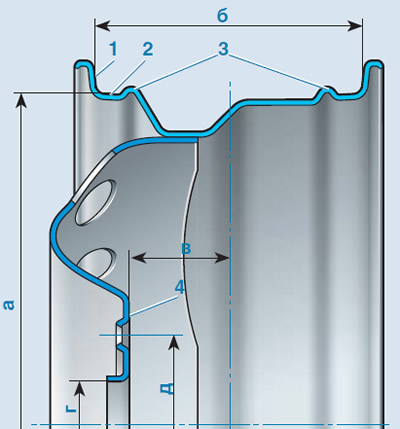
Main elements and dimensions of the wheel: 1 - rim edge; 2 — shelf; 3 - annular projections (humps) for additional fixation of the sides of the tubeless tire; 4 — mounting plane; a — mounting diameter; b - rim width; in — departure (distance between the plane of symmetry of the rim and the mounting plane of the wheel); g — diameter of the central hole for the hub; d — diameter of the circle where the fastening bolts are located
Possible additional designation H (H2) means the presence of one or two humps on the rim. Humps are the annular projections along the edges of the wheel rim intended for a tubeless tire. The main purpose of humps is to reliably fix the tire bead during turns to prevent the wheel from becoming depressurized.
Wheels with one hump along the outer side have one letter H in their designations. However, many wheel models have a hump along the inner edge of the rim as well, which is indicated by the H2 index. Two humps increase the reliability of the tire fixation on the wheel, but create problems during its installation.
Wheel offset (dimension "b") in the wheel marking is designated as ET and is given in millimeters. The diameter of the central hole (dimension "g") and the diameter of the location of the holes for the mounting bolts ("d") are given in millimeters and are designated, respectively, DIA and PCD.
The "Lanos" is equipped with wheels of the size 5.5Jx14. The size of the steel wheel of the "Lanos" is...
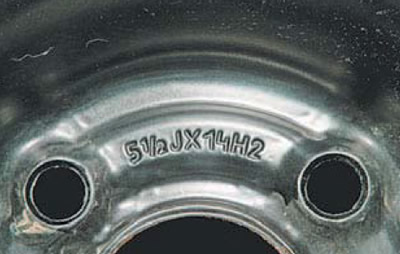
...marked on the outside of the disc between the mounting holes.
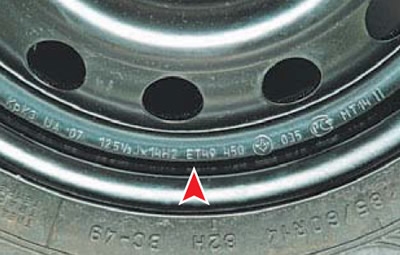
The wheel offset value (ET49) is additionally marked on the wheel rim.
Full characteristics of the wheel "Lanos" 5.5J x 14N₂ 4 x 100 x 56.6 ET49, where: 5.5 - landing width of the rim; J — profile symbol; 14 — the seat diameter (in inches) on which the tire rests; H2 - presence of two humps; 4 — number of mounting holes; 100 — PCD (Pin Center Circle Diameter), mm; 56.6 — diameter of the central hole (DIA), mm; ET49 — wheel offset, mm.
The main advantage of light-alloy wheels over steel ones is their lower weight. Reducing the weight of the wheel assembly with the tire leads to a reduction in unsprung inertial masses and improved operating conditions of the vehicle suspension, since the wheel "obeys" the returning action of the elastic elements of the suspension faster and restores lost contact with the road. This increases driving comfort and traffic safety. The vehicle's controllability and braking dynamics are improved, and fuel consumption is slightly reduced. Due to the high precision of manufacture and the characteristics of the materials, light-alloy wheels better hold the tubeless tire on the rim.
Forged wheels weigh even less than cast wheels. They have thinner walls - up to 3 mm, while cast wheels should have walls no thinner than 5.5 mm. However, forged wheels better withstand impacts from uneven road surfaces and are more resistant to destruction and deformation.
Light alloy wheels are made mainly from aluminum alloys. Less commonly, magnesium is used, although wheels made from it are 0.5-1.5 kg lighter than aluminum ones and have better (100 times) damping capacity. In addition, due to its high thermal conductivity, magnesium allows for additional reduction in heating of the brake mechanisms and hubs of the car while driving.
Aluminum and especially magnesium are metals that are very susceptible to corrosion. To protect the wheels, their manufacturers use expensive coatings - special varnishes of complex compositions, but this protection is not eternal, and it is very difficult to restore. The varnish can be damaged not only on a bad road or under the influence of winter salt, but also during inept installation/dismantling of the tire. In addition, light-alloy wheels are balanced using special weights that are glued to the surface of the rim. Regular weights on clamps may simply not fit on the rounded edge of the rim, and after rebalancing the wheel, scratches and corrosion stains from contact with the steel of the clamps may remain on it.
The increased thickness of the alloy wheel disc does not allow the use of standard wheel bolts for its fastening. Instead, longer ones are required, which are usually purchased complete with the wheels. Alloy wheels are more resistant to deformation from impacts than steel wheels. However, a steel wheel never breaks when deformed, and if it is capable of holding air in the tire, you can drive to the place of repair on it. Alloy wheels, as a rule, simply split when hit hard. In addition, if a bent steel wheel can be straightened ("rolled") on a special machine, then it is much more difficult to restore an alloy wheel.
Particularly dangerous in this regard are counterfeit, uncertified wheels that have not undergone special strength tests. The metal of "left" products may well contain hidden cavities, cracks, delaminations, which significantly reduces their strength. Therefore, when buying wheels in a store or at the market, you should carefully examine their markings, inquire about information about the manufacturer, and ask sellers for a certificate for the product.
Tires
The tire design has the following main elements.
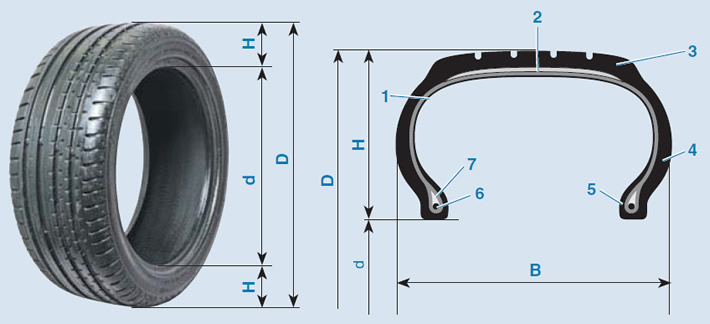
Structural elements and main dimensions of tires: D — outer diameter; H — tire profile height; B — tire profile width; d — tire seat diameter; 1 - frame; 2 - breaker; 3 - protector; 4 — sidewall; 5 — side; 6 - bead wire; 7 - filling cord
Carcass 1 is the main power element of the tire, which gives it strength and flexibility, and also determines many operational properties. It is several (usually four) layers of rubberized cord: textile or a combination of textile and steel. In the carcass of a radial tire, all cord threads are arranged in parallel - along the radius from one side to the other.
Breaker 2 is a cushion layer (belt), which is a rubber-fabric or metal-cord layer around the entire circumference of the tire between the carcass and the tread.
Protector 3 is the "running" part of the tire that directly contacts the road. It is a thick layer of wear-resistant rubber, the inner part of which is a solid strip, and the outer part is relief, i.e. covered with a pattern.
This pattern determines the purpose of the tire and its suitability for operation in certain road conditions.
According to the type of tread pattern, tires can be divided into road, all-season (universal), winter tires, including those designed for the installation of anti-skid studs, tires for off-road driving, as well as sports and racing tires.
Sidewall 4 - thin (1.5-3.0 mm) a layer of rubber on the sidewalls of a tire. Together with the carcass, it performs a load-bearing function, protects the carcass from mechanical damage, moisture penetration, and also serves to apply tire markings.
Bead 5 is the part of the tire designed to secure it to the wheel rim. It consists of a layer of cord wrapped around a wire bead ring 6 and a rubber filler cord 7. The beads prevent the tire from stretching and provide its structural rigidity at the nominal internal air pressure.
Tubeless tires have an airtight rubber layer that seals the interior of the tire over the inner casing, and a valve that fits into a hole in the rim of the wheel.
Tubeless tires do not lose air as quickly as tubed tires when punctured, especially small ones. In some cases, the puncture can be sealed without removing the tire from the wheel.
We recommend purchasing a tubeless tire repair kit and carrying it with you in your car, especially when traveling, away from tire shops. You should definitely take a tire pump or electric compressor with you.
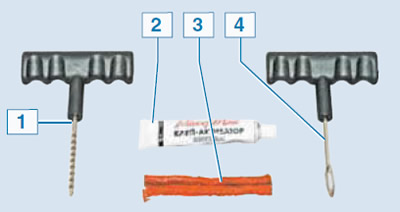
Tubeless Tire Repair Kit: 1 - hole cleaning tool; 2 - glue activator; 3 - repair inserts (flagella); 4 - tool for inserting repair insert
This method can only repair small punctures in the tread area. This method is not suitable for repairing the sidewall of the tire.
To determine the puncture site, inflate the tire and wet its surface with water. The puncture site will be more visible if you add car shampoo to the water or use a soap solution.
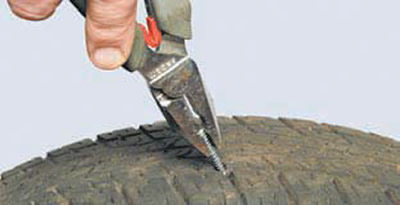
Remove the object that punctured the tire by applying a few drops of glue activator to the hole cleaning tool.
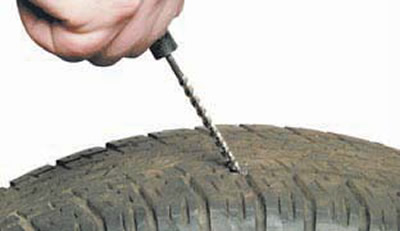
...we clean the walls of the hole by inserting the tool into it (3-4 times) at approximately the same angle at which the object that punctured the tire was located.
We insert the tourniquet into the needle head of the instrument for inserting the repair insert and align the ends of the tourniquet. We apply the glue activator to the tourniquet.
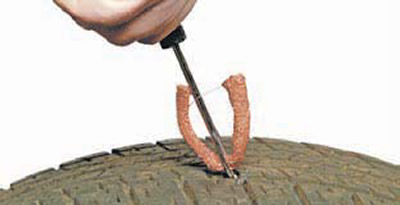
We insert the tool with the tourniquet into the hole being repaired so that the ends of the tourniquet protrude outward by approximately 10-15 mm.
Carefully remove the instrument from the hole, making sure that the flagellum remains in the hole.
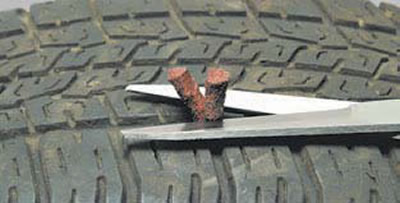
We cut off the protruding ends of the tourniquet flush with the surface of the tread.
Using a pump, we bring the pressure in the tire to the norm - the wheel is ready for use.
Lanos vehicles are equipped with tubeless radial tires measuring 185/60 R 14.
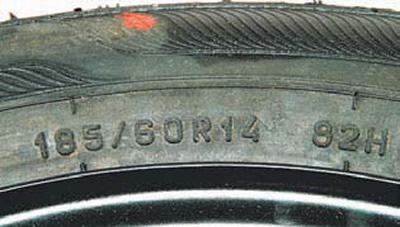
"Lanos" car tire marking
Decoding of the designation 185/60 R 14 82H: 185 — nominal width of the tire profile (B), mm; 60 — ratio of the tire profile height (H) to the width (B), %; R — designation of radial tire; 14 — landing diameter in inches; 82 — conditional load index of the tire (475 kgf); H is the tire speed index (210 km/h).
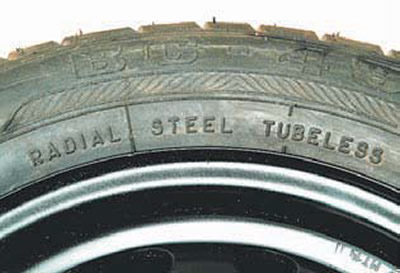
The sidewall of the tire also bears the markings "Radial" - radial tire and "Tubeless" - tubeless tire.
The dimensions of wheels and tires are determined by the car manufacturer, and you should not deviate from these standards, since they include nominal indicators of stability, controllability, and cross-country ability of the car in the entire range of its speeds. Only the tire tread pattern is not specified, which each owner chooses independently, based on specific operating conditions, season, driving style, and their financial capabilities. However, in any case, the tires used must strictly correspond to the parameters specified by the car manufacturer: geometric dimensions, load capacity, and maximum speed.
Checking the condition and care of tires
Wheels and tires should be inspected regularly to detect any damage that may occur (cuts, punctures), remove foreign objects stuck in the tread blocks or between them. Cracks and abrasions from curbs during unsuccessful parking may appear on the outer sidewalls of the tires. You should also inspect the tires for tread wear, especially one-sided or uneven.
When driving, the condition of the tires is monitored by the ability of the car to "hold the road" at high speed. If vibrations, lateral drift or "yawing" of the car appear and increase with increasing speed, you should immediately stop and check the condition of the tires. Most often, the cause is a decrease in pressure in one or more tires, which must be brought to the norm, since with reduced pressure, the elements of the tire design do not work correctly, overheating, accelerated wear and destruction of the tire from the inside occur. It is recommended to check the tire pressure daily before the first trip. In practice, drivers do this much less often, however, modern tire designs allow maintaining pressure at the required level for a fairly long time and "forgive" inattention up to a run of even 2-3 thousand km. However, at least once every one or two weeks, the tire pressure (including in the spare tire) it is recommended to check and bring it up to standard.
The pressure should be checked only on a "cold" tire, since after a trip, especially a long one, at high speed and in hot weather, the pressure is usually higher than normal. In this case, it should not be reduced.
The service life of tires is usually not specified by tire and car manufacturers, since it strongly depends on operating conditions and driving style. The average driver, buying new tires, can expect about 40-50 thousand km of their mileage, a careful, thrifty one - 70-80 thousand km. Driving on uneven roads, on over- or under-inflated tires, hitting obstacles, frequent sharp acceleration and braking, high speeds, vehicle overloads accelerate tire wear by 20-50%.
The use of tires with detachment of the tread, frame, breaker, bulges on the sidewalls ("hernias"), with deep damage exposing the cord, is prohibited. A worn tire should be replaced with a new one immediately, without waiting for its emergency destruction.
Tire storage
It is not recommended to change sets of tires on a single set of wheels every season: the bead ring stretches, rubber damage is inevitable, it is difficult to maintain the accuracy of the initial installation, as a result the balance is disturbed, wear progresses. It makes sense to buy a separate set of wheels for winter (or summer) tires. This, by the way, will speed up the "change of shoes" of the car, and at the same time will save the wheels, especially if it is equipped with light-alloy ones - beautiful and expensive. Of course, it is advisable to use them in the summer: in winter, the advantages of light wheels for high-speed driving are not so noticeable, and their appearance may suffer from contact with anti-icing reagents or objects invisible in the thickness of the snow.
If the wheels are changed, we recommend that you mark each tire and the wheel on which it is installed. It is best to store tires removed from wheels in an upright position, without hanging or stacking them. On the contrary, tires installed on wheels cannot be stored standing upright. It is better to store them hanging on wire hooks or stacked. No special "greenhouse" conditions are required for storing tires. The ideal temperature for them is 15-25°C, no heat sources or direct ultraviolet radiation, including sunlight, nearby. Contact of tires with oils, greases, paint, fuel and other similar substances is unacceptable, as well as the formation of condensation on them - take care of the ventilation of the storage facility. Upright tires should be rotated every four months.
When parking a car on wheels for a long time, it is necessary to occasionally check the tire pressure and roll the car a short distance so that the tire surface does not deform.