


Contents: Preparing your car for winter ↧ Operation ↧
Operating a car in winter is much more difficult than in any other period of the year. In winter, with a slightly discharged battery, starting the engine may be difficult, the likelihood of a traffic accident increases when driving a car during icy conditions and snowfall, many difficulties arise with washing, cleaning the interior, storing the car and protecting the body from salt on the roads. Operation in winter conditions has the greatest impact on the condition of the suspension elements, steering, braking system and body. It is better not to postpone preparing the car for winter until late autumn, but to do it a little earlier on fine days - yourself or at a car service. Car owners who are not going to operate their car in winter should also prepare for this period.
Firstly, you can't put your car in for the winter when it's dirty. The layer of dirt retains moisture, which creates excellent conditions for corrosion. You should also wash and clean the interior and trunk of the car. You should choose a dry and warm day for washing - after all, the car needs to be properly dried and a preservative applied to the body.
The battery should be removed from the vehicle and fully charged. It is best to store the battery in a cool, dry place. If the vehicle's security system must be left connected, the battery will need to be periodically charged from an external power source.
When the car is parked, it is recommended to service the car once every two months: turn the steering wheel 1-1.5 turns in each direction; press the brake, clutch and gas pedals 3-5 times, raise and lower the parking brake lever so that the drives do not stick.
In a car with air conditioning, it should be turned on once a week for a few minutes to maintain lubrication on the compressor parts and system seals.
Preparing your car for winter
Car owners planning to drive in winter are advised to wash the bottom and body of the car before use. In the cabin and trunk, you need to lift the mats and make sure there is no moisture.
Rubber mats in the interior should have high sides. They will protect the metal of the body from the salt solution flowing from the shoes.
It is also advisable to inspect the body and paint over any chips on the outer coating, otherwise rust stains will appear around them on the enamel in winter. It is advisable to treat the body of the car washed from the outside and dry with the damage painted over with one of the recommended car cosmetics for this purpose. It is useful to treat the car body with a polymer-based polish. A layer of such polish will protect the treated surface for several months. Periodic treatment of the body with protective polishes extends the service life of the paintwork of the body by 1.5-2 times, preserves its appearance and supports the marketable appearance of the car. It is necessary to inspect the protective covers of the CV joints of the front wheel drives, steering gear, ball joints. If damage is found on them, the covers must be replaced with new ones, since the ingress of salt, moisture and dirt into the units through damage in the covers will lead to the rapid failure of the units.
Particular attention should be paid to the condition of the battery. If problems with starting the engine arose due to the battery even in the warm season, we recommend replacing the battery with a new one before winter operation. The battery must be fully charged, the wire terminals and battery leads cleaned and lubricated with technical petroleum jelly after installation.
Pay attention to the condition of the windshield wipers; it is better to install special winter wipers.
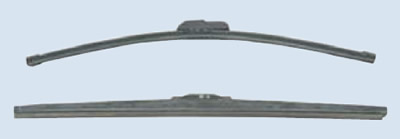
Externally, the winter brush differs from the summer one by the presence of a cover that covers the brush suspension system.
Sometimes such a cover has a snowflake image. The cover protects the brush suspension from being blocked by frozen moisture during temperature changes, for example, when frost comes after a thaw. A brush with a blocked suspension does not fit properly to the glass and cannot clean it well.
Due to the widespread use of anti-icing agents when driving in the city and outside the city, even in freezing temperatures, car windows quickly become dirty and lose their transparency. To clean the windshield, antifreeze must be poured into the windshield washer reservoir. As a rule, the minimum ambient temperature at which the liquid can be used is indicated on the packaging. At higher temperatures, antifreeze can be diluted with water in the specified proportions. However, the liquid often freezes at a higher temperature than that indicated on the canister label. In addition, antifreeze diluted with water can freeze during a sharp cold snap. Therefore, it is not recommended to dilute antifreeze in winter.
If the fluid does freeze in the washer reservoir, fill the ice with undiluted antifreeze, preferably warmed up, start the engine and wait until the ice melts. You can place the car in a warm room for a while and, as a last resort, remove the reservoir (see "Removal the windshield washer pump and reservoir") and melt the ice under running hot water.
Those who have not had time to change their summer or all-season tires to winter tires will be faced with unpleasant surprises like sideways skidding or complete lack of braking in seemingly harmless situations when the first frosts arrive. Using summer tires in winter conditions is absolutely unacceptable and it is better to replace them before the puddles start to freeze. All-season models can be driven in winter, but be careful, especially at the very first frosts.
Of course, when replacing summer tires with winter tires, fuel consumption will increase, and when driving on asphalt, winter tires are noisier than summer tires. But these disadvantages of winter "rubber" are secondary, since its efficiency during acceleration and braking on snow and ice is significantly higher than that of summer or all-season tires.
Winter tire models differ from summer and all-season tires not only in the tread pattern, which is more suitable for driving on snowy roads, but also in the composition of the rubber, which does not lose its elasticity in severe frosts. For regions with a mild climate, all-season tires with an extended operational range can be a good alternative.
When using a car on cleared city roads, non-studded tire models have an advantage, and when driving frequently on packed snow and ice, only studded tires should be used. It should be remembered that on wet or dry asphalt, the braking distance of a car with studded tires increases.
We will say something special about studded tires. Their positive qualities are undeniable, but, unfortunately, motorists often exaggerate them. They are really good as long as there is clean, dense ice under the wheels and something to grab onto, since their coefficient of adhesion in this case is much higher than that of non-studded tires.
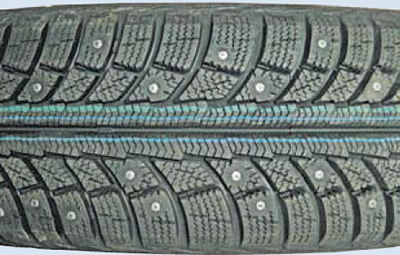
Studded winter tire
If the ice is loose, the effect of the studs is weaker. Snow is even worse - here the studs do not play a big role, the main thing here is the tread, the height and shape of the lugs.
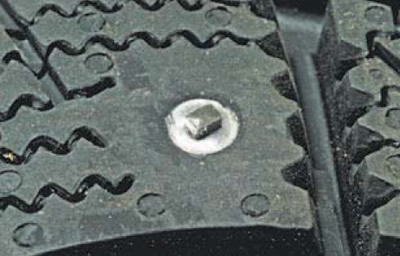
Recently, studs with a rectangular insert cross-section have been used, which improves the grip properties of tires in the longitudinal direction
It is useful to remember that a studded tire works completely differently when the car accelerates (even with slippage) and when braking with "skidding". In the first case, the tire throws off particles of cut ice, cleans itself, and the studs work effectively. In the second case, cut ice accumulates under the wheel, forming an ice cushion through which the studs may not reach the hard surface of the road. On a clean, dry road not covered with ice, the use of studded tires is not justified - their grip on the hard surface is even less than that of ordinary universal tires without studs.
Operation
First, you need to get into the car's interior, covered with a layer of snow. Therefore, in winter, the trunk must have a brush for sweeping away snow, as well as a scraper with which you can remove ice from the glass. Cleaning should begin from the driver's door.
After this, the door can be opened without the risk of snow ending up on the driver's seat, which will melt as the interior warms up. To save time, after cleaning the driver's door, you can start the engine so that it warms up before driving off, and at the same time the interior begins to warm up and the windows are cleared of ice.
Sometimes it is impossible to open the door or trunk lid with a key. The same thing can happen after washing the car and then driving it out into the cold. You can try to remove the moisture frozen in the lock mechanisms with one of the so-called "lock defrosters". As a rule, such compounds are packaged in small bottles or aerosol cans that should be kept warm.
Sometimes on a cold night, a damp door or trunk seal freezes tightly to the body. A frozen door should be opened carefully so as not to damage the seal, and to prevent the seal from freezing to the door before the cold weather, it is advisable to apply a layer of a special silicone-based compound to the rubber.
In winter, even a serviceable engine is harder to start. As is known, at sub-zero temperatures, the battery capacity decreases, and the engine oil becomes more viscous. As a result, it becomes more difficult for the starter to turn the engine crankshaft. Therefore, first of all, it is necessary to ensure that the battery is fully charged.
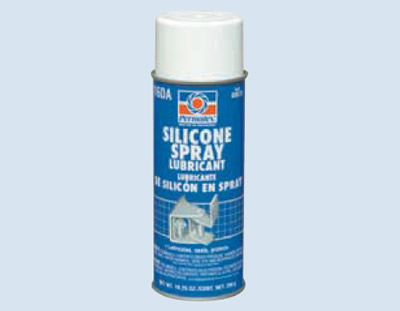
Silicone grease for protecting door seals in winter
It is also important to remember that when starting the engine without disengaging the clutch, the starter has to rotate not only the engine crankshaft, but also the gears of the gearbox, and the oil in the gearbox also becomes more viscous in winter. Therefore, to reduce the load on the starter when starting the engine in severe frosts, it is imperative to disengage the clutch. After the engine warms up a little and begins to run steadily, you can smoothly release the clutch pedal, preventing the engine from stalling. Remember that each engine start consumes battery power. Several unsuccessful attempts - and the engine will no longer be able to start without outside help.
Before starting the engine, it is better to "warm up" the battery a little by turning on the high beam headlights for 10-20 seconds.
If the starter confidently "turns" the engine, but it still does not start, you should immediately stop starting so as not to discharge the battery and sort out the serviceability of the motor. Often the cause of the malfunction is the presence of water in the fuel. During parking, water freezes in the fuel lines, fuel filter, mesh filter of the fuel module and thereby blocks the access of fuel to the engine. To prevent such a situation, you should add a special additive to the fuel that binds water, and it is also not recommended to leave the car in the parking lot with the tank filled less than a quarter.
After the engine has started, move the air flow distribution control handle to the windshield and front door glass blowing position and set the heater electric fan mode switch to position "1". As the engine warms up, the air coming out of the heater will become warmer, thus providing a "soft" (no heat stroke) heating of glass. When the glass is cleared of ice, you can direct some of the warm air downwards and some onto the glass to prevent fogging.
Once the engine has warmed up a bit and the windows have cleared, you can start driving. Don't forget that in cold weather, not only the oil in the engine and gearbox thickens, but also the fluid in the shock absorbers and the grease in the wheel bearings. When starting to drive, don't drive over uneven road surfaces at high speed - this can cause the shock absorbers to break. Drive at low speed for a while after starting to drive so that the fluid in the shock absorbers can warm up. It is necessary to wipe the condenser installed in front of the standard radiator of the car at least several times during the winter. It is this element of the air conditioner that is exposed to the aggressive environment of various anti-icing reagents, which are abundantly sprinkled and watered on our roads in winter. The reagents corrode the aluminum condenser, causing refrigerant leaks. It should be taken into account that it is unacceptable to cover the condenser with any anti-corrosion agent, as this will reduce its efficiency. In winter, when leaving the car in a parking lot, do not use the parking brake: the pads can freeze to the drums and block the rear wheels. The best way to defrost the pads is to remove the wheel, pour hot water from a kettle on the brake drum or direct hot gases from the exhaust pipe of the car onto it. To do this, you will need a flexible hose of the appropriate diameter and length.
[The article is based on data from the website «chevyman»]