


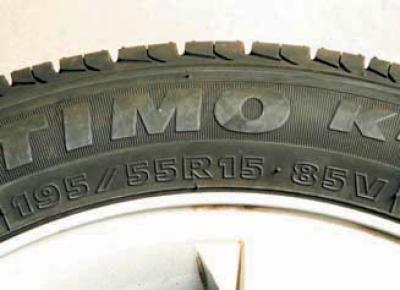
Tyre marking: 195 - tyre width in millimetres; 55 — the height of the tire profile as a percentage of its width; R — designation of a radial tire; 15 — tire seat diameter corresponding to the wheel rim seat diameter; 85 — load index; V — speed index.
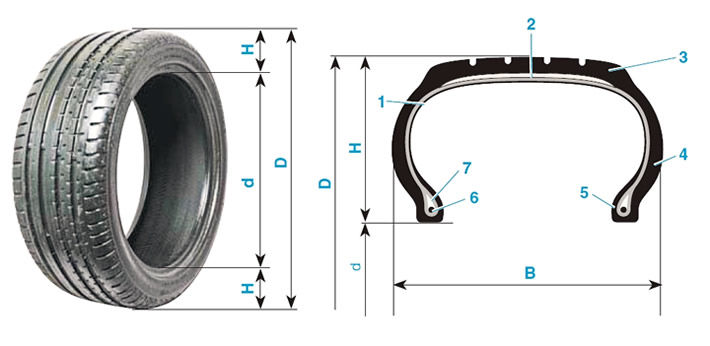
Structural elements and main dimensions of the tire: D — outer diameter of the tire; H — tire profile height; B — tire width; d — tire seat diameter; 1 - frame; 2 - breaker; 3 - protector; 4 — sidewall; 5 — side; 6 - bead wire; 7 - filling cord.
The size of the tires used on the car is closely related to the size of the wheels used. The Chevrolet Lacetti is equipped with low-profile tubeless tires of the following sizes: for 14-inch wheels — 185/65R14, for 15-inch wheels — 195/55R15.
The tire size is deciphered as follows: 185 (195) - tire width in millimeters; 65 (55) — the height of the tire profile as a percentage of its width. If the height of the tire profile is 65 percent or less, such a tire is called a low-profile tire; R — designation of radial tires; 14 (15) — tire seat diameter in inches (matching the wheel rim seat diameter).
The tire markings must include the load index (numerical) and speed index (latin letter). For Chevrolet Lacetti tires, the load index must be at least 85 (which corresponds to 515 kgf), and the speed index is not lower than T (190 km/h).
The tire speed index indicates the maximum speed that can be driven on these tires.
This speed should be slightly higher than the maximum speed of the car.
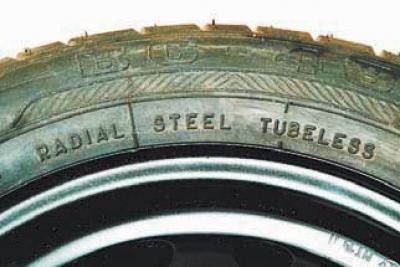
Additional designation of a radial (RADIAL) tubeless (TUBELESS) tire. It is not recommended to use tires of obsolete designs on a car: diagonal (the exception is a spare tire with a diagonal tire), as well as tube tires.
Although such tires are quite rare, it is still necessary to check when buying whether the tire has the letter R in its marking (or the word Radial), and also the word Tubeless, meaning that the tire has a tubeless design.
Usually a new car is sold with summer tires. If you intend to use the car in winter, be sure to buy a set of winter tires (before the start of winter, companies selling cars often offer buyers a set of winter tires as a gift). It is not advisable to change sets of tires on a single set of wheels every season: the tires will deteriorate from this. It makes sense to buy a separate set of wheels for winter (or summer) tires.
It is best to store tires removed from wheels in an upright position, and tires installed on wheels - hanging on wire hooks or stacked.
It is not necessary to create special conditions for storing tires; they can be stored in a garage or on a balcony in a city apartment. The main conditions for safe storage are the absence of heat sources and direct ultraviolet radiation nearby (sunlight), and sufficient ventilation to prevent dampness. Contact of tires with oils, greases, paint, fuel and other chemicals is unacceptable.
When parking a car on wheels for a long time, it is necessary to check the pressure in its tires at least once a month, and also move it (roll over) the car for a short distance so that the tires change their position, otherwise they may become deformed.
It is unacceptable to park a car for a long time on a completely deflated tire: its internal structure is damaged and its strength is reduced.
The service life of tires is usually not specified by tire and car manufacturers, since it greatly depends on operating conditions and driving style. The average tire mileage is approximately 40-50 thousand km (with careful use, it can reach 70-80 thousand km). Tire wear is assessed primarily by the depth of the tread grooves, which should be at least 1.6 mm. The maximum tire wear can also be determined by indicators - transverse protrusions in the longitudinal grooves of the tread. When the height of the indicator protrusion is equal to the height of the tread, this will mean that the tire is worn out and should be replaced.
Uneven wear of the tire tread (more wear on one side, only the central part of the tread or, on the contrary, only the side parts, "spots" (local abrasions), stepwise wear of tread blocks, destruction of individual blocks) indicate a careless attitude of the driver to the tires and to the car as a whole: aggressive driving with wheel slippage when starting from a standstill, braking with wheel locking, fast driving on roads with poor coverage, not brought up to standard (insufficient or excessive) air pressure in the tires, overloading the vehicle, etc. Also, uneven tire wear may indicate a malfunction or wear of the vehicle's suspension components, causing a violation of the wheel alignment angles.
It is dangerous to operate tires with local bulges on the sidewalls ("hernias"), as well as with deep damage to the tread or sidewalls that expose the cord.
Such tires should be replaced immediately with new or used tires that are still fit for use.
Do not skimp on your own safety and do not repair tires with cuts or tears longer than 2 cm.
The car uses tubeless tires. It is prohibited to install a tube in such a tire even for temporary sealing of a puncture or cut. The tube may be destroyed while driving, which will lead to an immediate and sharp drop in tire pressure and may entail an emergency situation.
Of course, you can install not only standard-size wheels and tires on the Chevrolet Lacetti, but also others, for example, larger-diameter wheels (16 inches or more) with appropriate low-profile or even ultra-low-profile tires. It is important that the main parameters of the wheels (offset, PCD and outside diameter of the tire) were exactly the same as the standard wheels, otherwise installation will be impossible. The width of the wheel with the tire should also not exceed a certain value, otherwise the wheel will touch the suspension and body elements, especially when turning the car. If it has a reduced offset, this can be avoided, but at the same time the load on the hub bearing will increase significantly, which is also bad.
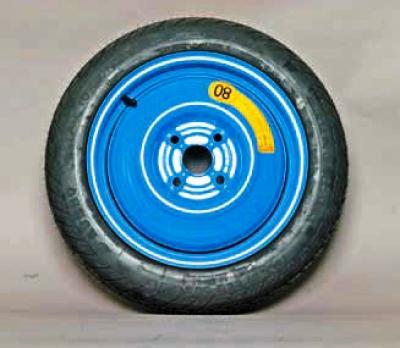
Spare wheel - "dummy" of the Chevrolet Lacetti The car is equipped with a spare wheel - "dummy". This wheel has standard landing places (number of mounting holes, PCD and DIA), but differs in the reduced height and width of the tire to take up less space in the trunk. The parameters of the "spare wheel": 125/70D15. On this wheel you can move at a speed of no more than 80 km/h. It is advisable to replace the "spare wheel" with a repaired or new standard wheel as soon as possible.
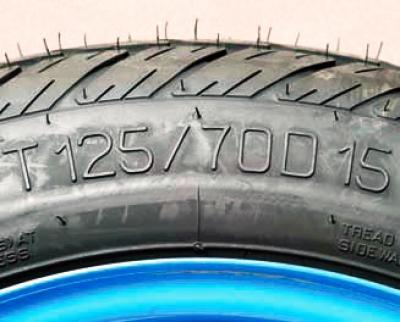
Marking of the spare tire - "spare wheel": T - shape of the wheel rim; 125 — tire width in millimeters; 70 — the height of the tire profile as a percentage of its width; D — designation of a diagonal tire; 15 — the tire seat diameter, corresponding to the wheel rim seat diameter.
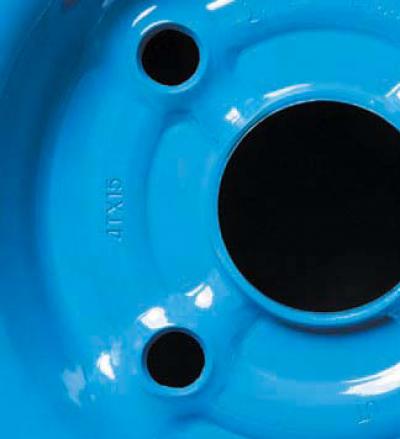
Wheel markings - "spare tires": 4 - rim width in inches; T — designation of the rim shape; 15 — wheel seat diameter corresponding to the tire seat diameter.
The original article is on the website ChevyMan.ru