


However, over time (after 3-5 years of operation), the battery gradually begins to lose capacity. This is manifested, first of all, in the difficulty of starting the engine in cold weather (the starter does not turn the crankshaft or turns it too slowly).
This symptom may be an indication for replacing the battery. But if it is not possible to replace it, and it is necessary to start the engine, you can use the old driver's method: "lighting", i.e. starting the engine by connecting the battery of another (serviceable) car.
Many drivers often mistake other engine problems for a discharged or faulty battery (ignition systems, power supply, etc.). A characteristic sign of a faulty battery is a quick engine start when "jump-starting". If the engine does not start immediately, there is no point in continuing this procedure, and you should start searching for and troubleshooting other systems. If after starting the engine from the battery of the "donor" car and then recharging the discharged battery, the starter again refuses to turn the engine crankshaft, then the battery is faulty and requires replacement.
To "light" a cigarette, you need a set of two connecting cables, necessarily from the factory (not homemade!) manufacturing.
Cables must have a conductor cross-section (excluding insulation thickness) at least 16 mm² - this is approximately equal to the cross-section of the wire connecting the battery to the starter (also without taking into account the thickness of the insulation). The length of each cable must be at least 1 m (optimally 1.2–1.5 m).
At the ends of each cable, clamps are installed in the factory version for fastening to the terminals of the storage batteries. In order not to confuse the polarity when connecting, one of the cables or only the handles of its clamps are painted red. This cable is usually used to connect the "positive" terminals of the storage batteries. The cable connected to the "negative" terminal of the storage battery of the "donor" car is black (less often - blue).
Starting an engine with a faulty battery from a donor car battery is a simple operation, but at the same time a responsible and even dangerous one.
Strictly adhere to the described procedure, and if you doubt your abilities, entrust it to more experienced drivers or call a technical assistance vehicle. Mobile service station workers often perform this operation (especially in frosty winters) and have professional equipment and devices for this purpose.
On each vehicle, apply the parking brake and set the gearshift lever to neutral (on a car with an automatic transmission, move the selector to position P).
On both vehicles, turn off the ignition and all devices and instruments that have a power supply.
We lift the plastic protective covers from both terminals of the discharged battery and disconnect the wire terminal from the negative terminal of the discharged battery (see Removal the battery).
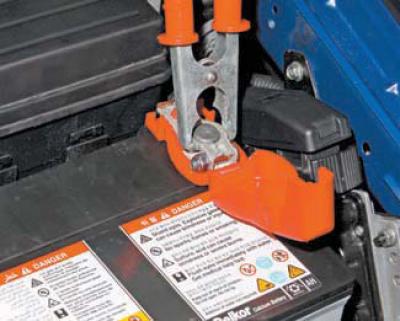
We connect the clamp of the "positive" (red) connecting cable to the "positive" terminal of the discharged battery... ...and the second clamp to the "positive" terminal of the "donor" car battery. We connect the clamp of the "negative" (black or blue) cable with the "minus" terminal of the "donor" car battery. The second clamp of the "minus" cable is connected to the "ground" (body or engine) a car with a discharged battery at a distance of about 0.3–0.5 m from the battery. It is best to connect the clamp of the "minus" cable to massive metal, unpainted and uncontaminated engine parts.
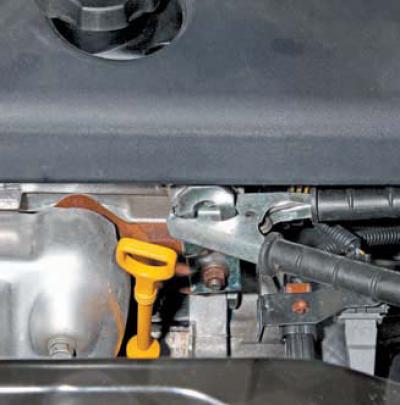
On a car with a 1.6L engine, it is convenient to attach the clamp of this cable to the engine eye bar.
A voltage surge in the on-board network of a car with an electronic engine management system can disable the electronic engine control unit. That is why you should start the engine with a discharged battery using jumper cables only in the sequence described above.
We start the engine of the "donor" car. After letting it idle for 3-5 minutes, we slightly increase the engine crankshaft speed, after which the second driver should try to start the engine of the car with a discharged battery. Usually, one starter activation is enough to start, but sometimes it is necessary to make 2-3 attempts. The duration of continuous operation of the starter at each start should not exceed 6 s. If the engine starts, you should maintain an increased crankshaft speed of the car with a discharged battery for some time, pressing the "gas" pedal, so that when the battery of the "donor" car is disconnected and the discharged battery is connected, the engine does not stop.
Next, connect the standard "minus" wire to the "minus" terminal of the discharged battery and only then disconnect the clamp of the "minus" cable from the "ground" of the car with the discharged battery. This is necessary to avoid a sharp voltage surge in the on-board network of the "donor" car. After this, disconnect the clamps of the "positive" cable from the "positive" terminal of the discharged battery and the "donor" battery.
When "lighting" the following precautions must be taken: - do not touch the uninsulated sections of the terminals of the connecting cables while they are connected to the terminals of the batteries; - when connecting the positive terminals of the batteries with a red cable, make sure that the uninsulated sections of the clamps do not come into contact with metal parts of the car that have contact with the ground, as this may cause a short circuit and damage the battery; — at an ambient temperature of -10°C and below, the electrolyte of a discharged battery freezes. When "lighting" a battery with frozen electrolyte, an explosion may occur. To avoid an explosion, you must first warm up the battery in a warm room; — Do not connect the negative connecting cable directly to the negative terminal of a discharged battery due to the risk of ignition from an accidental spark and explosion of oxyhydrogen gas released during charging.