


However, when the speed decreases, such a cable can sag, get under the wheels of the towed vehicle and rub against the asphalt.
The standard length of a towing cable is about 6 m. It provides a distance sufficient for safe towing and maneuverability of the towed vehicle. If the cable is shorter than the established standard, the driver of the towed vehicle may not have time to react to the sudden braking of the tractor, and a collision will occur. Remember this if you intend to use a rope that is at hand rather than a purchased cable.
Its breaking strength should be at least 2 tons, and its length should be at least 6.5–7 m, taking into account the attachment points. At the end of towing, the knots will probably tighten so much that you will not be able to untie them, so provide for the possibility of cutting the tied rope.
Flexible connecting links (ropes) when towing mechanical vehicles must have warning signs in the form of flags or shields measuring 200 x 200 mm with diagonally applied red and white alternating stripes 50 mm wide with a reflective surface. While commercially available ropes usually have such signs, you will have to attach them yourself to a homemade rope. Otherwise, you will be violating the Road Traffic Regulations.
The front of the Chevrolet Lacetti has two towing eyes, which are half rings made of thick steel rods, rigidly attached (welded) to the body elements.
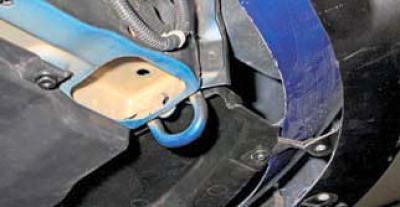
Left front towing eye
At the rear of the vehicle there is usually one towing eye, also rigidly attached to the body (located on the left side). It is used when towing or pulling another vehicle or to pull your vehicle out of a snowdrift, mud, etc. in a backwards direction.
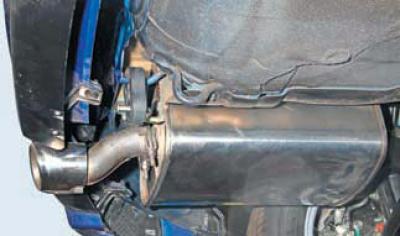
Rear towing eye
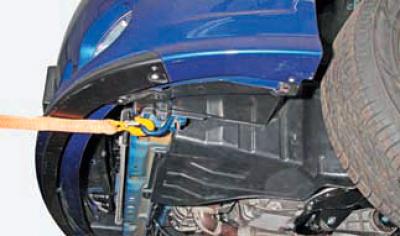
When towing your vehicle, hook the towing cable hook onto one of the front towing eyes (preferably the left one)... ...and on the towing vehicle (tractor) - onto the rear eye.
If the towing vehicle is equipped with a towing hitch (towbar), it is preferable to attach the towing cable to it.
The towing rope may have loops at the ends instead of fastening hooks. In this case, it is attached to the eye as follows: the loop is inserted into the eye, and a strong wrench is inserted into it (for example, wheeled). When the cable is tensioned, the key will prevent the loop from jumping out of the eye.
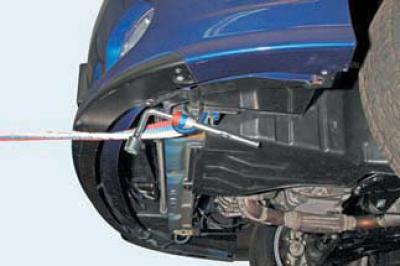
Attaching the cable to the vehicle's towing eye using a loop and a wheel lug wrench.
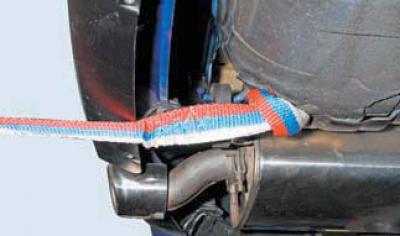
You can also secure the rope to the eye using the loop-in-loop method… …however, this method will only secure one end of the rope. Moreover, the loop can also become very tight when towing.
Before starting towing, turn on the hazard warning lights on the towed vehicle (according to the traffic rules), and in the dark and in conditions of poor visibility - also a side light.
The tractor-trailer must have its low beam headlights on at all times of the day.
On a car with a manual transmission, move the gearshift lever to neutral. On a car with an automatic transmission, set the selector to position N.
The speed of movement during towing should not exceed 50 km/h. A car with an automatic transmission may be towed at a speed of no more than 50 km/h and for a distance of no more than 50 km. If longer towing is required, the car should be towed using the full or partial loading method.
When partially loaded, the wheels of the front (drive) axle must be suspended.
Set the ignition key to the ACC or ON position. This will allow you to use the vehicle's electrical systems while driving (if your car battery is not dead): lights, windshield wiper and washer, heater, etc. If the engine is operational, it should be started, and the brake booster will operate. Otherwise, the driver of the towed vehicle will need to apply more force when pressing the brake pedal.
When towing your vehicle, do not turn the ignition key to the LOCK position under any circumstances, as this may activate the anti-theft device (the steering shaft will lock) and the car will lose control. This will inevitably lead to an emergency situation.
When towing begins, the driver of the towing vehicle must move off smoothly and drive his vehicle, avoiding jerks, so that the cable does not break. When breaking, the taut cable develops a very large force and can damage the body elements of both the towing and towed vehicle. When driving, the drivers of both vehicles must try to keep the cable taut, including when slowing down and stopping, so that the cable does not get under the wheels of the towed vehicle and does not fray.
The driver of a towed vehicle must not impede traffic by pressing the brake pedal without reason. He must inform the driver of the towing vehicle of the need to stop by turning on the horn or flashing the high beam headlights. If the electrical equipment of the towed vehicle is faulty, both drivers must agree on the conditional signals in advance. If the electrical equipment malfunction prevents the hazard warning lights from turning on, an emergency stop sign must be attached to the rear of the towed vehicle.
The driver of the towing vehicle must avoid braking and stopping on inclines, since further movement may cause particularly strong jerks of the cable, which can lead to its rupture. When turning, the towing vehicle must be driven along the maximum possible radius. The driver of the towing vehicle must regularly monitor the movement of the towed vehicle in the rear-view mirrors and follow the signals given by its driver.
The traffic regulations prohibit towing a vehicle with a faulty steering or braking system on a flexible hitch, as well as in icy conditions. In these cases, it is necessary to use the services of a special tow truck.
(The article was reprinted from the website: ChevyMan.ru)