
ChevyMan.ru
Mazda Mitsubishi Toyota Land Rover Honda Kia Nissan
English Русский
Български
Беларускі
Український
Српски
Hrvatski
Română
Polski
Slovenský
Magyar
|
Articles | Sitemap | Contacts |


Home   Aveo   Captiva   Cruze   Lacetti   Lanos   Niva   Tahoe   Others  
Captiva 1 (2006-2018)
  • Home
  • Captiva
  • 1 (2006-2018)
  • Manual
  • Car care
  • Towing a car

Towing a car (Chevrolet Captiva 1)

            0

Contents: Towing a vehicle with all-wheel drive ↧ Towing in emergency cases ↧
If you need to tow your vehicle, please contact our service department or a specialized company.

If you need to tow your vehicle, please contact our service department or a specialized company.


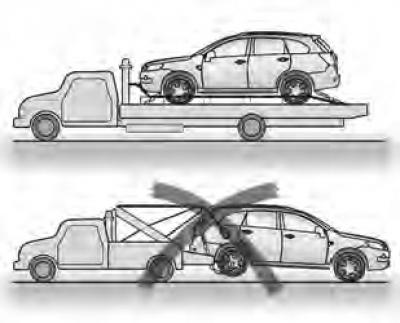
The best method of transportation is to use a tow truck.
The best method of transportation is to use a tow truck.


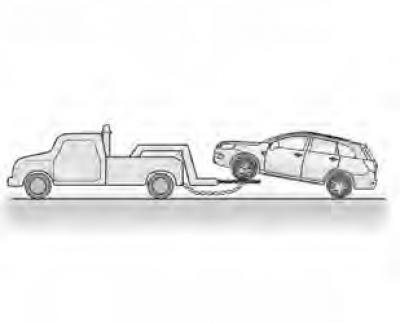
When towing on 2 wheels, lift the front drive wheels and tow with the front wheels blocked.
When towing on 2 wheels, lift the front drive wheels and tow with the front wheels blocked.


Towing a vehicle with all-wheel drive
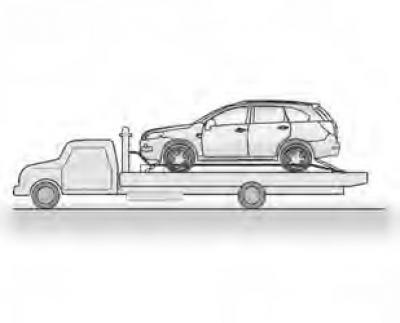


Towing a vehicle with all-wheel drive


Flatbed towing is the best method for towing a 4WD vehicle to avoid any damage.

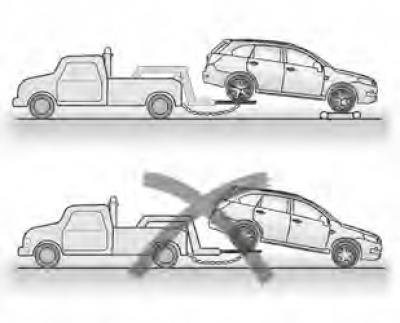
If this method is not available, use a towing dolly to tow the vehicle (see picture below).
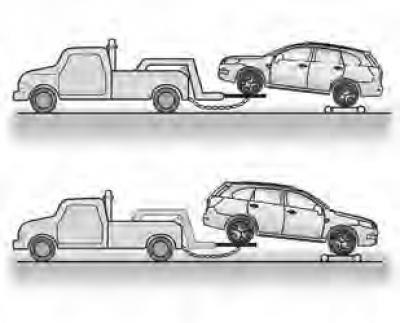
If this method is not available, use a towing dolly to tow the vehicle (see picture below).


Caution: Towing a vehicle with an all-wheel drive system with the front or rear wheels rolling on the road may cause serious damage to the vehicle's drive system.

Never tow a vehicle with its front or rear wheels still on the road.


When towing a vehicle, the following rules must be observed:
  • There must be no passengers in the towed vehicle.
  • In a towed vehicle, release the parking brake and place the transmission in neutral.
  • Turn on the hazard warning lights.
  • Observe the speed limit.

Towing in emergency cases


If it is not possible to tow the car with a tow truck, proceed as follows:


Towing eye at the front of the vehicle
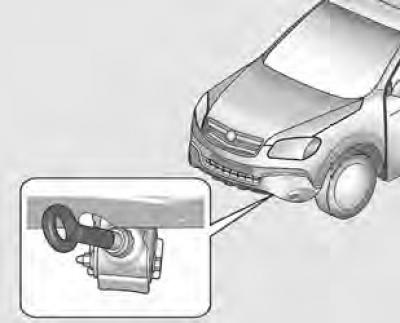


Towing eye at the front of the vehicle


The towing eye is located under the bumper of the car. Remove the plug on the front spoiler on the driver's side and attach the cable to the towing eye. There must be a driver in the towed car who will control it using the steering wheel and brake pedal. Towing in this way can only be carried out on a hard-surfaced road, for short distances and at low speed. In this case, the wheels, axles, transmission, steering and brakes of the car must be in good working order.

Warning: When towing a vehicle with a towing rope, there is a risk of damage to some vehicle parts.

To avoid breakdowns:

- Towing by the front eye should only be carried out in the absence of other towing equipment.

- It is recommended to tow the vehicle by its front end.

- The towing rope must not hit the bumper.

- Check that both ends of the towing rope are securely fastened in the eye by pulling the towing rope taut.

- Towing with a tow rope may damage the automatic transmission. To tow a vehicle with an automatic transmission, it is recommended to use a flatbed tow truck or a lift.


Caution: Vehicles with automatic transmission: Do not tow the vehicle using the towing eye. Towing with a tow rope may damage the automatic transmission. It is recommended to use a flatbed tow truck or lift to tow a vehicle with an automatic transmission.

- A vehicle with a manual transmission must be towed in forward gear, at a speed of no more than 88 km/h. In all other cases, as well as if there is a malfunction of the transmission, the front axle must be raised from the ground.

- The car should move at a moderate speed and without sudden jerks.


Warning: Use caution as you may lose control of the towed vehicle when towing with a rope.

- It is prohibited to tow a vehicle with damaged wheels, axles, gearbox, steering system and brakes.

- When towing the vehicle, do not turn off the ignition switch, as this will cause the steering column to lock and you will lose control of the vehicle.


Caution: Do not use the vehicle's towing hook for towing. Otherwise, the vehicle may be damaged.


Rear towing eye mount


When towing another vehicle, use the rear towing eye attachment.
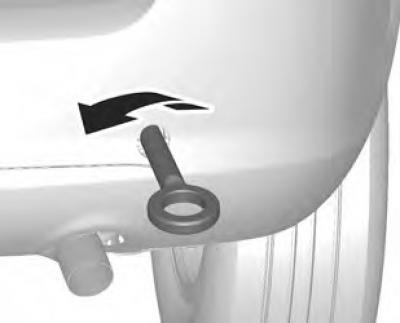
When towing another vehicle, use the rear towing eye attachment.


To use the rear towing eye mount, follow the steps below.

1. Locate the rear towing eye mount under the cargo area floor paneling.

2. Open the cover on the rear bumper and firmly screw the towing eye mount into place.

When using the rear towing eye mount, the cable or chain tension must be directed strictly along the vehicle axis. Do not allow the force to be applied at an angle to the vehicle axis. To avoid accidents, do not allow the cable tension to be released suddenly.

Caution: Do not use the towing hook to tow another vehicle. Otherwise, damage to the vehicle may occur.

The article was checked: Vladimir Romannikov
This article is available at russian, bulgarian, belarusian, ukrainian, serbian, croatian, romanian, polish, slovak, hungarian

Share information:

Previous articles
Captiva 1: Car care
Next articles

Starting the engine from an additional battery
Changing tires on a car
Tire repair kit
Car wheels and tires
Automotive tool
Car exterior care


See similar articles on the topic of Chevrolet cars:
Towing a car Chevrolet Aveo T300 (2012-2018)
Towing a car Chevrolet Cruze 1 (2008-2016)
Towing a car Chevrolet Lacetti 1 (2002-2009)
Towing a car Chevrolet Lanos T150 (2002-2009)
Towing a car Chevrolet Niva 1 (2002-2016)
Towing a car Chevrolet Tahoe 1 (1992-2000)
Jacking and towing a car Chevrolet Trailblazer 1 (2001-2008, petrol)
Link in different formats to this page


Visitor comments

No comments yet


How much will 11 + 11 =


Captiva 1 (2006-2018) 
  • Manual
  • Before leaving
  • Keys, doors and windows
  • Seats, protection systems
  • Instruments and controls
  • Lighting system
  • Information and entertainment
  • Navigation system
  • Climate control
  • Driving a car
  • Car care
  • Maintenance
  • Engine 2.0 l (diesel)
  • Engine device
  • Troubleshooting
  • Engine repair
  • Cooling system
  • Engine electrical equipment
  • Control and power systems
  • Exhaust system
  • Engine FAM II 2.4D
  • Engine device
  • Troubleshooting
  • Engine repair
  • Cooling system
  • Engine electrical equipment
  • Control and power systems
  • Exhaust system
  • Engine HFV6 3.2L
  • Engine device
  • Troubleshooting
  • Engine repair
  • Cooling system
  • Engine electrical equipment
  • Control and power systems
  • Exhaust system
  • Transmission
  • Front drive axle
  • Rear drive axle
  • Automatic gearbox - device
  • Automatic gearbox - service
  • Automatic gearbox - repair
  • Manual gearbox - device
  • Manual gearbox - service and repair
  • Clutch
  • Transfer case
  • Chassis
  • Car suspension
  • Brake system
  • Steering
  • Body
  • Heating and ventilation
  • Air conditioning (manual)
  • Air conditioning (automatic)
  • Seat belts
  • Airbags
  • Car seat
  • Interior (internal elements)
  • Exterior (external elements)
  • Doors and windows
  • Electrical equipment
  • Equipment and devices
  • Lighting and lamps
  • Windshield wipers and washers
  • Electrical circuits


ChevyMan.ru © 2017-2026 · Mobile version · Feedback · Site search · Interesting to read · Sitemap: EN BG BY UA RS HR RO PL SK HU

Aveo 2003-2008 · Aveo 2006-2011 · Aveo 2012-2018 · Captiva 2006-2018 · Cruze 2008-2016 · Lacetti 2002-2009 · Lanos 2002-2009 · Niva 2002-2016 · Tahoe 1992-2000 · Tahoe 2000-2014 · Lumina 1 1989-1994 · Trailblazer 1 2001-2008 · Orlando 1 2010-2018 ·
🛡️ For your security and to improve our service, this site uses cookies. You can disable them in your browser.