


Contents: Condition of tires and rims ↧ Winter tires ↧ Tire designations ↧ Tire pressure ↧ Tire pressure monitoring system ↧ Tread depth ↧ Direction of rotation of tires ↧ Tires and wheels of other sizes ↧ Wheel caps ↧ Anti-skid chains ↧
Condition of tires and rims
Drive over sharp-edged obstacles at low speed and, if possible, move perpendicular to the obstacle. Driving over sharp objects can damage the tire and wheel rim. When parking, do not rub the tires against the curb.
Check your wheels regularly for damage. If there is damage or unusual wear, contact a service center.
Winter tires
Winter tyres provide increased driving safety at temperatures below 7°C and should therefore be fitted to all wheels.
Tire designations
For example, 215/60 R 16 95 H
- 215: Tire width, mm
- 60: Aspect Ratio of Cross Section (tire height to tire width), %
- R: Cord type: radial
- RF: Type: RunFlat
- 16: Wheel diameter, inches
- 95: The load rating of the tire, e.g,
- 95 is equivalent to 690 kg
- H: Speed code letter
Speed code letter:
- Q: up to 160 km/h
- S: up to 180 km/h
- T: up to 190 km/h
- H: up to 210 km/h
- V: up to 240 km/h
- W: up to 270 km/h
Tire pressure
Check the pressure in cold tires at least once every 14 days and before each long trip. Don't forget to check the pressure in the spare tire.
Unscrew the valve cap.
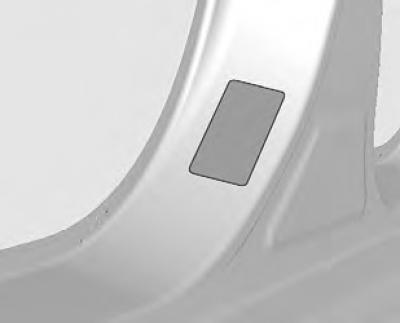
Tire pressure sticker on driver's door frame.
Pressure data is given for cold tires. Data applies to both winter and summer tires.
Always inflate the spare tire to the pressure for a fully loaded vehicle.
Incorrect tire pressure reduces driving safety, impairs controllability, comfort, fuel efficiency and leads to accelerated tire wear.
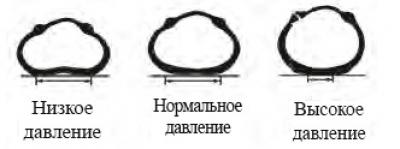
Note: Check the air pressure in cold tires. When the tires heat up, the pressure in them increases. Tires can heat up after 1.6 km of running, it takes three hours to cool down (after the car stopped).
Warning: Excessively low pressure can cause the tires to overheat and develop internal damage, which can lead to tread separation and, at high speeds, even tire failure.
Tire pressure monitoring system
The tire pressure monitoring system checks the pressure in all four tires every minute when the vehicle speed exceeds a certain limit.
All wheels must be equipped with pressure sensors, the tire pressure must correspond to the passport values. If the car is equipped with wheels without sensors, the tire pressure monitoring system will not be able to function. If possible, install sensors.
Tread depth
Check the tread depth regularly.
For safety reasons, it is necessary to change tires when the tread depth decreases to 2-3 mm (4mm for winter tires).
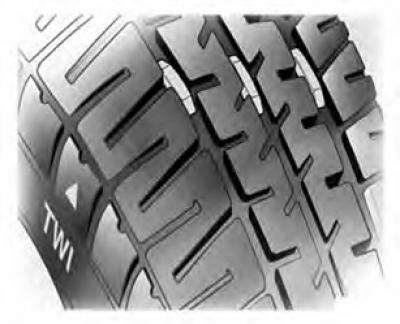
The minimum tread depth (1.6 mm) established by the rules corresponds to the appearance of wear indicators (TWI). The locations of the indicators are marked on the sidewall of the tire.
If the front is more worn than the rear, swap the front and rear wheels. Make sure that the direction of rotation of the wheels does not change.
Tires age even if they are not used. It is recommended to change tires every 6 years.
Direction of rotation of tires
Tires need to be rotated to ensure more even wear across all tires. The first rotation is the most important.
If unusual wear is noticed, rotate the tires as soon as possible and check the wheel alignment. Also check for damage to the tires and wheels.
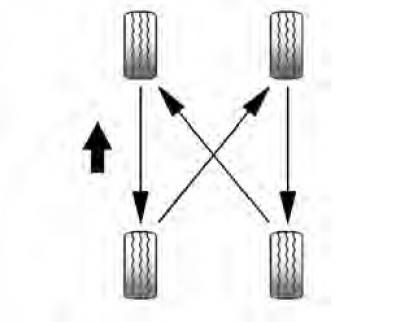
When rotating tires, be sure to follow the rotation order shown. Do not use the spare tire when rotating tires. Adjust the front and rear tire pressures to the recommended values on the tire data plate and the maximum permissible load after rotating the tires.
Reset the tire pressure monitoring system.
Make sure all wheel nuts are securely tightened.
Warning: Corrosion and dirt on the wheel or parts it attaches to can cause the lug nuts to loosen over time. The wheel may come off, causing an accident. When changing a wheel, remove any corrosion or dirt from the areas where the wheel attaches to the vehicle. In an emergency, you can use a cloth or paper towel, but you should use a scraper or wire brush to remove all the corrosion and dirt later.
Lightly lubricate the center of the wheel hub with wheel bearing grease after changing a wheel or rotating wheels to prevent corrosion and dirt deposits. Avoid getting grease on the flat mounting surface of the wheel or on the wheel nuts or bolts.
Tires and wheels of other sizes
If you use tires with sizes different from the factory tires on your vehicle, you may need to reprogram the speedometer, change the nominal tire pressure and other vehicle parameters.
After changing to a different tire size, replace the tire rating plate on your vehicle.
Warning: Installing unsuitable tires or wheels may cause an accident and invalidate the vehicle's operating permit.
Warning: Do not use tires and wheels that are different in size and type from those originally equipped on your vehicle. Doing so may adversely affect the safety and performance of your vehicle. It may also cause loss of control or rollover, resulting in serious injury. When replacing tires, make sure that all four tires and wheels being installed are the same size, type, tread depth, manufacturer, and load rating. Using tires of any other size or type may seriously affect ride quality, handling, ground clearance, braking distance, tire clearance, and speedometer accuracy.
Wheel caps
It is necessary to use wheel covers and tyres specified by the manufacturer for the respective vehicle and meeting all requirements for the given wheel and tyre combination.
When using wheel covers and tyres not specified by the manufacturer, the tyres must not have reinforced sidewalls.
Wheel covers must not interfere with brake cooling.
Warning: Using incorrect wheel covers and tires may cause sudden loss of pressure, resulting in an accident.
Anti-skid chains
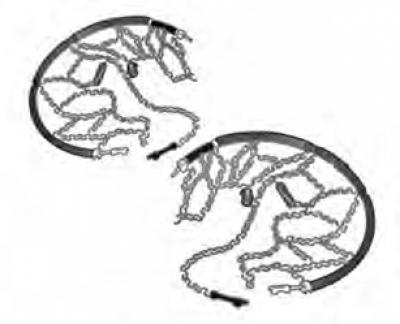
Before attaching snow chains to your tires, remove the wheel caps to avoid scratches.
- Follow the chain manufacturer's instructions.
- Snow chains can only be fitted to 16-inch front tires. Do not fit snow chains to tires of other sizes.
- Tighten the snow chains after driving approximately 1.0 km.
Caution: Using snow chains may adversely affect vehicle handling.
Do not exceed 50 km/h or the chain manufacturer's recommended speed limit, if lower.
Avoid sharp turns, bumps and holes.
Avoid braking on locked wheels.
Note: The recommended tire chains for this vehicle are SAE Class, Type S chains.
If you have anti-skid chains on your wheels, it is recommended to drive at low speeds.
If you hear the sound of the chains contacting the vehicle body, stop and reattach the snow chains.
If the sound does not stop, slow down until the sound disappears completely.