


The length of the cable should provide a distance between the towing (tractor) and the towed vehicle within 4-6 m, which is the optimal distance for safe towing and maneuverability of the towed vehicle. If the cable is shorter than the established norm, the driver of the towed vehicle may not have time to react to the sudden braking of the tractor, and a collision will occur. To tow a vehicle…
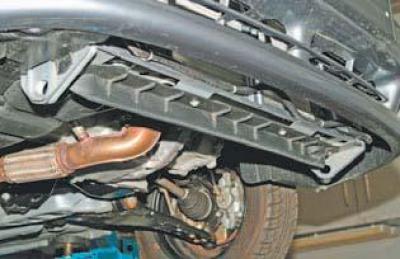
…we secure the cable to one of the two eyes…
…and on the towing vehicle (tractor) – by the rear eye.
If the tractor is equipped with a towing hitch (towbar), it is preferable to attach the towing cable to it.
If there are no carabiners or hooks at the ends of the cable, it should be secured to the eyes with a knot or improvised means.
When towing, turn on the hazard warning lights in accordance with the Road Traffic Regulations. Move the gearshift lever to neutral.
To tow another vehicle (its weight should not be much greater than the weight of the Lanos)…
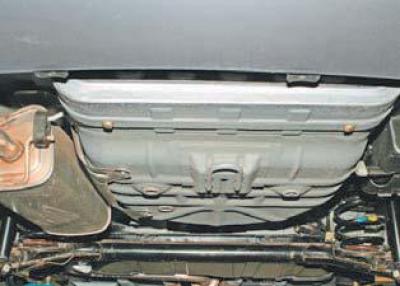
...under the bottom of the body in its rear part there is an eye specially designed for this purpose.
Warning devices for marking flexible connecting links when towing mechanical vehicles must be made in the form of flags or shields measuring 200x200 mm with diagonally applied red and white alternating stripes 50 mm wide with a reflective surface.
To prevent the cable from breaking during towing, we move off smoothly and tow the car, avoiding jerks, and during braking and stopping we do not allow the cable to get under the wheels of the car.
The speed of movement during towing should not exceed 50 km/h. Regardless of the time of day, the hazard warning lights must be turned on on the towed vehicle, and if the latter is faulty, an emergency stop sign must be attached to the rear.
In the dark and in conditions of poor visibility, the side lights should be additionally turned on. The low beams on the towing vehicle (tractor) should be turned on at any time of the day.
Before slowing down, the driver of the tractor must signal the driver of the towed vehicle in advance by turning on the brake signal by lightly pressing the brake pedal. The driver of the towed vehicle must start braking first - in this case, the cable will be constantly taut.
For smoother towing, the driver of the tractor should extend the acceleration time in each gear, and change gears as quickly as possible to avoid losing speed at the moment of switching. For the same purpose, it is recommended to overcome climbs immediately, trying not to change gears, since it will be difficult to move off on an incline. Jerks during towing can lead to a break in the cable, the ends of which can damage both cars. Turns should be made at a larger radius. The driver of the tractor should regularly monitor the movement of the towed car in the rear-view mirrors and follow the signals given by its driver.
In turn, the driver of the towed vehicle must begin braking in a timely manner, trying to prevent the cable from sagging and getting under the wheels. He must also, in the event of any difficulty in towing, give the driver of the tractor an audible or visual signal or signal with his hand through the open window (it is better to agree on signals in advance).
To avoid steering wheel locking and to ensure operation of electrical energy consumers, the ignition key on the towed vehicle must be turned to the "ON" position - ignition. If the engine is operational, it must be started, with the brake booster operating. Otherwise, the driver of the towed vehicle will need to apply more force when pressing the brake pedal.
The traffic regulations prohibit towing a vehicle with a faulty steering or braking system on a flexible hitch, as well as in icy conditions. In these cases, it is necessary to use the services of a special tow truck.
[The article is reprinted from the website ChevyMan]