


Chevrolet Lacetti is equipped with wheels with the following parameters: — width and landing diameter of the wheel rim in inches: 6Jx15 (steel and light alloy) or 5.5Jx14 (5½Jx14) (only steel).
Station wagons are only equipped with 15-inch wheels; — number of mounting holes and the diameter at which their centers are located (PCD), in millimeters: 4x114.3 — wheel offset (ET) in millimeters: 44 — diameter of the center hole (DIA) in millimeters: 56.6; — number of humps: 2 (possibly designated as H2).
If you need to purchase one or more new wheels for your vehicle to replace or wear out, you should remember that the new wheels must exactly match these parameters - with the exception of the wheel offset value (a deviation of no more than 5 mm is allowed, and the deviation must be the same on both wheels of the same axle), as well as the diameter of the central hole (only upward deviations are allowed).
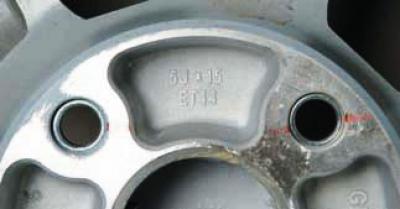
Marking of a light alloy wheel on the inner surface of its disk (central part)
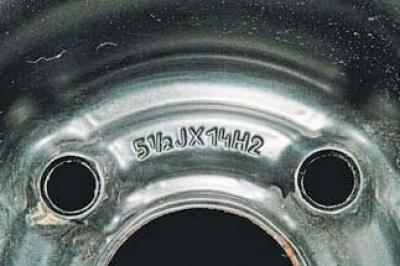
Marking of a steel wheel Wheel offset is the distance from the plane of symmetry of the wheel rim to the mating plane of the disk (central part of the wheel).
The international offset designation is ET. The offset is measured in millimeters. The smaller the wheel offset (negative values are also possible), the more the wheel protrudes outward from the wheel arch of the car. When installing wheels with a reduced offset, the load on the hub bearings of the car increases significantly. With an increased offset, the wheel is "recessed" inside the wheel arch and can touch body and suspension elements, especially when turning the car. However, a deviation of the wheel offset of approximately 5 mm in either direction is considered acceptable.
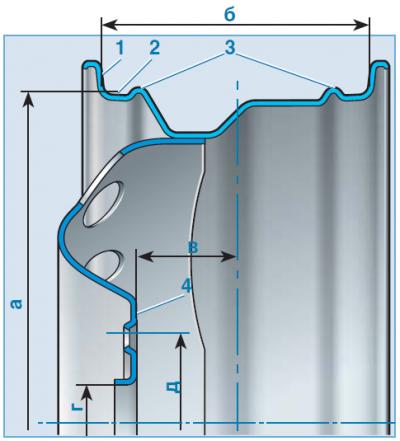
Main elements and dimensions of the wheel: 1 - rim flange; 2 — rim shelf; 3 - humps; 4 — wheel disk mating plane; a — the rim seat diameter corresponding to the tire seat diameter; b - rim width; in — wheel offset; g — diameter of the central hole; d — diameter at which the centers of the wheel mounting holes are located (PCD) Wheels with a PCD size different from the nominal one cannot be used. This will lead to severe wheel beating during movement, damage to the mounting holes and studs, and in the worst case — to the destruction of the wheel and its detachment from the car while moving, which will inevitably lead to an emergency situation.
It is unacceptable to bore and adjust the mounting holes of the wheel to the location of the studs on the hub using a file or drill. The mounting holes are made in the wheel disk with high precision, which is impossible to achieve in artisanal conditions.
Only special nuts with a conical chamfer should be used to secure the wheel. The chamfers of the nuts ensure that the wheel is centered on the hub. It is unacceptable to start driving the car if any of the wheels are not secured with all the nuts, or if any of the nuts cannot be tightened (rotate on studs). If the threads on a nut or stud are damaged, immediately replace these parts with new ones yourself or at a service station.
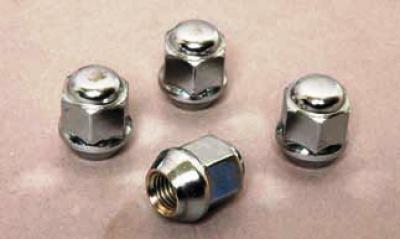
Wheel mounting nuts
The diameter of the wheel's center hole (international designation - DIA) is important because each car hub has a protruding belt that performs an auxiliary function when installing the wheel. The diameter of the wheel's center hole must not be less than the outer diameter of this belt, otherwise the wheel simply cannot be installed. Contrary to popular belief, this belt does not center the wheel on the hub (this function is performed by the wheel mounting nuts), therefore, the installation of spacer rings on the belt in cases where the diameter of the central hole and the outer diameter of the belt differ significantly is, by and large, not necessary.
Humps are the annular projections on the inside of the wheel rim. Usually two humps are made (the H2 designation may not be present in the wheel marking, but the humps are quite clearly visible).
Humps are used for a more secure fit and better sealing of the tubeless tire on the wheel. Wheels with one hump or no humps at all when using tubeless tires are best not used (however, such wheels are very rare these days).
If you install wheels on your car whose parameters differ significantly from the standard ones, authorized Chevrolet service stations may refuse you warranty repairs of those car systems that are directly related to the wheels: suspension elements, steering, brake system, hub bearings, etc.
In the SE and SX trim levels, the car has steel wheels and only in the CDX trim level, alloy wheels. The main advantage of alloy wheels compared to steel wheels is their lower weight, which improves the operating conditions of the suspension (the wheels "obey" the return action of the elastic elements of the suspension faster and restore lost contact with the road). This increases driving comfort and traffic safety. The car's handling and braking dynamics are improved, and fuel consumption is slightly reduced. In addition, due to the high precision of manufacture and the characteristics of the materials, the alloy wheel better holds the tubeless tire on the rim and provides better sealing of the tubeless tire.
However, light alloy wheels also have their disadvantages. For example, the aluminum alloys they are made of are very susceptible to corrosion, especially in places where the protective varnish coating of the wheel is damaged. The varnish can be damaged not only on a bad road or under the influence of winter salt, but also when installing/deinstalling the tire unskillfully.
When balancing light alloy wheels, special weights are glued to the surface of the rim. If there are no such weights in the tire shop, the mechanic may try to install regular weights on steel brackets and thus damage the varnish coating on the edge of the rim.
Light alloy wheels are more resistant to impact deformation than steel wheels. However, even with a strong impact, a steel wheel does not break, but only deforms.
If it is able to hold air in the tire, you can even drive it to the repair shop under your own power. A light alloy wheel can split from a strong impact. In this regard, it is dangerous to buy counterfeit wheels that have not undergone special certification and strength tests. Their metal may contain hidden cavities, cracks, delamination, which significantly reduces their strength.
Therefore, when buying wheels in a store or at a market, you should carefully examine their markings, inquire about information about the manufacturer, and ask sellers for a certificate for the product.
During the operation of the vehicle, its wheels should be regularly checked for dents in the edges and other types of rim deformation, and for cracks in the spokes and disk (the central part where the holes for its fastening are located), integrity of mounting holes, severe corrosion (this is especially true for alloy wheels). A small dent in the rim flange of a steel wheel usually does not affect the tightness of the tire and does not cause the wheel to wobble when driving. Do not try to straighten the dent manually with a hammer or sledgehammer - you risk damaging the wheel even more. It is better to give such a wheel to a specialized workshop for repair, where it can be straightened ("rolled") on a machine. Ideally, it is advisable to replace the wheel.
Restoring a light alloy wheel is much more difficult. Many experts are inclined to believe that damaged - deformed or cracked - light alloy wheels are only suitable for remelting, because the key to the strength of such a wheel is the homogeneity of its structure, which is inevitably disrupted by deformation and especially by the appearance of cracks. However, there is another opinion: a light alloy wheel can be restored using special technologies and high-quality equipment. In any case, there are plenty of services offering repair of light alloy wheels.
The source of the article is available on the website «CHEVYMAN.RU»