


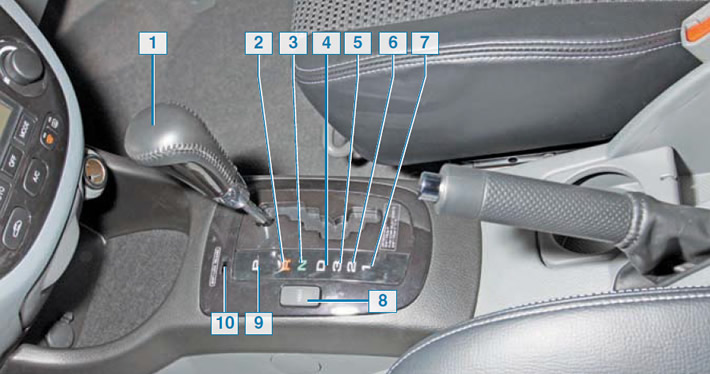
Automatic transmission controls for a car with a 1.8 liter engine: 1 — selector; 2 — R mode (Reverse, back gear); 3 — mode N (Neutral, neutral position); 4 — mode D; 5 - mode 3; 6 - mode 2; 7 - mode 1; 8 — HOLD button for fixing the engaged gear; 9 — mode P (Parking, parking lot); 10 - Shift-lock release socket
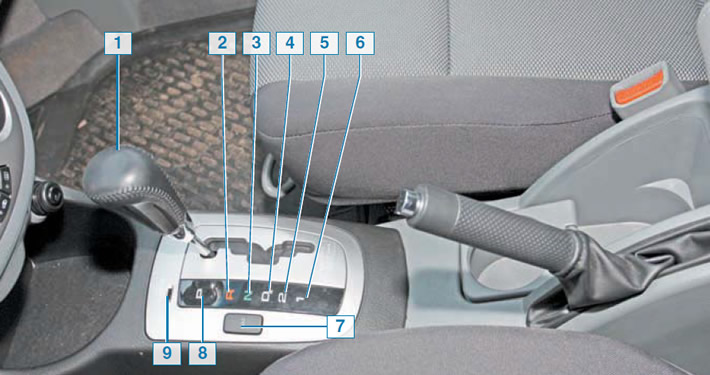
Automatic transmission controls for a car with a 1.6 liter engine: 1 — selector; 2 — R mode (Reverse, back gear); 3 — mode N (Neutral, neutral position); 4 — D4 mode; 5 - mode 2; 6 - mode 1; 7 — HOLD button for fixing the engaged gear; 8 — mode P (Parking, parking lot); 9 - Shift-lock release socket
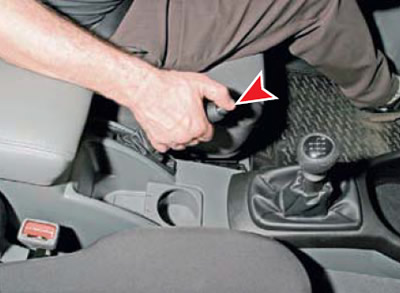
Parking brake lever (the button at the end of the handle is shown by the arrow)
To engage the parking brake, pull the lever by its handle up until it stops (while this happens, 7-10 characteristic clicks are heard). At the same time, the parking brake indicator lights up on the instrument panel (red color). To release the parking brake, pull the lever slightly upward by its handle, press the button at its end and move the lever all the way down. The indicator on the instrument panel should go out.
Always engage and disengage the parking brake completely, without allowing the lever to be in intermediate positions. If the parking brake is not fully engaged, the vehicle may spontaneously move (to roll) when stopped or parked even on a slight slope. Incomplete release of the parking brake can lead to overheating and damage to the parking brake pads and discs while the vehicle is moving.
Always engage the parking brake when you stop or leave your vehicle (even for a short time). It is especially important to do this when stopping and parking on a road with a slope (on the rise or on the descent). Exceptions are cases of vehicle maintenance or repair, when it is necessary to maintain the ability to rotate the rear wheel. In this case, prevent spontaneous movement (rolling) the vehicle by engaging one of the forward gears or the reverse gear, and also place wheel chocks under the vehicle's wheels.
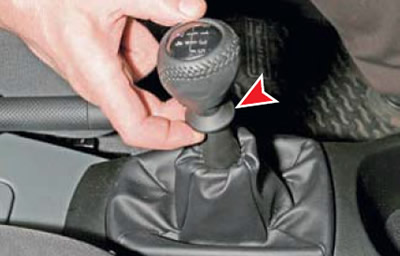
Manual gearbox lever (the ring required to engage reverse gear is shown by the arrow)
Cars with engines with a working volume of 1.4, 1.6 and 1.8 liters can be equipped with a manual gearbox with five forward gears and one reverse gear. Gear shifting is carried out according to the diagram applied to the gear shift lever handle. To engage the reverse gear, you should first pull up the ring located under the gear shift lever handle with your fingers, and then move the lever towards you and forward.
Reverse gear can only be engaged after the vehicle has come to a complete stop.
Engaging any gear should only be done when the transmission is completely disengaged (squeeze to the stop) clutch pedal. Do not allow even a slight pressing of the clutch pedal while the vehicle is moving, as this will lead to slippage and rapid wear of the clutch mechanism. Slight slippage of the clutch is allowed only when starting off.
On slippery roads, in order to avoid slipping of the vehicle's drive wheels, it is recommended to start moving from second gear. In all other cases, use only first gear to start off.
When driving downhill, do not disengage the clutch and gear (do not use the "coasting" mode). You should drive downhill in the same gear that you would drive uphill on this section of the road.
Cars with 1.6 and 1.8 liter engines can be equipped with automatic transmissions of two different models, but practically identical in operation. These transmissions have four forward gears and one reverse gear. Automatic transmission control (changing its operating modes) the selector lever is used to select gears. When the vehicle is parked (parked), the selector lever should be in P or N position.
Start the engine only when the selector is in position P (it can also be started when the selector is in position N, however, it is recommended to do this only if for some reason starting is impossible when the selector is in position P).
Before starting the engine, be sure to press the brake pedal. Also, only when the brake pedal is pressed can you move the selector from position P to position R, from position R to position N, from position N to position D (D4 on a car with a 1.6L engine) and vice versa. It is especially important to keep the brake pedal pressed when moving the selector from position P to position R and from position N to position D (D4), since a car with an automatic transmission can start moving on its own, without the driver pressing the gas pedal. This can lead to the driver losing control over the car.
Never press the accelerator pedal when moving the selector from the stop and park positions (N and P) to the drive positions (R, D (D4), 3, 2 and 1). This may result in loss of control over the vehicle and emergency failure of the automatic transmission.
To move forward, hold down the brake pedal, move the selector to position D (D4), release the brake pedal and, if the car does not move, lightly press the accelerator pedal. In cold weather, do not start moving immediately after starting the engine. If the cold engine stops, press the brake pedal, return the selector to position P, start the engine, warm it up and only then move off.
When driving in reverse, adjust the speed by the degree of pressure on the "gas" pedal (the automatic transmission will automatically engage the required gear) and use mode D (D4) first whenever possible, using modes 3, 2 and 1 only in difficult road conditions. When mode 3, 2 or 1 is selected, the gearbox will only shift up to 3rd, 2nd or 1st gear respectively.
If you have difficulty starting off on a slippery road, you can use the gear lock mode. To do this, move the selector to position D (D4) and press the HOLD button located next to it. At the same time, the orange HOLD indicator will light up in the instrument cluster. In this case, the car will start off in 2nd (with 1.8 l engine) or 3rd gear (car with 1.6 l engine). This will prevent wheels from slipping. This mode can be disabled by pressing the HOLD button again (the indicator will go out).
During short stops (for example, at traffic lights or when boarding and disembarking passengers), if you do not intend to get out of the vehicle, do not move the selector lever from the drive position (R, D (D4), 3, 2, or 1) to the P or N positions. Hold the vehicle stationary by pressing the brake pedal. This is especially important when stopping on an incline. When stopping for an extended period of time or when parking the vehicle, stop the vehicle by pressing the brake pedal, apply the parking brake, and then move the selector lever from the drive position to the P position.
Always apply the parking brake when leaving the vehicle, even for a short time. It is recommended to move the selector to position P only when the parking brake is applied.
If it is necessary to ensure the possibility of moving the vehicle manually (rolling), move the selector to position N. Do not forget to apply the parking brake when stopping the car, as it may roll spontaneously. The N·mode is also used for towing the car. Remember that a car with an automatic transmission can only be towed forward at a speed of no more than 50 km/h and for a distance of no more than 50 km. To tow for a longer distance, it is necessary to hang up the drive (front) wheels or resort to the help of a tow truck.
If for some reason the selector is locked in position P and does not change its position under any circumstances, do the following. Remove the key from the ignition, press the brake pedal and insert the ignition key into the Shift-lock release slot. This will move the selector to position N. Remove the key and try to start the engine. The selector should be able to move to other positions. Remember that this situation indicates a malfunction and requires contacting a service station for repairs.
An automatic transmission is a complex electronic-mechanical device. Handle it carefully, do not violate the order of changing its operating modes, do not move the selector from one position to another abruptly, jerkily. When driving forward, try to use the D and D4 modes for the most part. Remember that aggressive driving with sharp acceleration and braking, as well as prolonged skidding of the car can lead to damage to the gearbox parts and failure of the unit.
With careful handling and timely maintenance, automatic transmissions usually serve for a long time and reliably, but in the event of any breakdowns, their repair is more expensive than the repair of manual transmissions.