


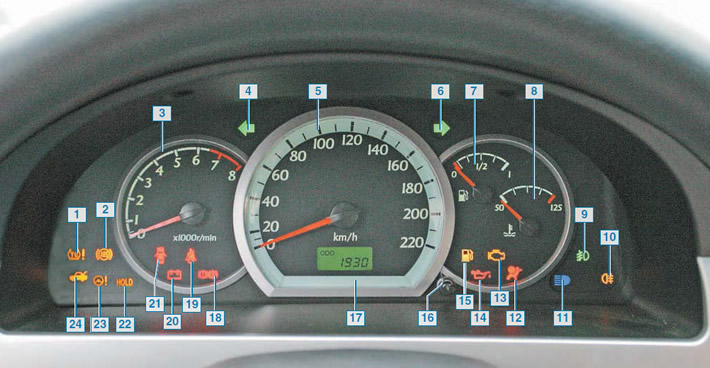
1 — TCS traction control system malfunction indicator (installed on parts of cars) lights up yellow when the ignition is turned on (key in ON position) and should light for about 3 seconds, after which it goes out. When TCS is turned on while driving, this indicator will start flashing. If it lights up spontaneously while driving or does not go out after the ignition is turned on, this indicates a malfunction of this system and the need to contact a service station to fix the problem;
2 — the anti-lock braking system (ABS) malfunction indicator lights up yellow when the ignition is turned on and should remain on for about 3 seconds, after which it goes out. If the indicator does not light up after the ignition is turned on or lights up (flashes) while the car is moving, then there is a malfunction in the system. In this case, you should contact a service station to fix the malfunction;
3 - tachometer (engine crankshaft speed indicator). shows the current crankshaft speed when the engine is running. After starting a cold engine, the arrow is set between values 1 and 2 (the crankshaft speed is approximately 1250 min⁻¹) and as the engine warms up, it drops below value 1, i.e. to the crankshaft speed in idle mode (approximately 750 min⁻¹);
Do not allow the engine to operate in modes where the tachometer needle is in the red sector of the scale (i.e. the maximum permissible crankshaft speed of 6500 min⁻¹ is exceeded). This may lead to emergency engine failure.
4 — The left turn signal indicator lights up with a flashing green light when the left turn signal is turned on and when the hazard warning lights are turned on;
5 - speedometer (vehicle speed indicator);
6 — The right turn signal indicator lights up with a flashing green light when the right turn signals are turned on and when the hazard warning lights are turned on;
7 — fuel level indicator in the fuel tank: 0 — empty tank, 1/2 — tank is approximately half full of fuel; 1 — full tank. When the ignition is off, the indicator arrow drops to 0 (this is not a malfunction). When the ignition is turned on, the pointer of the indicator after 1-2 seconds is set to the current fuel level in the tank. When the remaining fuel is about 6 liters, the fuel reserve indicator (15) lights up;
This indicator has a relatively high measurement error, so it can only be used to judge fuel consumption indirectly. You can accurately measure fuel consumption on your car only with the use of special equipment at a service station or at a testing ground.
8 — engine coolant temperature gauge. If the gauge needle moves into the red sector of the scale, this means that the coolant temperature has exceeded the permissible threshold (approximately 115°C) and the engine is overheating. In this case, stop the car as soon as possible, turn off the air conditioner (if it was turned on) and let the engine idle for a while (you can turn on the heating system, setting the temperature regulator to the highest temperature and the fan to maximum rotation speed). After a while, turn off the engine, let it cool down and try to start it again. If the coolant temperature starts to rise quickly again and exceeds the permissible threshold, you should not continue driving the car. Try to diagnose and fix the malfunction yourself, or call a roadside assistance vehicle or a tow truck to move your car to a service station for repairs;
Do not allow the engine to run in overheated mode - this may lead to its emergency breakdowns. Never open the hood of a car with an overheated engine if steam is coming from under the hood - you can get burns to your face and hands. Regularly (not less than every 1000 km of run) check the coolant level in the expansion tank and, if necessary, bring it up to normal by adding coolant (only on cold engine).
9 - Fog light indicator lights up green when fog lights are turned on;
10 — The indicator for turning on the fog lights in the rear lights lights up orange when the fog lights in the rear lights are turned on;
The fog light bulbs in the taillights shine very brightly and can blind drivers of vehicles traveling behind you. Always turn off the fog light bulbs in the taillights when they are not needed.
11 — the high beam indicator lights up blue when the high beam headlights are turned on, including briefly when the high beams are flashing;
12 — the indicator of malfunction of one or more airbags should flash several times with red light when the ignition is turned on. If the indicator does not flash, or is constantly on after several flashes, or flashes or is constantly on while the engine is running, this indicates a malfunction of the system and the need to immediately contact a service station for diagnostics and repairs;
Driving a vehicle with a faulty airbag system puts the driver and passengers at extreme risk because the airbag system may not deploy in the event of an accident.
13 — The engine management system malfunction indicator lights up orange when the ignition is turned on and during starter operation and goes out after the engine starts. If the indicator continues to light after the engine starts, or lights up briefly and then goes out, or lights up continuously while the engine is running, this indicates a malfunction in the engine management system. This does not require immediate stopping of the car and switching off of the engine, unless there are other indications (overheating, uneven engine operation, reduced engine power, etc.), since the electronic control unit can switch to backup (bypass) operating modes. However, to diagnose the malfunction and eliminate it, you must contact a service station as soon as possible. After eliminating the malfunction, the indicator should go out after starting the engine;
14 - low fuel level indicator (emergency) the engine oil pressure indicator lights up red when the ignition is turned on and goes out after the engine starts. If the indicator lights up while the engine is running, this indicates that there is insufficient pressure in the engine lubrication system. In this case, you must stop the engine and check the oil level in the engine oil pan. If the level is below the minimum value, (mIN marks on the dipstick) you should add oil and start the engine again. If the indicator light continues to light, you should stop the engine and try to determine the cause of the malfunction (see Troubleshooting) and, if possible, eliminate it. If this fails, you need to contact a service station. Engine operation with the low fuel level indicator on (emergency) engine oil pressure is not allowed;
A small consumption is allowed when the engine is running (output, loss) engine oil, which is not a malfunction. It is recommended to check the oil level in the engine oil pan at least every 1000 km (see Maintenance). The oil level should not be below the MIN mark and above the MAX mark on the dipstick. Only add the same oil as is currently in the engine. Add oil in small portions, as it will be difficult to remove excess oil.
15 - The fuel reserve indicator lights up orange when there is approximately 6 liters of fuel left in the tank (approximately 30-50 km of run). In this case, it is necessary to refuel the car as quickly as possible, without allowing it to run out completely (engine stops), because this may cause damage to the high-pressure fuel pump and the catalytic converter;
16 — Daily mileage reset button. By briefly pressing this button, you can change the indication on the odometer display in the following order: odometer — daily mileage counter A — daily mileage counter B and so on in a circle. Pressing and holding the reset button during the daily mileage indication will reset this counter (regardless of the second). It is not recommended to use this button while the vehicle is moving;
17 — odometer and trip meter display (on cars with manual transmission);
18 — The parking brake and brake system malfunction indicator lights up red when the parking brake is applied. After the parking brake is released, (lowering the lever) this indicator should go out. If it remains lit, this indicates that the fluid level in the brake and clutch hydraulic reservoir is insufficient;
19 — The driver's seat belt indicator lights up red when the ignition is turned on if the driver has not fastened his seat belt; at the same time, a special sound signal is also turned on for 6 seconds;
20 — the low battery indicator lights up red when the ignition is turned on and goes out after the engine is started. If the indicator continues to light or turns on while the vehicle is moving, this may indicate insufficient tension or a break in the accessory drive belt (see Replacing the accessory drive belt). Check the tension or replace the belt yourself, or contact a service station to fix this problem. If the belt is in normal condition and sufficiently tensioned, then the problem has occurred in the battery charging circuit. You should also contact a service station to fix it;
Operating a vehicle with a low battery indicator on may result in failure of the on-board electrical equipment, and operating the engine with an insufficiently tensioned accessory drive belt may also result in failure of the power steering.
21 — The door ajar indicator lights up red if one of the doors is open or not fully closed. If the key is in the ignition, a warning sound is heard when the driver's door is open or not fully closed;
22 — indicator of gear lock mode activation (in a car with an automatic transmission). Lights up yellow when the ignition is turned on for 2-3 seconds (then it goes out), or if this mode is activated (the HOLD button is pressed). When the gear lock mode is turned off, the indicator should go out. If it flashes, this indicates a malfunction of this function and the need to contact a service station for repairs;
23 — variable power steering system malfunction indicator (installed on parts of cars). Lights up yellow when the ignition is turned on and goes out after about 3 seconds. If this indicator does not light up when the ignition is turned on, or does not go out, or lights up while the car is moving, this indicates a malfunction of this system and the need to contact a service station for repairs;
24 — trunk lid open indicator (in a sedan car) lights up yellow if the trunk lid is not closed.
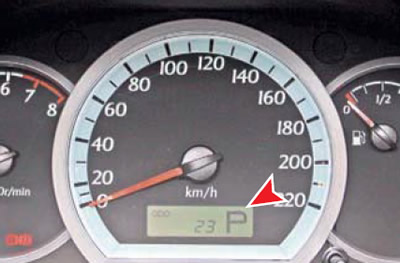
Odometer of a car with automatic transmission
On vehicles equipped with automatic transmissions, the odometer displays the operating mode of the automatic transmission and, when changing gears, the engaged (current) gear (shown by arrow). The trip odometer reset button functions in the same way as the same button in the instrument cluster of a vehicle with a manual transmission.
The source of the article is available on the website «chevyman.ru»