
ChevyMan.ru
Mazda Mitsubishi Toyota Land Rover Honda Kia Nissan
English Русский
Български
Беларускі
Український
Српски
Hrvatski
Română
Polski
Slovenský
Magyar
|
Articles | Sitemap | Contacts |


Home   Aveo   Captiva   Cruze   Lacetti   Lanos   Niva   Tahoe   Others  
Captiva 1 (2006-2018)
  • Home
  • Captiva
  • 1 (2006-2018)
  • Body
  • Exterior (external elements)
  • Diagnosis and elimination of wind noise

Diagnosis and elimination of wind noise (Chevrolet Captiva 1)

            0

Contents: Wind noise diagnostics ↧ Wind noise reduction ↧

Wind noise diagnostics


Attention! The assistant must drive the car, and the specialist must detect the location of the wind noise at this time, in order to avoid injury and damage to the car.


A test drive of the vehicle is necessary to accurately determine the location of the wind noise. Often there is a primary leak and secondary leaks. If all leaks are not repaired, the wind noise will only subside slightly, but will not disappear completely.

During the test drive, the technician should use the following means to determine the location of the wind noise.
  • Mechanical stethoscope or vacuum hose
  • Insulating tape
  • Sealing putty
  • Marker
  • Screwdriver

To conduct a road test, follow these steps:

1. Choose a route along smooth, straight streets going in all four directions (north, south, east and west).

2. Choose streets where there is no heavy traffic or loud noise that could interfere with the test.

3. Drive the vehicle at the speed at which the noise was noticed by the customer, or accelerate until the noise was noticed. However, do not exceed the speed limit established by law.

4. Wind noise is considered external if at least one of the following circumstances is present:
  • Wind noise is caused by the wind.
  • Wind noise can be heard when the door glass is down while the vehicle is moving.
  • Wind noise is eliminated when the tape is applied to various moldings and gaps.

5. Interior wind noise is created by the air flow coming out of the car. This flow must be eliminated as follows.


  • To detect a leak, tape over the pressure equalization valves in the body. This will create air pressure inside the car and increase wind noise.
  • Locate the leak using a stethoscope or vacuum hose.
  • Temporarily seal the leak with electrical tape.
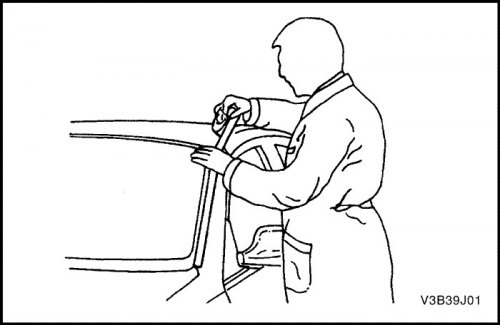
Temporarily seal the leak with electrical tape.

  • Continue testing to determine if all leaks have been detected.
  • Once all leaks have been identified, return to the workshop and perform permanent repairs using appropriate leveling techniques and sealing materials.

Wind noise reduction


Fixing wind noise leaks is very similar to fixing water leaks. See section 9I, "Water Leakage". The actual procedure depends on the type of sealant used.

Leaks around door seals do not always indicate that the seals are bad. Adjusting the door or window may solve the problem. See section 9P, "Doors" or section 9L, "Glass and Mirrors".

The article was checked: Vladimir Romannikov
This article is available at russian, bulgarian, belarusian, ukrainian, serbian, croatian, romanian, polish, slovak, hungarian

Share information:

Previous articles
Captiva 1: Exterior (external elements)
Next articles

Eliminating water leaks
Squeaks and rattles of the body
General description and operation of mirrors and glass
Schematic diagrams of heating glass and mirrors
Diagnostics of electrical systems of glass and mirrors
Windshield — Removal and Installation


See similar articles on the topic of Chevrolet cars:
Possible malfunctions of the cooling system, their causes and methods of elimination Chevrolet Aveo T300 (2012-2018)
Diagnosis of engine condition by the appearance of spark plugs Chevrolet Cruze 1 (2008-2016)
Possible malfunctions, their causes and methods of elimination Chevrolet Niva 1 (2002-2016)
Extraneous sounds, noise, knocking or vibration Chevrolet Orlando 1 (2010-2018)
Link in different formats to this page


Visitor comments

No comments yet


How much will 15 + 47 =


Captiva 1 (2006-2018) 
  • Manual
  • Before leaving
  • Keys, doors and windows
  • Seats, protection systems
  • Instruments and controls
  • Lighting system
  • Information and entertainment
  • Navigation system
  • Climate control
  • Driving a car
  • Car care
  • Maintenance
  • Engine 2.0 l (diesel)
  • Engine device
  • Troubleshooting
  • Engine repair
  • Cooling system
  • Engine electrical equipment
  • Control and power systems
  • Exhaust system
  • Engine FAM II 2.4D
  • Engine device
  • Troubleshooting
  • Engine repair
  • Cooling system
  • Engine electrical equipment
  • Control and power systems
  • Exhaust system
  • Engine HFV6 3.2L
  • Engine device
  • Troubleshooting
  • Engine repair
  • Cooling system
  • Engine electrical equipment
  • Control and power systems
  • Exhaust system
  • Transmission
  • Front drive axle
  • Rear drive axle
  • Automatic gearbox - device
  • Automatic gearbox - service
  • Automatic gearbox - repair
  • Manual gearbox - device
  • Manual gearbox - service and repair
  • Clutch
  • Transfer case
  • Chassis
  • Car suspension
  • Brake system
  • Steering
  • Body
  • Heating and ventilation
  • Air conditioning (manual)
  • Air conditioning (automatic)
  • Seat belts
  • Airbags
  • Car seat
  • Interior (internal elements)
  • Exterior (external elements)
  • Doors and windows
  • Electrical equipment
  • Equipment and devices
  • Lighting and lamps
  • Windshield wipers and washers
  • Electrical circuits


ChevyMan.ru © 2017-2026 · Mobile version · Feedback · Site search · Interesting to read · Sitemap: EN BG BY UA RS HR RO PL SK HU

Aveo 2003-2008 · Aveo 2006-2011 · Aveo 2012-2018 · Captiva 2006-2018 · Cruze 2008-2016 · Lacetti 2002-2009 · Lanos 2002-2009 · Niva 2002-2016 · Tahoe 1992-2000 · Tahoe 2000-2014 · Lumina 1 1989-1994 · Trailblazer 1 2001-2008 · Orlando 1 2010-2018 ·
🛡️ For your security and to improve our service, this site uses cookies. You can disable them in your browser.