


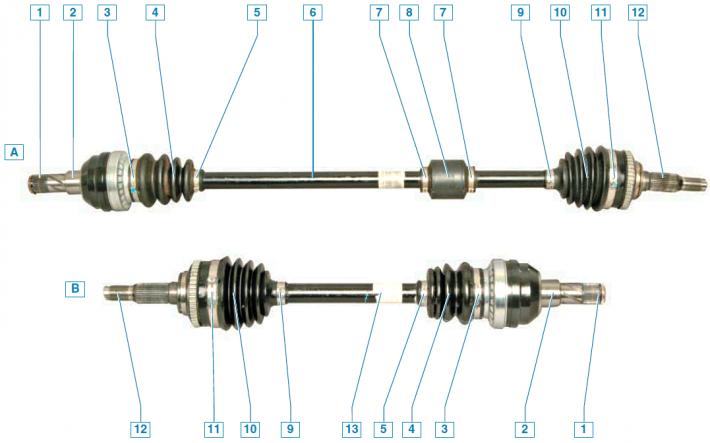
Drives of the right "A" and left "B" wheels: 1 - retaining ring; 2 — inner hinge housing; 3 - large clamp for fastening the mudguard of the inner hinge; 4 - inner hinge mudguard; 5 — small clamp for fastening the mudguard of the inner hinge; 6 — right wheel drive shaft; 7 — damper mounting clamp;8 — damper; 9 — small clamp for fastening the mudguard of the outer hinge; 10 — outer hinge mudguard; 11 - large clamp for fastening the mudguard of the outer hinge; 12 — outer hinge housing; 13 — left wheel drive shaft.
Wheel drives with constant velocity joints (CV joints) are used to transmit torque from the main transmission to the drive wheels at various wheel turning angles and suspension travels.
The wheel drive consists of inner and outer constant velocity joints connected to each other by a shaft. The drive shafts are made of steel rod. The ends of the shaft have splines on which the CV joints are installed. A damper is installed on the longer shaft of the right drive. The drive joints are covered with mudguards. The joint consists of a housing, a separator, a cage and six balls, which are placed in profiled grooves of the housing and the cage. The joint cage is installed on the shaft splines and fixed from longitudinal movement by a locking ring. The splined tailpiece of the outer joint housing, on the end of which a thread is cut, is inserted into the wheel hub and secured with a bearing nut, and the splined tailpiece of the inner joint housing is inserted into the axle gear of the differential box and fixed in it by a locking ring.
The outer joints of the left and right wheel drives are interchangeable.
The internal drive joints are also interchangeable.
The outer and inner drive hinges are of detachable design.
The hinge parts are manufactured with high precision. The inner surface of the hinge body is hardened with high-frequency current. Balls of the same sorting group are installed in the hinge. When assembling the hinge, the balls are selected for each hinge individually, so it is impossible to repair the hinge by replacing parts in a garage or service station.
A worn joint is replaced only as an assembly.
Before assembly, a special lubricant for wheel drive joints is added to the outer and inner joints.
The tightness of the hinge, which is an essential condition for its reliable operation, is ensured by rubber mudguards. The hinge cover is put on the hinge body and the drive shaft and secured with clamps. When replacing the cover, the clamps that secure it should also be replaced with new ones.
Only special clamps with a smooth inner surface and without protruding parts may be used.
Replenishment or replacement of lubricant, as well as any other maintenance of the wheel drives during the operation of the car is not required. The car owner only needs to monitor the condition of the protective covers of the hinges and the clamps of their fastening.
A damaged cover must be replaced as quickly as possible, since dirt getting into the lubricant causes rapid wear of the hinge parts and its failure.
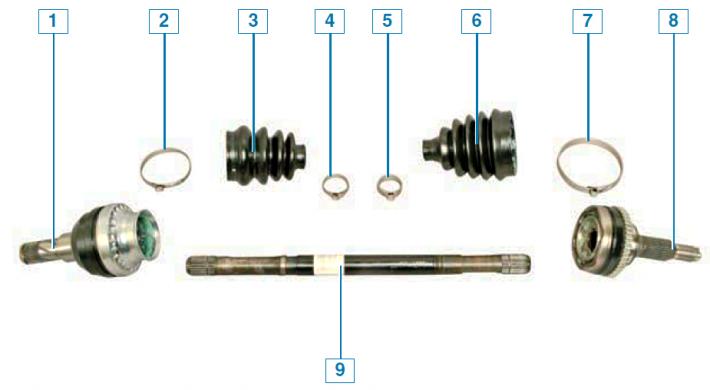
Wheel drive elements: 1 - internal hinge; 2 - large clamp for fastening the inner hinge cover; 3 — inner hinge cover; 4 - small clamp for fastening the inner hinge cover; 5 — small clamp for fastening the outer hinge cover; 6 — outer hinge cover; 7 - large clamp for fastening the outer hinge cover; 8 - outer hinge; 9 — shaft.
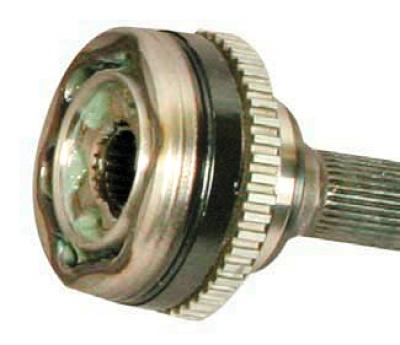
A toothed ring is pressed onto the outer joint housing, ensuring the operation of the anti-lock braking system sensor
(The original article is on the website «chevyman.ru»)