


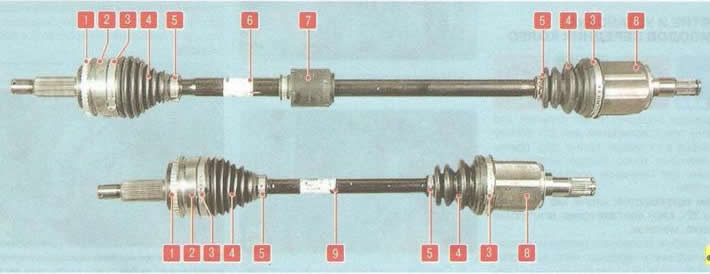
Fig. 6.10. Front wheel drives: 1 - wheel speed sensor setting ring; 2 - external constant velocity joint; 3 - large clamp for fastening the hinge cover; 4 - hinge covers; 5 - small clamp for fastening the hinge cover; 6, 9 - drive shafts; 7 - dynamic damper; 8 - internal constant velocity joint
The Birfield type outer joint consists of a housing, a separator, a cage and six balls. Grooves for placing the balls are made in the joint housing and in the cage. The grooves in the longitudinal plane are made along the radius, which ensures the required angle of rotation of the outer joint. The splined tip of the outer joint housing is installed in the front wheel hub and attached to it with a nut.
The outer joint collar is mounted on the shaft splines and secured to the shaft with a retaining ring.
The inner joint of a vehicle with a Tripod automatic transmission consists of a housing and three rollers on needle bearings mounted on the journals of a three-pin hub. The joint housing has grooves for the rollers. The three-pin hub is fixed on the shaft with a locking ring, the rollers allow the hub to move in the grooves of the joint housing in the axial direction, due to which the drive can be lengthened or shortened to compensate for the mutual movements of the suspension and the power unit. The splined tip of the inner joint housing is secured in the differential axle gear with a spring locking ring.
In Birfield type joints, balls of the same sorting group are installed. All the parts of the joint are selectively matched to each other, therefore it is impossible to repair the joint by replacing individual parts, and only the assembled joint and a small repair kit, including a retaining ring, a cover and clamps for fastening the cover, and in some cases, grease, are supplied as spare parts.
The Tripod type hinge is supplied as spare parts in the form of two repair kits: a large one, which includes all the hinge parts, and a small one, which is similar to the repair kit for the lower hinge.
For lubrication of joints, a special lubricant with molybdenum disulfide is used. The cavities of all joints are protected from road dirt and water by rubber corrugated covers 4, fixed to the joint housings and to the drive shafts by large 3 and small 5 clamps, respectively.
The outer and inner constant velocity joints of both drives are identical. However, the drive shafts differ in length, so the drives of the right and left wheels are not interchangeable. To reduce vibration in the transmission, a dynamic damper 7 is installed on the shaft of the right drive, secured with clamps similar to the small clamps 5 of the covers 4.
Helpful advice: Drive joints are very durable, their estimated service life is almost equal to the service life of the car. However, during operation they are changed or repaired quite often due to damage to the protective covers. Such work is quite expensive and labor-intensive. In order to save a lot, regularly check the condition of the protective covers of the joints and immediately replace them at the slightest damage. If water or dust gets into the joint through a damaged cover, it will fail after several hundred kilometers. A sealed joint wears out extremely slowly.