


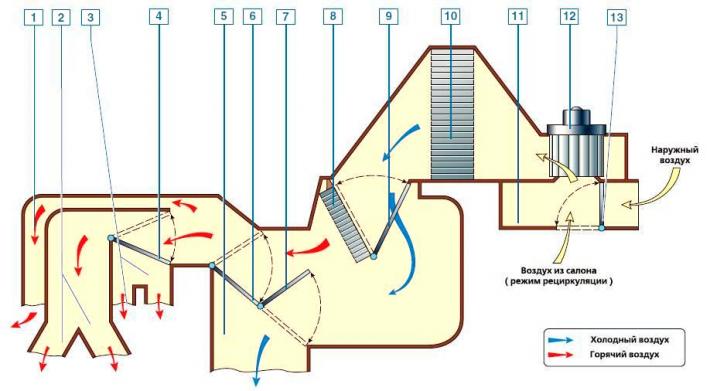
Air flow diagram in the heating, ventilation and air conditioning system: 1 – air duct for blowing side windows; 2 – windshield blower air duct; 3 – air duct for side and central deflectors; 4 – air distribution flap to the windshield or deflectors; 5 – air conditioning duct; 6 – upper air distribution flap; 7 – lower air distribution flap; 8 – heater radiator; 9 – temperature regulator flap; 10 – evaporator heat exchanger; 11 – Fan guide casing; 12 – fan electric motor; 13 – recirculation system flap
The car can be equipped with either a ventilation and heating system or a ventilation, heating and air conditioning system, which serve to create the most comfortable conditions for the driver and passengers, regardless of weather conditions.
The ventilation and heating system includes: a heater, a heater fan, air ducts and deflectors.
Air from the heater is supplied through air ducts to the windshield and side window deflector grilles, to the central and side deflectors on the instrument panel, and also to the ventilation openings in the heater casing to supply air to the feet of the driver and passengers.
The system is controlled by turning the handles located on the ventilation, heating and air conditioning control unit.
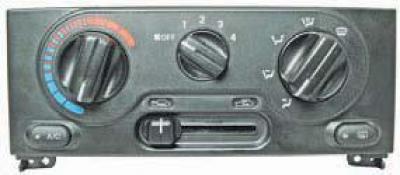
The control unit is installed on the instrument panel console.
The heater is installed under the instrument panel on the right, the air ducts are secured under the instrument panel.
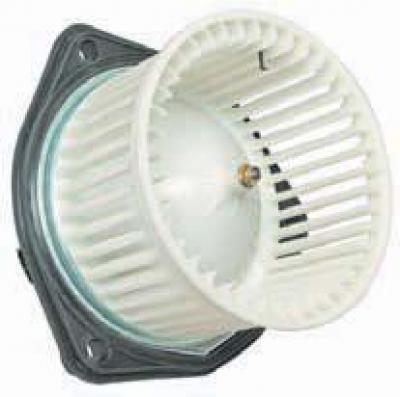
The heater housing contains a heater fan, an additional heater fan resistor, distribution flaps that direct air flows to specific areas, and a heater radiator connected by hoses to the engine cooling system, through which coolant constantly circulates.
Depending on the position of the valve associated with the temperature regulator, outside air can pass through the heater radiator or bypass it.
The air is heated by the heat of the engine coolant circulating through the heater radiator tubes.
For example, at an outside temperature of -18°C, the air after passing through the heater radiator heats up to 54°C, at -4°C - accordingly, up to 59°C, at 10°C - up to 64°C.
When the car is moving, air enters the heater through the grilles located in front of the windshield.
The heater fan serves to increase the air supply to the passenger compartment while the vehicle is moving, as well as when parked.
The intensity of air supply is determined by the rotation speed of the fan.
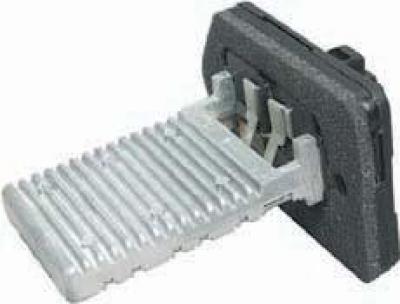
Additional heater fan resistor
The fan motor, depending on the connection of an additional resistor, can rotate at four different speeds.
The distribution of air flows in the cabin is carried out by an air flow distribution regulator, which is connected to the flaps by rods.
By controlling the flaps, the regulator directs air flows through the air ducts to the central and side deflectors, to the lower ventilation openings in the heater casing, as well as to the glass defroster grilles located in the instrument panel.
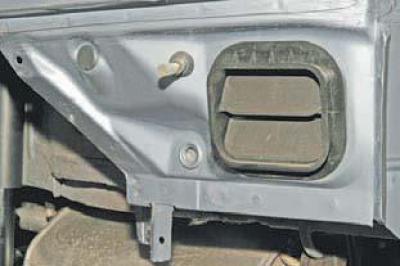
Cabin air outlet valves
Air exits the cabin through openings located on top of the trunk sides, and then out through valves installed behind the sides of the rear bumper.
To speed up the heating of the passenger compartment and prevent outside air from entering the passenger compartment (when driving a car on smoky, dusty sections of the road) serves as an air recirculation system.
When the air recirculation mode lever is moved, the recirculation system flap blocks the flow of outside air into the vehicle interior, causing the air in the vehicle interior to circulate in a closed circuit without exchanging with outside air.
Some vehicles are equipped with an air conditioning system.
The air conditioning system is designed to reduce the temperature and humidity of the air in the cabin.
The air conditioner is turned on by pressing the air conditioner switch button located in the heating, ventilation and air conditioning control unit, while the heater fan must be on.
When the air conditioner is turned on, the indicator located next to the air conditioner switch button lights up.
The air conditioning compressor is mounted on the engine bracket at the front, on the right.
The compressor is driven by a V-belt from the auxiliary drive pulley.
The compressor pulley has a built-in electromagnetic clutch that switches the compressor shaft on and off the pulley based on ECU signals.
After the compressor, the refrigerant vapor enters the condenser, located in front of the engine cooling system radiator.
Next, the refrigerant enters the receiver, which is attached to the condenser on the right side.
From the receiver, the refrigerant enters the reducer and then the evaporator, located under the instrument panel in the heater body.
The air cooled in this way enters the car's interior.
From the evaporator, the refrigerant is sucked back into the compressor and the working cycle is repeated.
Valves for filling and releasing refrigerant from the air conditioning system are installed on the high and low pressure pipelines.
A refrigerant pressure sensor is installed on the pipeline between the compressor and the condenser.
The pressure sensor sends a signal to the ECU, which controls the electric fans of the engine cooling system depending on the value of the coolant pressure and the vehicle speed.
In addition, based on signals from the pressure sensor, the ECU switches off the air conditioning compressor when the refrigerant pressure in the system drops to 2.0 bar and when the pressure increases to 27.0 bar.
A shut-off valve is installed in the pipeline fitting, under the pressure sensor, which closes when the sensor is unscrewed.
Therefore, when replacing the pressure sensor, there will be no refrigerant leakage from the air conditioning system.
The refrigerant in the air conditioning system is under high pressure.
When performing work involving depressurization of the air conditioning system, avoid contact with eyes, skin and respiratory tract.
Any work with refrigerant must be carried out only in a ventilated area.
When filling the air conditioning system, use only materials recommended by the manufacturer.
It is prohibited to carry out welding or soldering work on air conditioning system components.
Repair and maintenance work on the air conditioning system should be carried out at specialized service centers.
To search for leaks in the system, special equipment is used, and a special contrast agent will need to be introduced into the system.
After removing the refrigerant from the system, it is necessary to pump out the air to remove any remaining moisture.
Before filling the system, it is necessary to add a special oil recommended by the manufacturer.