


The battery is charged with a current of 5.5 A with the plugs unscrewed. Charging is carried out until abundant gas emission begins and the voltage and density of the electrolyte remain constant for 3 hours. The density of the electrolyte of the charged battery at 25°C must correspond to the data in Table 7-5 for each climate zone.
Table 7-5. Electrolyte density at 25°C, g/cm
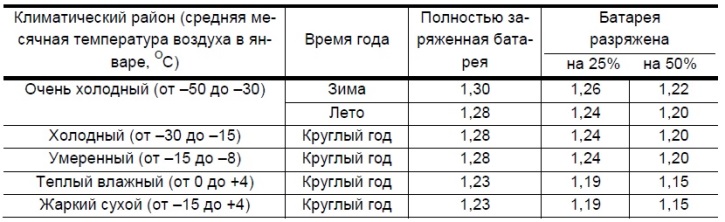
When charging the battery, it is necessary to periodically check the electrolyte temperature and not allow it to rise above 40°C. If the temperature reaches 40°C, then the charging current should be halved or the charging should be interrupted and the battery should be cooled to 27°C.
Charging is stopped when abundant gas emission begins in all battery elements, and the voltage and density of the electrolyte during the last three measurements (produced in 1 hour) will remain constant.
If at the end of charging the density of the electrolyte (determined taking into account the temperature correction) differs from the specified one, then adjust it. If the density is increased, remove some of the electrolyte and add distilled water. If the electrolyte density is below the norm, then remove it from the element and add electrolyte of increased density (1.4 g/cm³).
After adjusting the electrolyte density, continue charging the battery for another 30 minutes to mix the electrolyte. Then disconnect the battery and measure its level in all elements after 30 minutes. If the electrolyte level is below the norm, add electrolyte with a density corresponding to the given climatic region (see table 7-5). If the electrolyte level is above normal, remove the excess with a rubber bulb.
The article was borrowed from the website: «CHEVYMAN.RU»