


To remove air from the hydraulic drive:
- clean tank 4 (figure 3-2) hydraulic clutch drive and nipple 14 of the working cylinder for bleeding dust and dirt;
- check the fluid level in the hydraulic drive reservoir and add fluid if necessary;
- install a hose on the nipple 14 of the working cylinder and immerse its lower end in a container with hydraulic fluid (30-50 g);
- unscrew nipple 14 by ½-3/4 of a turn, sharply press and smoothly release the clutch pedal until air bubbles stop coming out of the hose (while doing this, check the fluid level in the tank and top it up if necessary);
- press the pedal and tighten the fitting 14 until it stops. Remove the hose and put on the fitting cap.
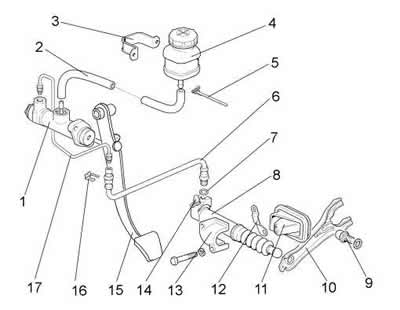
Figure 3-2. Clutch drive:
1 - master cylinder;
2 - connecting hose of the master cylinder and the tank;
3 - tank mounting bracket;
4 - clutch hydraulic reservoir;
5 - hose clamp;
6 - clutch drive hose;
7 - gasket;
8 - clutch slave cylinder;
9 - fork support;
10 - clutch release fork;
11 - Fork cover;
12 - thrust plate;
13 - working cylinder bracket;
14 - bleed nipple;
15 - clutch pedal;
16 - bracket;
17 - clutch drive tube.
If, despite prolonged pumping, air bubbles come out of the hose, check the reliability of the connections, find out if there are cracks in the tubes or leaks in the connections with the fittings. Air may penetrate through damaged sealing elements of the master or slave cylinder.
When pumping:
- the end of the bleed hose must be constantly immersed in liquid;
- after bleeding, bring the fluid level in the tank to the upper mark on its body.