


If the clutch does not disengage completely when the pedal is pressed all the way ("leads"), which is accompanied by a characteristic grinding of gears when the reverse gear is engaged, air may have entered the clutch hydraulic drive. Remove it by bleeding the hydraulic drive.
In addition, bleeding is performed when filling the hydraulic drive with fluid after its replacement or after repair of system components associated with depressurization.
1. Check the level of working fluid in the reservoir of the master brake cylinder (the reservoir is common for both main cylinders) and, if necessary, bring it up to standard.
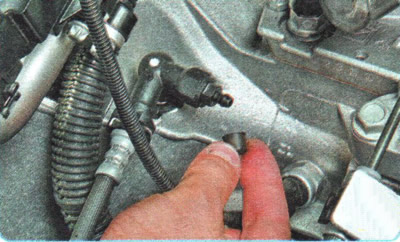
2. Remove the protective cap from the valve to remove air from the clutch slave cylinder.
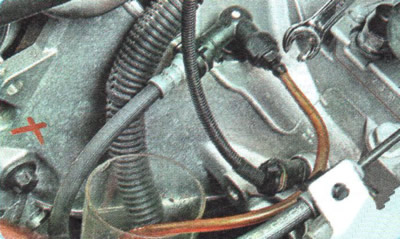
3. Attach a hose to the valve and lower its end into a container with a small amount of brake fluid. Ask an assistant to press the clutch pedal 4-5 times at intervals of two to three seconds, and then hold it down. Holding the hose adapter from turning, unscrew the valve by 3/4 of a turn. Fluid with air bubbles will come out of the hose into the container.
4. Close the valve and ask to release the clutch pedal.
5. Repeat steps 3 and 4 several times until liquid starts coming out of the hose without air bubbles.
WARNING: When bleeding the hydraulic drive, periodically check the fluid level in the master cylinder reservoir. Do not allow the fluid level in the reservoir to drop below 25 mm from the bottom of the reservoir. Top up the fluid in a timely manner, otherwise, when the bottom of the reservoir dries, air will get into the system and bleeding will have to be repeated again.
6. Close the valve, put on the protective cap and, if necessary, add fluid to the master cylinder reservoir.
[The original article can be found on the resource: «CHEVYMAN.RU»]