


Alloy wheels
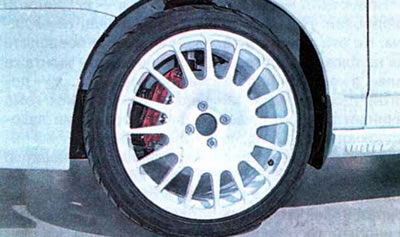
The main advantage of alloy wheels over steel ones is their lower weight. Accordingly, their installation on a vehicle leads to a reduction in unsprung mass and, as a consequence, to an increase in comfort and driving safety, as well as an increase in dynamics.
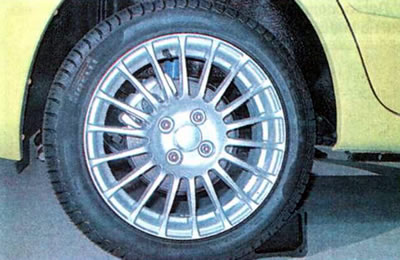
The second advantage, and for many it is the main one, is a more interesting and varied design.
In the production of light alloy wheels, aluminum alloys are mainly used, less often magnesium alloys, although in the second case the wheels are even lighter in weight and have better damping capacity. In addition, due to better thermal conductivity, magnesium discs improve heat dissipation from wheel hubs and brake mechanisms.
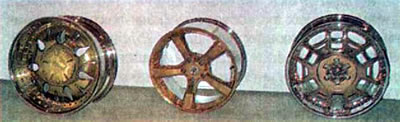
Depending on the technology used in production, alloy wheels can be cast or forged (stamped). All other things being equal, forged wheels are lighter and stronger than cast ones, but their production is quite expensive and requires very powerful pressing equipment. Therefore, forged wheels from foreign manufacturers are very expensive, but in Russia there are a number of re-profiled defense enterprises that produce such wheels at a price that does not exceed the cost of cast wheels from lesser-known manufacturers.
The disadvantage of alloy wheels is their tendency to corrode. That's why the discs are coated with a protective varnish. But this protection is not eternal and can be damaged both on a bad road and during improper tire installation, and good powder coating of the disk is an expensive pleasure. Of course, a steel disc also begins to actively rust when the paint coating is damaged, but in this case, the rust is superficial and does not lead to a change in the structure of the disc metal. The second disadvantage of an alloy wheel is that, unlike a steel wheel, it cannot be rolled if damaged. To straighten a disc, special equipment is required, and in the event of a strong impact, cast alloy wheels usually split. In this regard, forged wheels better withstand impacts from uneven road surfaces and are more resistant to deformation and destruction. Therefore, counterfeit and very cheap disks are very dangerous, as their casting may contain cavities, cracks and other hidden defects.
Alloy wheels are perhaps the accessory that has the greatest impact on the appearance of a car.
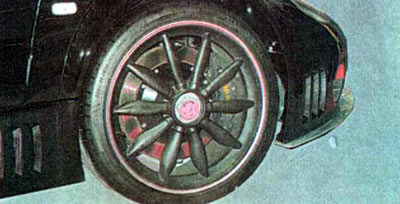
The main thing when choosing disks is to select the correct geometric parameters. Currently, the choice of alloy wheels is huge and all you need to know to select a wheel for your car is the number and diameter of the mounting holes, the diameter of the central hole, offset, width and diameter of the wheel disk. However, as practice shows, most car owners have no doubts about the need to match the number and diameter of the mounting holes, and perhaps also the correspondence of the diameter of the central hole using centering rings. The other parameters are usually treated with disdain; the main thing is that the wheel fits in the arch and does not touch anything. But this is completely wrong, and often simply dangerous. As a rule, the vehicle operating instructions indicate the parameters of the wheels and tires approved for installation on a given vehicle. It can be noted that the manufacturer usually provides the opportunity to choose the diameter of the disks within certain limits, indicating its width and offset, which may vary slightly depending on the diameter. This is not done just like that. Tires and wheels are important elements of a car's chassis. Therefore, any change in their parameters will inevitably lead to a change in the driving performance of the car, and not for the better. By specifying certain parameters obtained during engineering calculations and verified during finishing tests, the manufacturer guarantees the proper operation of suspension units without reducing their service life, as well as compliance of the vehicle's controllability with the requirements laid down during its design. Don't be condescending about this and try to argue with factory engineers and testers, it may cost more than it might seem at first glance. Also, when choosing wheels with a larger diameter, keep in mind that the tire profile decreases and the width often increases. On our "ideal" roads, it becomes much easier to damage such a tire, disk, and even suspension. In addition, the car becomes more "nervous" and sensitive to ruts on the road, and a wheel with a larger disc diameter, all other things being equal, is heavier than a wheel with a smaller disc diameter, which leads to worse dynamics and worse comfort due to the increase in unsprung masses. And finally, it should be remembered that the larger the radius of the disk, the more expensive it is, and the rubber is also significantly more expensive.
The second problem when buying disks is the choice of manufacturer. Here you need to be very careful and be sure to ask the seller for certificates for the disks being sold. It's up to you to decide which manufacturer to choose, but remember: your safety depends on the quality of the disks. Is it worth saving on it?