


Contents: Inspection ↧ Replacement ↧
1. As a rule, excessive wear or damage to the supports is extremely rare. To avoid damage or increased wear of transmission components, damaged or worn out bearings should be replaced immediately.
Inspection
2. Before inspection, the supports should be relieved by slightly lifting the engine.
3. Raise the vehicle and place vertical supports underneath it, then place a hydraulic jack under the engine sump. A wooden block must be placed between the jack lever and the pallet. Raise the engine slightly to relieve the load on the mounts. Do not support the entire weight of the engine on the jack.
4. Check the supports for breaks or separation of the rubber elements from the metal base. Sometimes the rubber elements delaminate right down the center. To reduce wear, it is recommended to apply silicone grease to the bearings.
5. Estimate the relative movement of the support plates and the engine or supporting element. Determine the movement by wedge the supports with a large screwdriver or pry bar. If there is excessive movement in the supports, first check the tightness of the fasteners. As a rule, if the support has failed, this is manifested by significant movement of the engine when the support is wedged or when a load is applied to the power unit.
Replacement
6. Disconnect the negative battery cable.
7. Remove the radiator fan (see chapter 3).
8. Disconnect the wire and remove the MAP sensor (absolute pressure).
9. Unscrew the upper connecting nuts of the left and right engine mounts (even if it is assumed that only one support needs to be replaced) (see illustration).
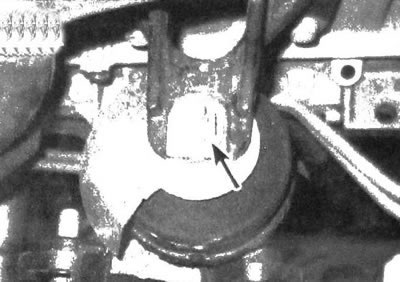
17.9. To facilitate the replacement of one support, it is necessary to unscrew the upper connecting nuts of both supports
10. Raise the vehicle and support it on vertical stands.
11. Place a hydraulic jack under the engine sump. A wooden block must be placed between the jack lever and the pallet. Raise the engine slightly to relieve the load on the mounts.
12. Unscrew the lower support connecting nut.
13. If the design provides for the presence of a protective pallet shield, remove it at this stage of the procedure.
14. Lower the vehicle.
15. Raise the engine with a jack so that it is possible to disconnect the supports from the brackets, the nuts of which have already been unscrewed. Remove the support.
16. Installation is carried out in the reverse order of removal. Treat the threads of the support fasteners with anaerobic sealant and ensure that the tightening torque specified in this chapter is maintained.
[The text of the article was obtained from the website: ChevyMan.ru]