


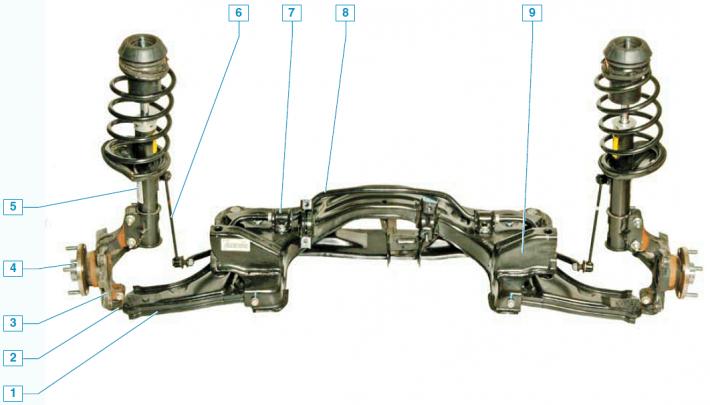
Front suspension: 1 - lever; 2 — ball joint; 3 - steering knuckle; 4 — hub; 5 — shock absorber strut; 6 — stabilizer link lateral stability; 7 — bracket for fastening the stabilizer bar to the subframe; 8 — transverse stabilizer bar; 9 — subframe.
The front suspension is independent, MacPherson type, with telescopic shock absorber struts, wishbones, subframe and anti-roll bar.
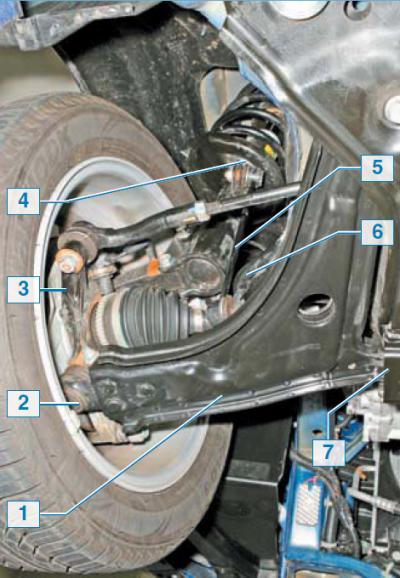
Elements of the front suspension on the car: 1 - lever; 2 — ball joint; 3 - steering knuckle; 4 — shock absorber strut; 5 — stabilizer link lateral stability; 6 — transverse stabilizer bar; 7 — subframe
The suspension is based on two shock absorber struts, which allow the front wheels to move up and down when driving over uneven surfaces and simultaneously dampen body vibrations. A bracket for attaching the strut to the steering knuckle is welded to the lower part of the strut body, and a bracket for attaching the anti-roll bar is welded to the middle part. A hydraulic gas-filled shock absorber is installed in the strut body.
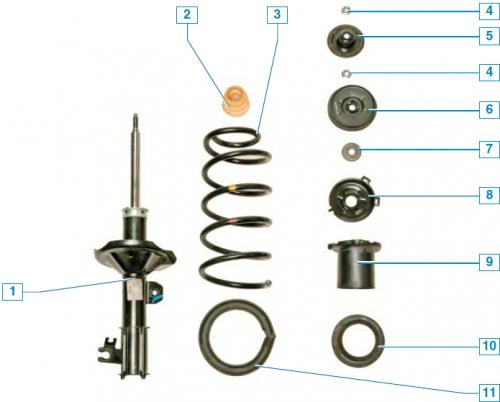
Shock absorber strut elements: 1 - telescopic stand; 2 — compression stroke buffer; 3 - spring; 4 - nut; 5 - thrust washer; 6 - upper support of the rack; 7 - thrust bearing; 8 — upper spring support cup; 9 — spring centering sleeve; 10 - Upper rubber gasket; 11 - lower rubber gasket
The shock absorber rod has a polyurethane foam compression buffer designed to limit the upward travel of the wheel when the car is moving over uneven surfaces. The helical cylindrical spring of the shock absorber strut rests with its lower turn through a rubber gasket on the lower cup welded to the strut body, and with its upper turn (reduced diameter) — on the centering sleeve, fixed on the shock absorber rod together with the upper rubber-metal support of the strut. The upper support of the strut, resting against the cup of the body mudguard, due to its elasticity allows the strut to swing during suspension movements and does not allow high-frequency vibrations to be transmitted to the body.
The thrust bearing, located on the shock absorber rod between the upper spring support cup and the upper strut support, allows the strut to turn with the steered wheel.
Braking and traction forces during vehicle movement are perceived by suspension arms connected via ball joints to steering knuckles and via silent blocks to the suspension subframe. The subframe is attached to the side members at four points: rigidly at the front with two nuts to the studs, and via silent blocks at the rear (pressed into the subframe holes) - with two bolts.
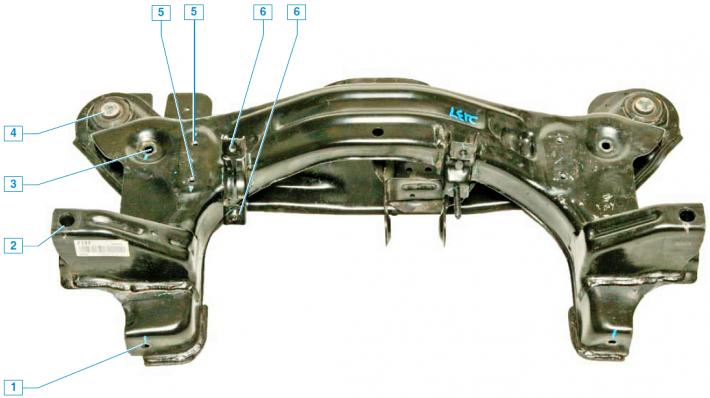
Subframe, suspension and steering mounting holes: 1 - lever (front); 2 - subframe (front); 3 - levers (rear); 4 — subframe (rear); 5 — stabilizer bars; 6 - steering mechanism
The ball joint housing is riveted to the arm with three rivets, and the ball joint pin is attached to the steering knuckle eye using a clamp connection.
A double-row closed-type radial thrust ball bearing is pressed into the hole in the steering knuckle, and the wheel hub is pressed into the inner rings of the bearing.
The inner rings are tightened (through the hub) nut on the threaded part of the outer joint housing tailstock. The bearing is not adjusted during operation and does not require replenishment of grease. The front wheel hub bearings are interchangeable. The hub bearing nuts of both wheels are the same, with right-hand threads.
The anti-roll bar is made of spring steel. The bar is attached in its middle part to the suspension subframe with brackets through two rubber cushions. Both ends of the bar are attached to the shock absorber housings through the ball joints of the anti-roll bar struts.
To ensure good stability and control of the car, the front wheels are installed at certain angles relative to the body elements and suspension.
Wheel toe-in is the angle between the plane of rotation of the wheel and the longitudinal axis of the vehicle. Wheel toe-in helps to ensure the correct position of the steered wheels at various speeds and angles of rotation of the vehicle. Signs of deviation of the wheel toe-in angle from the norm: strong saw-tooth wear of tires in the transverse direction, squealing of tires when turning, increased fuel consumption due to high rolling resistance of the front wheels. Toe-in is adjusted by rotating the steering rods with the locknuts of the steering rod ends unscrewed.
The longitudinal tilt angle of the steering axis is the angle between the vertical and the line passing through the pivot points of the ball joint and the bearing of the upper support of the shock absorber strut in a plane parallel to the longitudinal axis of the car. It helps stabilize the steered wheels in the direction of straight-line movement. Symptoms of deviation of the angle from the norm are: the car pulling to the side when driving, different forces on the steering wheel in left and right turns, one-sided wear of the tire tread.
Wheel camber is the angle between the plane of rotation of the wheel and the vertical. It helps the rolling wheel to be in the correct position when the suspension is operating. If this angle deviates greatly from the norm, the car may drift away from straight-line movement and the tread may wear out on one side.
Only the toe-in angle is adjustable. The camber angle and the longitudinal tilt angle of the wheel pivot axis are determined by the design geometry of the suspension and body parts. These angles are not adjustable during operation.
It is recommended that wheel alignment checks and adjustments be carried out at a service station using special equipment (adjustment stand). Before adjustment, the wheels must be set to the straight-ahead position of the vehicle. The vehicle must be placed on a horizontal platform and loaded in accordance with the manufacturer's recommendations.
The installation angles must correspond to the following values: — toe-in: 0°±10' — camber angle: –20'±45' — longitudinal tilt angle of the steering axis: 4°±45'
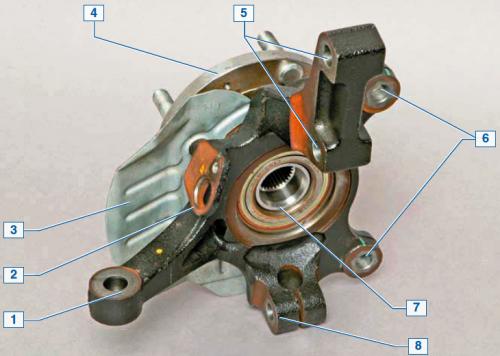
Steering knuckle assembly with bearing and hub: 1 — eye for mounting the steering rod end; 2 — wheel speed sensor mounting eye; 3 — shield; 4 — hub; 5 — mounting holes to the shock absorber strut bracket; 6 — brake shoe guide mounting eye; 7 — hub bearing; 8 — ball joint pin mounting eye
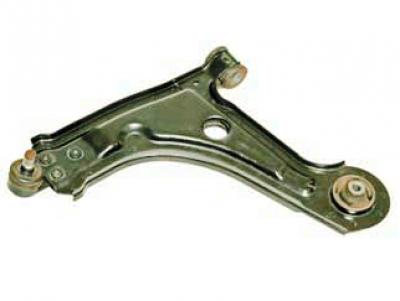
Front suspension arm
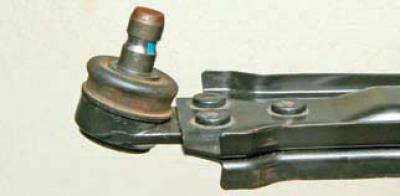
The ball joint housing is riveted to the lever with three rivets at the factory.
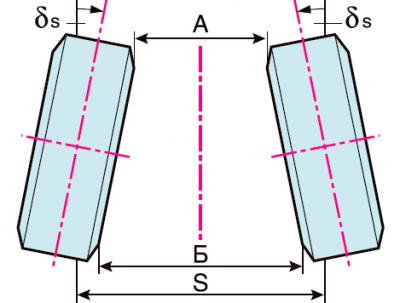
B–A — front wheel alignment; A and B — distance (mm) between the edges of the wheel rims in front and behind; δs — front wheel toe angle; S — track
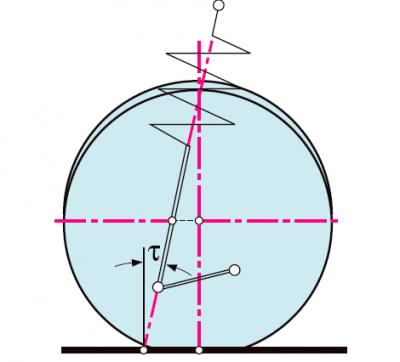
t — angle of longitudinal inclination of the wheel rotation axis (caster)
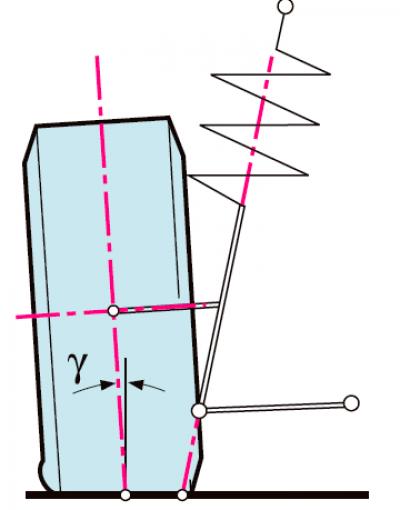
γ — camber angle
[The article is reprinted from the website chevyman.ru]