


When the engine is not running, the switched-on consumers are powered from the battery, and after the engine is started, from the generator.
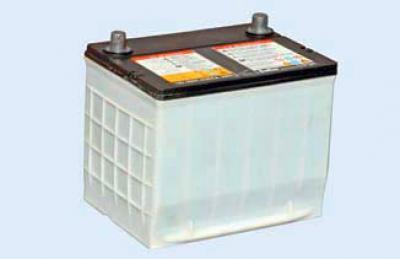
When the generator is running, the battery is charged.
The vehicle is equipped with a maintenance-free lead-acid starter battery with a capacity of 55 Ah.
The generator is a synchronous AC electric machine with a built-in rectifier unit and voltage regulator.
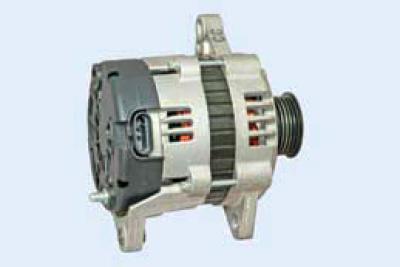
The generator pulley is driven by a poly-V belt from the auxiliary drive pulley.
The stator and generator covers are tightened with four screws. The rotor shaft rotates in ball bearings installed in the generator covers. The bearings are sealed, the grease in them is designed for the entire service life of the generator. The rear bearing is pressed onto the rotor shaft, and is installed in the cover with a slight interference fit. The front bearing is pressed into the front cover, and on the rotor shaft the bearing fit is sliding.
The generator stator contains a three-phase winding. The second ends of the phase windings are soldered to the terminals of the rectifier unit, which consists of six silicon diodes (valves) - three "positive" and three "negative", pressed into two horseshoe-shaped aluminum plate holders in accordance with the polarity (positive and negative on different plates). The rectifier unit is fixed to the rear cover of the generator.
The excitation winding is located on the generator rotor, and its terminals are soldered to two copper contact rings on the rotor shaft. Power is supplied to the excitation winding through two brushes, which are installed in the brush holder. The brush holder and voltage regulator are fixed to the rear cover of the generator.
The voltage regulator is a non-separable unit; if it fails, it is replaced.
the "minus" of the battery should always be connected to the "ground" of the car, and the "plus" to the generator terminal. Reverse connection will lead to breakdown of the generator rectifier block diodes.
When the generator is running, do not disconnect the battery, as the resulting voltage surges may damage the electronic components of the circuit.
The starter is a four-brush DC electric motor with excitation from permanent magnets, with a planetary gearbox, a freewheel roller clutch and a two-winding traction relay.
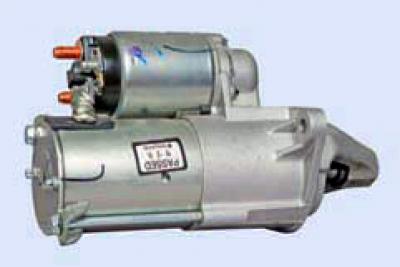
Permanent magnets are attached to the steel housing of the starter. The housing and covers of the starter are tightened with two bolts. The armature shaft rotates in plain bearings. Torque from the armature shaft is transmitted to the drive shaft through a planetary gearbox consisting of a central and crown (with internal gearing) gears and three satellites on the carrier (drive shaft).
A freewheel clutch is installed on the drive shaft (overrunning clutch) gear.
The traction relay is used to engage the drive pinion with the engine crankshaft flywheel ring gear and to turn on the power supply to the starter motor. When the ignition key is turned to the START position, voltage is supplied to both windings of the traction relay (retracting and retaining). The relay anchor is pulled in and moves the drive lever, which moves the freewheel clutch with the drive gear along the splines of the drive shaft, engaging the gear with the flywheel ring. In this case, the pull-in winding is disconnected and the contacts of the traction relay are closed, turning on the starter motor. After returning the key to the ON position, the holding winding of the traction relay is de-energized and the relay anchor, under the action of the spring, returns to its original position - the relay contacts open and the drive gear disengages from the flywheel.
The faulty traction relay is replaced. The faulty starter drive is detected during inspection after disassembling the starter.
The lighting and signaling system includes two headlights; fog lights; side direction indicators; rear lights; license plate lights; additional brake signal; interior and luggage compartment lighting lamps; sound signal, as well as switches for all these thieves.
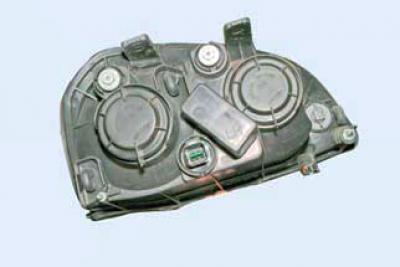
Headlights for cars with sedan and station wagon bodies
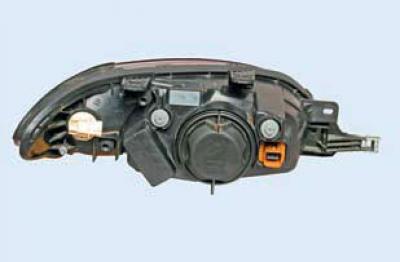
Headlight unit of a hatchback car
The headlights of hatchback cars differ from those of sedan and station wagon cars.
The headlights of cars with sedan and station wagon bodies are equipped with: a halogen low beam lamp, a halogen high beam lamp, a parking light lamp, and a turn signal lamp (orange color) and the actuator (gear motor) headlight beam direction regulator. Unlike them, the hatchback's headlight unit has a dual-filament halogen high/low beam lamp.
Fog lights are installed in the front bumper.
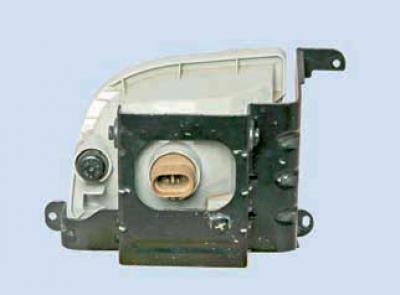
The fog light contains a halogen lamp, the direction of the light beam of which is adjusted with a screw.
The rear lights of cars with all three body types differ from each other.
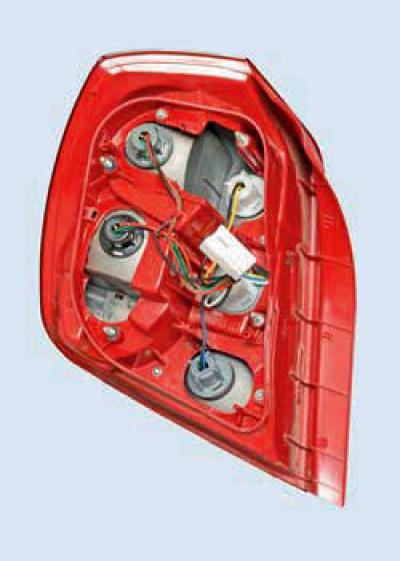
rear light of a sedan car
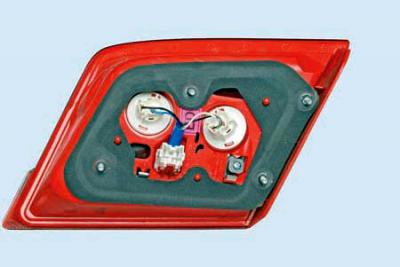
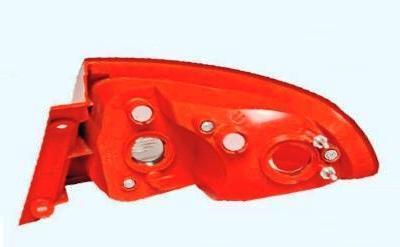
rear light of a hatchback car
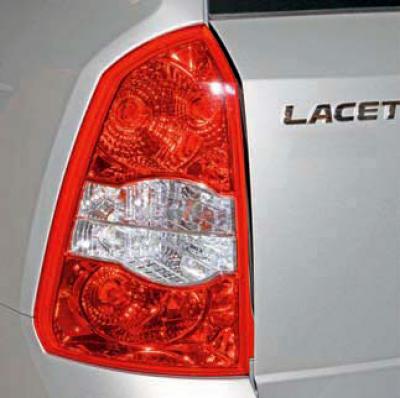
station wagon tail light
The rear light contains two-filament brake light and parking light bulbs; direction indicator (orange color); fog light; reversing lights. The lights on cars with sedan and station wagon bodies are installed on the rear wings. The rear lights of a car with a hatchback body consist of two parts: one is installed on the rear wing, the other - on the trunk door. The sedan light has two two-filament lamps (21/5 W): one for the brake signal and parking light, the second - for the parking light, but only the 5 W filament is turned on when the parking light is turned on.
The car is equipped with driver and front passenger airbags. The driver's airbag is located on the steering wheel. The front passenger airbag is installed in the instrument panel.
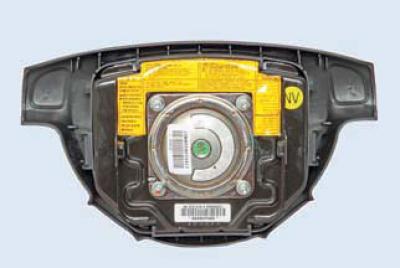
Some vehicles are equipped with driver and front passenger side airbags, which are installed in the backrests of the front seats on the door side. The airbag control unit is located in the passenger compartment under the floor tunnel trim between the front seats. This unit also controls the driver and front passenger seat belt pretensioners.
For electrically connecting the airbag, horn switches and audio system head unit control unit to the instrument panel wiring harness instead of the usual sliding contact (to avoid sparking and unintentional deployment of the airbag) a drum device with a spiral cable, operating on the principle of a tape measure, was used.
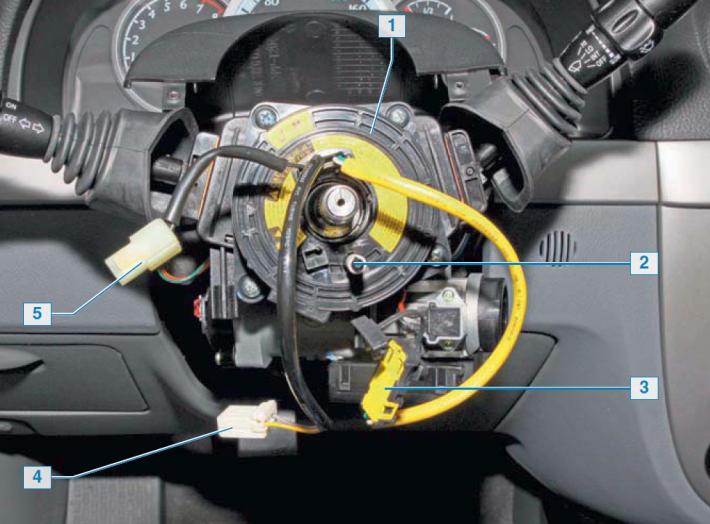
Drum device with spiral cable: 1 — drum device body; 2 - drum device leash; 3 - Airbag wiring harness; 4 — wiring block of the control unit of the head unit of the audio reproduction system; 5 — wiring block for horn switches.
The drum device is attached to the connector of the steering column switches. Several turns of metal-plastic tape, which is an electrical conductor, are spirally laid in the cylindrical plastic body of the device. One end of the tape is connected to the instrument panel wiring harness via wires with pads. The other end of the tape is connected by wires to pads with an airbag, a control unit of the head unit of the audio system and horn switches. The drum leash enters the hole in the hub of the steering wheel. When rotating, the wheel turns the drum by the leash, and with it the tape, which is located in the cylindrical body either on a larger or smaller radius.
From its center position, the drum can rotate in each direction to the stop by 3.25 turns. This prevents the tape from breaking when turning the steering wheel from the neutral position to the stop in each direction.
Before installing the steering wheel, it is necessary to set the drum of the device to the middle position, while the leash should be located at the bottom.
All door locks are locked by electric drives. Removal of the door lock electric drives is shown in Chapter. Body.
Depending on the configuration, the car may be equipped with electric windows for only the front doors or all doors.
Removal of electric windows is shown in Chapter. Body.
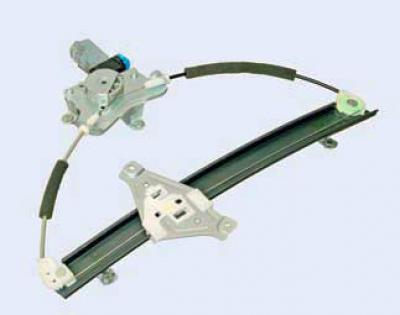
The window lifter motor-reducer consists of a worm gearbox and a reversible DC electric motor. A drum with a cable is installed on the output shaft of the gearbox. A slider is fixed to the cable, moving along a guide. Glass holders are attached to the slider with two screws.
The windshield wiper is installed under the windshield trim.
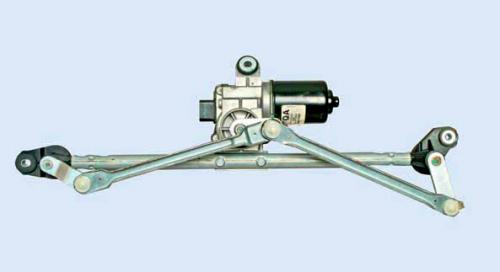
The cleaner's electric motor is three-brush, two-speed, with excitation from permanent magnets.
The windshield washer consists of a polyethylene tank with an electric pump, nozzles on the hood and connecting hoses. The washer tank is located behind the left front wing. The filler neck of the tank is located in the engine compartment.
Hatchback and station wagon cars are equipped with a wiper and washer for the luggage compartment glass. The wiper is installed inside the luggage compartment door. The wiper electric motor is a two-brush motor with excitation from permanent magnets.
The washer nozzle is fixed to the trunk door and connected by a hose to the windshield washer pump, which supplies the liquid to it. The washer pump on the hatchback and station wagon is reversible; when the pump motor shaft rotates in one direction, the liquid from the tank is supplied to the windshield, and when it rotates in the other direction, the liquid is supplied to the trunk door glass.
The car is equipped with a battery discharge protection system. If you remove the key from the ignition switch and open the driver's door with the headlights or side lights on, the headlights and side lights will turn off automatically. In this case, only the interior light will not turn off. The protection system is controlled by a unit located on the left under the instrument panel.
The manufacturer installs a standard vehicle anti-theft system on some vehicles. The anti-theft system control unit is installed under the floor tunnel lining. The siren is installed in the engine compartment.
The anti-theft system also includes sensors for opening the hood, doors and trunk. In the event of an unauthorized attempt to enter the car or start the engine, the anti-theft system turns on the siren and all direction indicators for 28 seconds.
Most electrical circuits are protected by fuses. Powerful consumers (rear window heating element, engine cooling fan, electric windows and others) are connected via a relay.
The fuses and most of the relays are installed in two mounting blocks, one of which is located on the left, in the engine compartment, and the second in the instrument panel. This block is covered by a cover on the left end of the instrument panel.
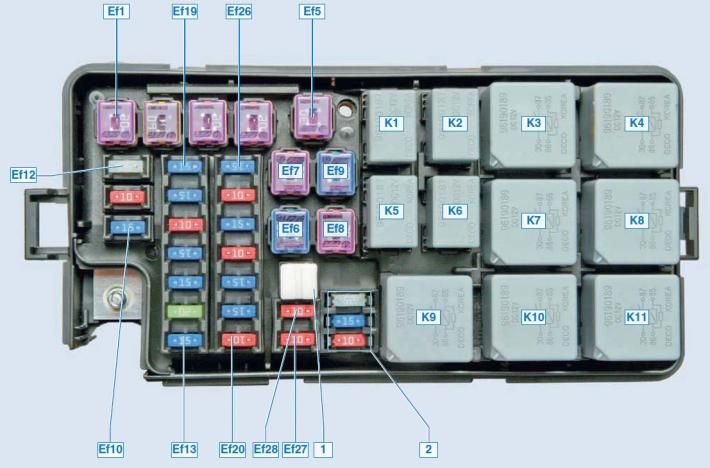
Fuses in the engine compartment mounting block
| Fuse designation (rated current, A) | Protected elements |
| Ef1 (30) | Fuse chains F13-F15 and F21-F24 |
| Ef2 (60) | ABS control unit circuits |
| Ef3 (30) | Heater fan |
| Ef4 (30) | Ignition switch (starter, fuse chains F5-F8) |
| Ef5 (30) | Ignition switch (fuse circuits F1-F4, F9-F12, F17-F19) |
| Ef6 (20) | Low Speed Cooling Fan Relay Power Circuit |
| Ef7 (30) | Rear window heating element |
| Ef8 (30) | Cooling Fan High Speed Relay Power Circuit |
| Ef9 (20) | Electric motors for window lifts of the right front and rear doors |
| Ef10 (15) | Ignition coil, ECU, EGR valve |
| Ef11 (10) | ECU, main relay (ECU Sirius D4) |
| Ef12 (25) | Headlights, parking light relay winding |
| Ef13 (15) | Brake light switch, brake lights |
| Ef14 (20) | Electric motor for window lift, left front door |
| Ef1 5 (15) | High beam headlights |
| Ef16 (15) | Sound signal, siren of car anti-theft system, hood opening sensor |
| Ef17 (10) | Air conditioning compressor clutch |
| Ef18 (15) | Fuel pump |
| Ef19 (15) | Instrument cluster, interior and trunk lights, immobilizer status indicator, warning signal, control unit for folding exterior mirrors |
| Ef20 (10) | Left headlight low beam lamp |
| Ef21 (15) | Oxygen concentration sensors, adsorber purge valve, phase sensor, ECU (Sirius D4), winding of the low speed relay of the cooling system fan, winding of the high speed relay of the cooling system fan, winding of the control relay of the cooling system fan |
| Ef22 (15) | Injectors, EGR valve, fuel pump relay coil (ECU HV-240) |
| Ef23 (10) | License plate lights, left headlight side light, left rear light side light, warning light |
| Ef24 (15) | Fog lights |
| Ef25 (10) | Heating elements for outside rear view mirrors |
| Ef26 (15) | Central locking control unit |
| Ef27 (10) | Right headlight low beam lamp |
| Ef28 (10) | Right headlight side light, right rear light side light, instrument lighting dimmer, clock, instrument cluster light, ventilation, heating and air conditioning control unit light, air conditioning automatic control unit light, ashtray light, headlight beam aiming light, audio head unit light, HOLD mode switch light, hazard warning switch light |
Engine bay mounting block relay
| Designation | Name | Switched circuits |
| K1 | Parking light relay | Side light bulbs in headlights, side light bulbs in rear lights, instrument cluster and control illumination bulbs |
| K2 | Horn relay | Sound signal |
| K3 | Engine Management System Main Relay | Injectors, oxygen concentration sensors, phase sensor, adsorber purge valve, fuel pump relay winding, high-speed cooling system fan relay, low-speed cooling system fan relay, cooling system fan control relay |
| K4 | Headlight relay | Headlight bulbs |
| K5 | Fog light relay | Fog light bulbs |
| Kb | Air Conditioning Compressor Relay | Air conditioning compressor electromagnetic clutch |
| K7 | Fuel pump and ignition coil relay | Fuel pump motor and ignition coil |
| K8 | Window lifter relay | Electric window lift motors |
| K9 | Cooling Fan Low Speed Relay | Electric motor of the cooling system fan |
| K10 | Rear window heating relay | Rear window heating element |
| K11 | High Speed Cooling Fan Relay | Electric motor of the cooling system fan |