


We remove the high-voltage wire tip from the spark plug and insert a working spark plug into it.
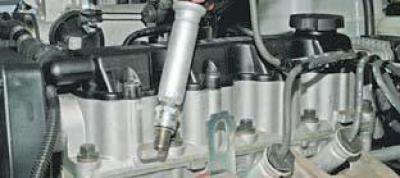
We position the spark plug so that there is contact between the side electrode of the spark plug and the engine ground.
To avoid electric shock when turning the crankshaft with the starter, do not touch the spark plug or the metal screen of the high-voltage wire tip with your hands.
The assistant, having turned the key in the ignition switch to the "START" position, turns the crankshaft.
With a working spark plug, high-voltage wire, ignition coil and its circuits..
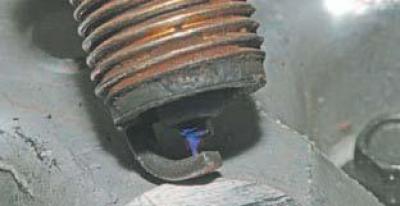
…a spark should regularly jump between the spark plug electrodes.
If this is not the case, it is necessary to check the power supply and control circuits of the coil.
To check the coil power supply circuit…
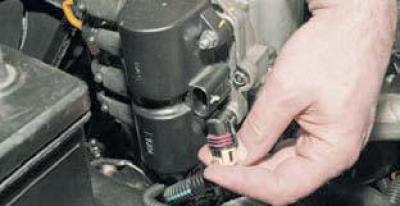
…we disconnect the engine management system wiring harness connector from it…
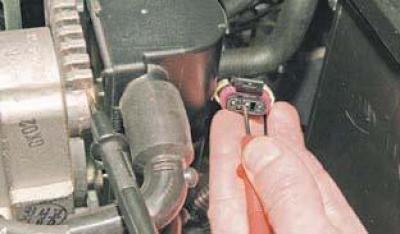
…and connect the tester probes between the engine ground and the "B" terminal of the wiring harness connector.
When the ignition is on, the device should record a voltage equal to the voltage at the battery terminals.
If the voltage value does not correspond to the norm, we check the integrity of the fuse "F15" of the mounting block located in the passenger compartment, as well as the serviceability of the circuit (open or short to ground) between terminal "B" and the ignition switch.
To check the ignition coil control circuit, we use a tester with a 1.2 W lamp.
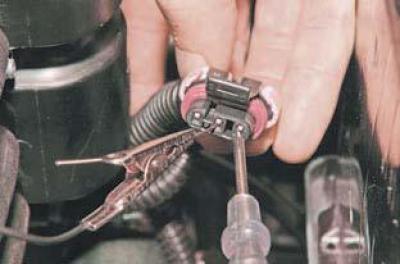
We connect the probes of the tester to terminals "B" and "A" (or to "B" and "C") of the ignition coil control wiring harness connector and take two measurements.
With the ignition coil control and power supply circuits in good condition, when the crankshaft is turned by the starter (in both cases) the test light should flash frequently.
Otherwise, we check the serviceability of the circuits between terminal "A" of the ignition coil and terminal "M1" of the ECU harness connector, as well as between terminal "C" of the ignition coil and terminal "M35" of the ECU harness connector.
If the power supply and control circuits of the ignition coil are in good condition, but when checking the working spark plug inserted into the tip of the high-voltage wire, there is no spark (see above), then the coil is faulty and must be replaced.
To check the ignition coil, disconnect the high-voltage wire tips from it.
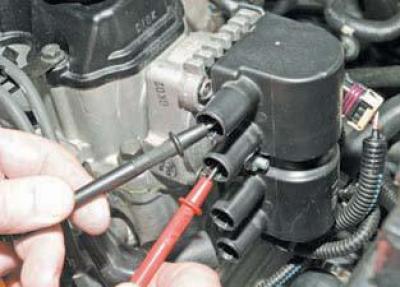
Using a tester, we measure the resistance of the secondary winding of the coil between the high-voltage terminals of the 1st and 4th cylinders.
Similarly, we measure the resistance of the secondary winding of the coil between the terminals of the 3rd and 4th cylinders.
A serviceable coil should have a secondary winding resistance of 5.0–6.0 kOhm.
(The source of the article is available on the website: ChevyMan)