


We carry out the check on the engine warmed up to operating temperature. We release the pressure in the engine fuel system (see "Replacing the fuel filter") and do not install the fuel pump fuse in place. Unscrew the spark plugs from the cylinder head (see "Checking the condition and replacing spark plugs").
Disconnect the engine management system wiring harness connector from the ignition coil (see "Removal the ignition coil").
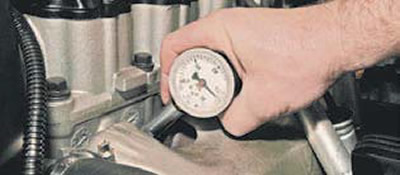
We install the compression tester tip into the spark plug hole of the cylinder head.
We connect the wire terminal to the negative terminal of the battery.
We turn the crankshaft with the starter while fully pressing the gas pedal for 2-4 seconds (the pressure gauge readings should stop increasing).
We record the pressure gauge reading and release the pressure in the compression tester.
For a correct compression rating, the battery must be fully charged - crankshaft speed during cranking must be at least 180 min⁻¹.
We check the compression in other engine cylinders in the same way. The compression of a serviceable engine should be within 11.0-13.0 bar, and the difference in readings across the cylinders should not exceed 1.0 bar. To determine the causes of low compression, pour 10-15 cm³ of engine oil into the cylinder through the spark plug hole and repeat the measurement. If, during the repeated measurement, the compression has increased by more than 2.0 bar, the most likely cause of the malfunction is severe wear, sticking or breakage of the piston rings. If the pressure gauge readings have not increased after pouring in the oil, then, most likely, the valve plates do not fit tightly to the cylinder head seats. This can happen if the thermal clearances in the valve drive are violated, as well as with severe wear, burnout or damage to the plates or valve seats. The cause of the malfunction can only be finally determined after disassembling the engine.
The article was reprinted from the website: CHEVYMAN.RU