


2. To set any piston to TDC, the crankshaft should be rotated in one of the following ways. The normal direction of rotation of the crankshaft is clockwise (if you stand facing the front of the car).
Caution! Before starting the procedure, move the transmission selector to the Neutral or Park position (on automatic transmission) or to a neutral position (with manual transmission). Also disconnect the low voltage wires from the ignition coil.
- a). Turn the front flywheel bolt with a socket wrench and extension.
- b) Turning the crankshaft using the remote ignition switch. Connect the wires of the switch to the terminals S and B (battery) on the starter solenoid relay. When the piston approaches TDC, turn the crankshaft further with a socket wrench.
- c) Turning the crankshaft with the starter (you'll need an assistant here). When the piston reaches TDC, tighten the crankshaft with a socket wrench.
4. Using the wire from the spark plug of the 1st cylinder, find the corresponding terminal on the distributor cap and mark it with a line on the body (right below the output).
5. Remove the distributor cap.
6. Turn the crankshaft clockwise until the mark on the front flywheel of the crankshaft aligns with the "O" mark on the fixed scale (see photo).
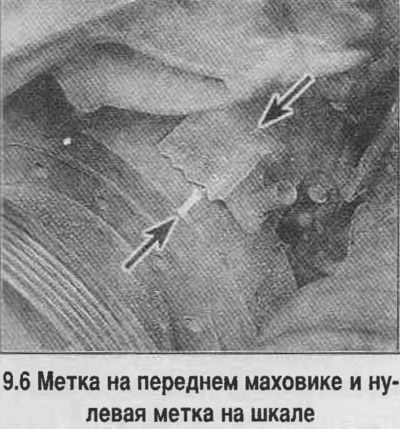
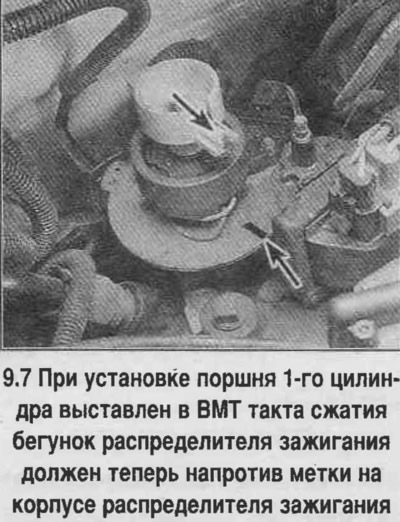
7. The distributor rotor should now be exactly opposite the mark on the distributor housing (see photo). If the distributor rotor is facing the opposite direction (180°), then turn the crankshaft 1 turn (360°) clockwise. The rotor should now be exactly opposite the mark on the distributor housing. When the rotor points to the tip of the high-voltage wire of the spark plug of the 1st cylinder (which is indicated by a mark on the distributor housing), and the timing marks match, the piston of the 1st cylinder is set at TDC of the compression stroke.
8. After the piston of the 1st cylinder has been set to TDC of the compression stroke, each of the pistons can be set to TDC in the order of cylinder firing by turning the crankshaft by 90°.
Original version of the article on the website: «chevyman.ru»