


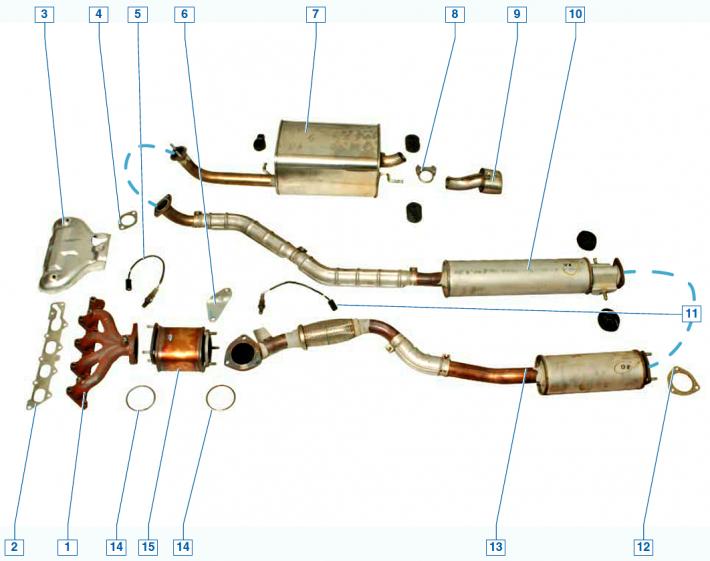
Exhaust system: 1 - exhaust manifold; 2 - manifold sealing gasket; 3 - heat shield; 4 - Main muffler pipe flange gasket; 5 - oxygen concentration control sensor; 6 - catalytic converter bracket; 7 - main muffler; 8 — clamp for fastening the main muffler nozzle; 9 — main muffler nozzle; 10 - second additional muffler; 11 - diagnostic oxygen concentration sensor; 12 — sealing gasket of flanges of the first and second additional mufflers; 13 - intermediate pipe with metal compensator and first additional muffler; 14 — sealing gasket of catalytic converter flanges; 15 - catalytic converter.
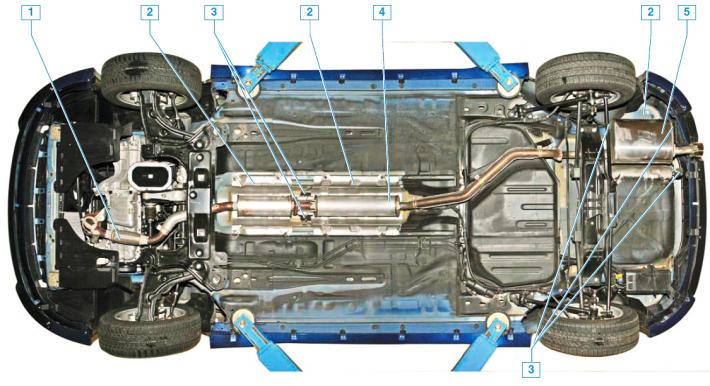
Location of the exhaust system on a hatchback vehicle: 1 - intermediate pipe with metal compensator and first additional muffler; 2 - heat shield; 3 — Exhaust system suspension cushion; 4 - second additional muffler; 5 - main muffler
The exhaust system consists of an exhaust manifold, a catalytic converter, two additional and main mufflers and connecting pipes.
The exhaust manifold is secured to the cylinder head studs with ten nuts.
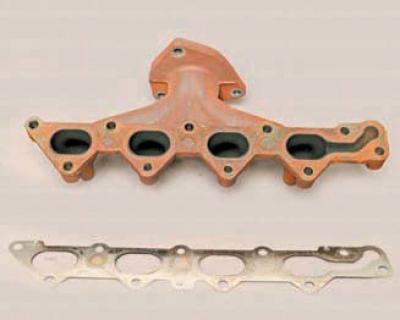
A metal sealing gasket is installed between the exhaust manifold and the cylinder head.
The catalytic converter is attached to the exhaust manifold flange with three studs and nuts.
The intermediate pipe flange is attached to the other flange of the catalytic converter with three studs and nuts.
Both connections are sealed with heat-resistant gaskets.
A control sensor for measuring the concentration of oxygen in the exhaust gases is installed in the exhaust manifold in front of the catalytic converter (lambda probe).
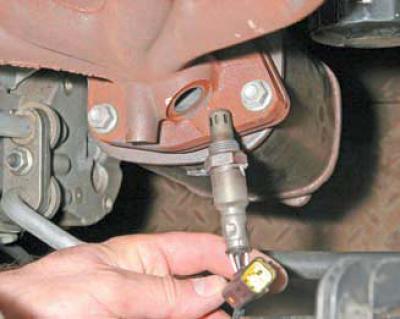
Location of the control oxygen concentration sensor in the exhaust manifold
After the catalytic converter, a second sensor is installed in the intermediate pipe, which performs diagnostic functions.
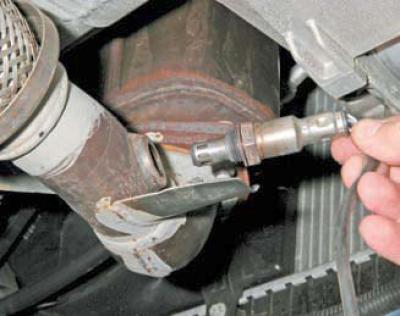
Installation location of the diagnostic oxygen concentration sensor in the intermediate pipe
The catalytic converter ensures compliance with Euro 4 toxicity standards by reducing emissions of carbon monoxide, nitrogen oxides and unburned hydrocarbons into the atmosphere.
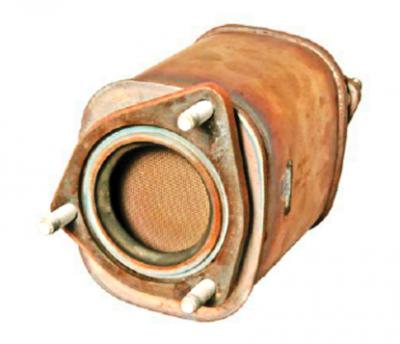
Catalytic converter
If lead compounds are present in the exhaust gases, the catalytic converter and oxygen concentration sensors quickly fail.
Therefore, operating a vehicle, even for a short period, on leaded gasoline is strictly prohibited.
The failure of the neutralizer can also be caused by a faulty ignition system or fuel system.
When misfires occur, unburned fuel gets into the neutralizer, burns out and disables the block with catalytic converters, which can lead to blockage of the exhaust system and engine shutdown (or severe loss of power) engine.
A metal compensator is built into the front part of the intermediate pipe, and the first additional muffler is built into the rear part.
The flange of the first additional muffler located on the intermediate pipe is connected to the flange of the second additional muffler.
To ensure tightness, a sealing gasket is installed between the flanges.
On the bottom of the body, above the additional and main mufflers, heat shields are installed to protect the anti-corrosion coating from overheating.
The additional muffler pipe has a flange connection with the main muffler pipe.
A sealing gasket is also installed at the connection of their flanges.
The exhaust systems of hatchback and sedan cars differ only in the rear pipes of the main mufflers.
The entire system is suspended from the body on five rubber cushions.
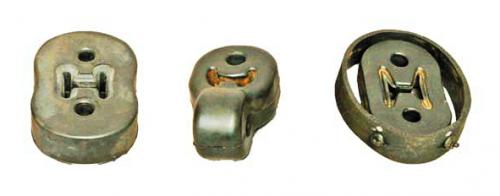
Exhaust system suspension cushions: rear main muffler suspension cushion; front main muffler suspension cushion; suspension cushion of intermediate pipe and additional mufflers;
The catalytic converter, intermediate pipe and mufflers are non-separable units; if they fail, they must be replaced with new ones.
Maintenance of the exhaust system consists of its periodic inspection, checking for leaks in connections and the presence of through corrosion, tightening loose connections and replacing rubber suspension cushions.
(Original version of the article on the website: «CHEVYMAN»)