


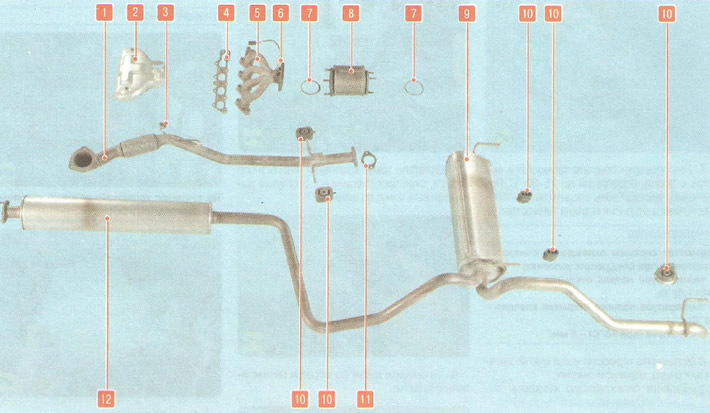
Fig. 5.17. Exhaust system components: 1 - intake pipe; 2 - exhaust manifold heat shield; 3 - diagnostic oxygen concentration sensor; 4 - exhaust manifold sealing gasket; 5 - exhaust manifold; 6 - oxygen concentration control sensor; 7 - gasket of flanges of catalytic converter of exhaust gases; 8 - catalytic converter; 9 - main muffler; 10 - cushions of exhaust system units; 11 - additional muffler flange gasket; 12 - additional muffler
The exhaust gases are discharged from the engine through the exhaust manifold 5 (Fig. 5.17), the catalytic converter 8 of the exhaust gases, the inlet pipe 1, the additional muffler 12 and the main muffler 9,
A control (main) oxygen concentration sensor 6 is installed on the exhaust manifold, and a diagnostic sensor 3 is installed on the inlet pipe.
A metal-reinforced sealing gasket 4 is installed between the cylinder head and the exhaust manifold flange.
The inlet pipe is connected with one end to the flange of the catalytic converter of exhaust gases, and with the other end to the flange of the additional muffler. All flange connections of the system are sealed with metal-reinforced gaskets, the additional and main mufflers are made as a single element.
To reduce the transmission of vibrations from the power unit to the exhaust system and body, a corrugated vibration-compensating bellows in a metal braid is mounted in the intake pipe.
The system elements are suspended from the body on five rubber cushions 10.
To protect the engine and the body base from heating by the system elements, a steel heat shield 2 is installed above the exhaust manifold; heat shields are also installed above other elements of the exhaust system.
The exhaust system does not require special maintenance. It is enough to periodically check the reliability of the tightening of the threaded connections and the integrity of the suspension cushions. In case of damage to the system elements, through corrosion or burnout, they are replaced as a whole, since the mufflers and neutralizer together with the pipes are non-separable units.
Helpful Hint: Check the exhaust system periodically. If the exhaust system is noisy, check for leaks. To do this, start the engine and inspect the entire system. By running your hand over the possible leaks without touching the components, you will immediately feel the gas leak. If necessary, replace rusted and burnt components.
Warnings: Allow the exhaust system to cool before repairing, as it heats up to a high temperature when the engine is running. Exhaust gases are toxic, poisoning by them occurs unnoticed, so before starting the engine in the garage, be sure to open the gate!
For details, visit the website: chevyman