


There are two designs of the inlet pipe and neutralizer with an additional muffler assembly to meet the Euro-2 and Euro-3 toxicity standards.
The Euro-2 compliant intake pipe has a built-in oxygen concentration control sensor 5 and is connected to the neutralizer flange using a movable hinge. A metal-graphite sealing ring 7 with a spherical surface is placed between the flanges.
The Euro-3 standard intake pipe has a control sensor 5 of oxygen concentration and a compensator of vibrations that occur during engine operation and during vehicle movement, and is connected to the flange of the neutralizer using three bolts with nuts. A gasket 18 is installed between the flanges of the intake pipe and the neutralizer. A diagnostic sensor 19 of oxygen concentration is installed in the pipe behind the neutralizer.
The inlet pipe 15 is secured with nuts to the studs of the exhaust manifold, and a sealing gasket 3 is installed between them. Locking plates 1 are placed under the nuts securing to the manifold. The other end of the inlet pipe is secured with clamp 14 to bracket 6, installed on the gearbox cover.
Neutralizer 13 and additional muffler 12 form a non-separable unit, which is attached to the main muffler with a clamp, and are suspended together with the main muffler 11 to the floor of the body using two cushions 10.
The mufflers together with the pipes form non-separable units and are replaced with new ones during repairs.
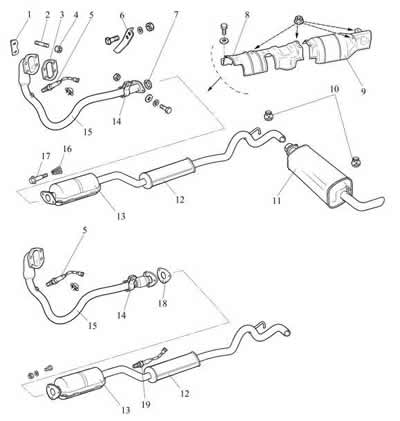
Figure 2-78. Exhaust system:
1 - plate;
2 - hairpin;
3 - gasket;
4 - nut;
5 - oxygen concentration control sensor;
6 - bracket;
7 - sealing ring;
8 - Front body floor protection screen;
9 - rear body floor protection screen;
10 - muffler suspension cushion;
11 - main muffler;
12 - additional muffler;
13 - Neutralizer;
14 - clamp;
15 - intake pipe;
16 - conical spring;
17 - bolt;
18 - gasket;
19 - diagnostic oxygen concentration sensor.