


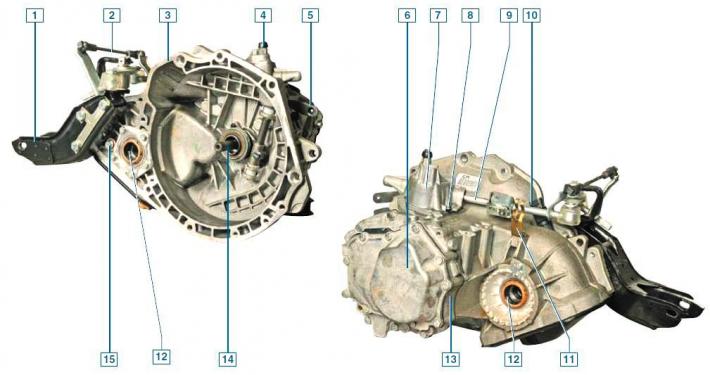
Transmission: 1 — powertrain rear support bracket; 2 — shift mechanism rod; 3 - gearbox housing; 4 — breather (filler plug); 5 — clutch release drive shaft lever; 6 - back cover; 7 — gear shift cover; 8 - plug of the hole for adjusting the control drive; 9 — gear shift shaft; 10 - speed sensor; 11 — heater radiator outlet hose holder; 12 — front wheel drive oil seal; 13 — intermediate crankcase; 14 — primary shaft; 15 — oil level inspection plug
The gearbox is mechanical, two-shaft, with five forward gears and one reverse gear, with synchronizers on all forward gears.
It is structurally integrated with the differential and final drive.
The gearbox housing consists of three parts cast from aluminum alloy: the crankcase combined with the clutch housing, the intermediate housing and the rear cover.
The primary shaft has a dismountable design, on it on splines is mounted a block of leading gears of 1-4 gears, as well as a leading gear of 5th gear.
All drive gears are in constant engagement with the corresponding driven gears of the forward gears.
Gears are cylindrical, helical, with the exception of straight-toothed reverse gears.
The secondary shaft is hollow (for supplying oil to the driven gear bearings).
It contains driven gears, forward gear synchronizers and the main transmission drive gear, which is made integral with the shaft.
Each driven gear has an additional straight-toothed crown, with which the sliding clutch of the synchronizer is connected when the gear is engaged.
The front shaft bearings are roller bearings, the rear ones are ball bearings.
Roller bearings withstand large radial loads, ball bearings withstand both radial and axial loads arising from the engagement of a pair of helical gears.
The shafts are held from axial movement by ball bearings installed in the intermediate crankcase.
The differential is a bevel gear with two satellites.
The preload in the bearings is adjusted by turning the bearing adjusting nut (from the left drive side).
The driven gear of the main transmission is bolted to the differential box flange.
The differential box contains two satellites and two axle gears.
The satellites are mounted on an axle secured in the differential box.
The axle gears are connected to the splined tails of the inner joint housings of the wheel drives, which are fixed in the gears with split spring rings.
The cylindrical surfaces of the tailpieces are fitted with seals pressed into the cover and nut.
To prevent water from entering and reduce dust from entering the gearbox cavity, its breather is installed in the upper part of the gearshift mechanism housing.
Oil can be poured into the gearbox by unscrewing the breather.
The gearbox control drive consists of a control mechanism, a control rod and a gear shift mechanism.
The gear shift lever is mounted on the floor tunnel in the plastic housing of the control mechanism and is connected to the control rod.
The other end of the control rod is connected by means of a terminal connection to the tip of the gear shift mechanism mounted on the gearbox.
At the factory, the gearbox is filled with transmission oil designed to last the entire service life of the vehicle.
The oil level in the gearbox should be at the level of the lower edge of the inspection hole.
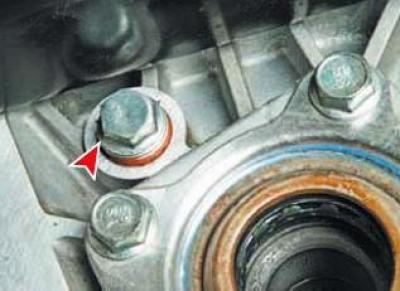
The oil level inspection plug is installed with sealant
There is no drain hole in the gearbox.
To drain the oil from the gearbox, you will need to remove the lower crankcase cover.
Oil leaks from the gearbox can be found in the places where the wheel drive seals and the primary shaft are installed.
For operations on replacing the primary shaft seal, see the work Removal the clutch release mechanism.
[The text of the article was obtained from the website chevyman.ru]