


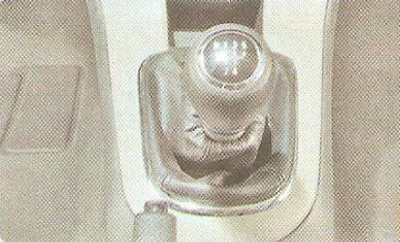
Manual transmission operate according to the shift pattern printed on the handle of its lever. In the neutral position, the lever is automatically set to the position for engaging III or IV gear, from which it can be moved forward or backward, respectively. To engage I or II gear, move the lever to the left as far as it will go and then forward or backward, respectively. To engage V gear, move the lever to the right as far as it will go and forward.
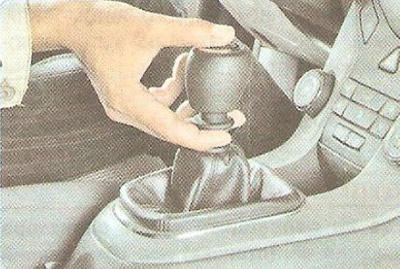
To engage reverse gear, pull up on the locking ring, move the lever to the left until it stops, and then forward.
Warning: Only engage reverse gear when the vehicle is completely stopped. To avoid transmission damage, avoid shifting when the wheels are spinning.
Automatic transmission has six forward gears and one reverse gear. Each gear is engaged automatically depending on the position of the gear selector lever, vehicle speed and accelerator pedal position.
During the break-in period of a new vehicle or immediately after connecting the battery (after it is disconnected or replaced) gear shifting may not be as smooth as usual. However, this does not indicate a malfunction: after a few automatic gear shifts, the shifting process will become smooth.
In addition to the automatic control mode, there is also a manual mode, in which the driver can independently control the automatic transmission in the same way as a manual transmission, by moving the selector lever forward or backward.
Unlike a manual transmission, an automatic transmission, when in manual control mode, allows the driver to change gears without releasing the accelerator pedal.
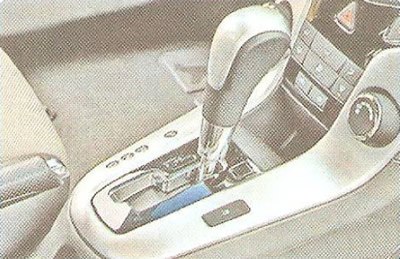
The selector lever is located on the floor tunnel. The control mode scale is applied to the floor tunnel trim.
The control mode scale is marked with the following symbols:
- P - Parking. In this position, the gearbox is locked to prevent the parked vehicle from moving. If the selector lever is in this position, the engine can be started;
- R reverse. Move the lever to this position only after the car has come to a complete stop;
Warning: Never move the selector lever to the "P" (park) or "R" (reverse) position while the vehicle is moving! This will damage the gearbox.
- N - neutral. In this position of the lever, none of the gears are engaged in the gearbox. This position is used during long stops, for example, in traffic jams;
Warning: Never move the selector lever to the "N" (neutral) position while driving! You may accidentally move the lever to the "P" or "R" position while the car is moving, which will damage the gearbox. In addition, engine braking will be impossible.
Helpful Hints: To avoid losing control of the vehicle, always keep your foot on the brake pedal when the lever is in the "N" position and when moving the lever into this position.
If the vehicle is on a slope, when starting the engine, the selector lever must be set to the "P" position, and not to the "N" position.
- D - forward movement. This is the main position of the selector lever, in which it is located most of the time while driving. In this case, the automatic transmission selects the gear that is optimal for the given speed and acceleration of the car.
Note: A special locking device will not allow the selector lever to be moved from the "P" position to any other position unless the brake pedal is held down.
You do not need to press the brake pedal to move the lever further to the "N" and "D" positions. To move the lever back from the "D" position to the "N" position, you do not need to press the brake pedal, but to move the lever further to the "I" position, you should press the pedal and move the lever to the right, and to move the lever to the "P" position, you do not need to press the pedal, but you should also move the lever to the right.
Warning: When starting off, do not press the accelerator pedal while moving the selector lever from the "P" or "N" position to any other position. This is dangerous, as the vehicle may suddenly move forward or backward.
Regardless of whether the vehicle is moving or stationary, to select manual gear shifting mode, press the gear lock button. In this case, the gear engaged by the driver will be locked from automatically shifting to the next gear until the driver decides to do so. When manual control mode is activated, the gear lock indicator lamp lights up in the instrument cluster and a number corresponding to the number of the engaged gear appears on the display.
Warning: In manual transmission mode, upshifting or downshifting does not occur automatically. The driver must independently determine the moment of gear engagement in accordance with road conditions. In this case, it is necessary to ensure that the engine speed does not exceed the maximum permissible value (the tachometer needle did not enter the red zone of the scale).
Notes
In manual transmission mode, only one of the three forward gears can be selected. To reverse or park, press the gearshift lock switch again to release the mode, and then move the selector lever to the "R" position (reverse) or "P" (parking), respectively.
In manual transmission control mode, when the vehicle speed decreases, downshifting occurs automatically. When the vehicle stops, first gear is automatically engaged.
To make it easier to start off on a slippery surface, press the gear lock switch and move the selector lever to the "O" position. This will immediately engage second gear in the transmission, which will ensure a smooth start on a slippery road. Then press the gear lock switch again to re-engage the automatic control mode.
Move the selector lever smoothly, without excessive force. Sharp and strong movements can damage the lever.
(For details, visit the website «ChevyMan»)