


The front axle area on the indicator diagram will light when you move the control lever to the 4WD position and the front axle is engaged.
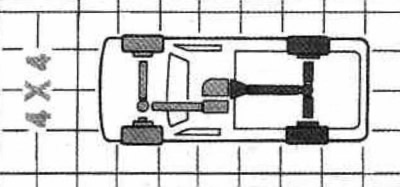
Some delay between lever movement and indicator illumination is normal. If the front axle indicator does not go out immediately after disengaging all-wheel drive, have the system checked by your dealer.
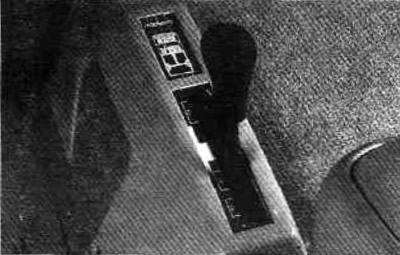
The indicator next to the lever shows that the transfer case is set to the following positions:
2-wheel drive on the rear wheels (2H): These are the positions for driving in most cases on streets and highways.
The front axle is not connected in this case.
4-wheel drive (4H): This position engages the front axle to assist in vehicle steering.
Use 4H when you need extra grip, on wet or icy roads or in most off-road situations.
Neutral (N): Move the lever to this position only when your vehicle needs to be towed or pulled.
4-wheel drive (4L): This position also engages the front axle and provides additional power and a higher gear ratio. This position is used for off-road driving only.
You can shift from 2H to 4H and from 4H to 2H while driving. The front axle will connect quickly if you take your foot off the gas pedal for a few seconds after shifting the lever.
In very cold weather, it is better to stop the car or reduce speed to move the control lever to 4H.
To turn 4L or N on or off you need to:
- 1. Reduce vehicle speed to 1-3 mph (2-5 km/h) and move the gearshift lever to N.
- 2. Move the transfer case control lever in one quick, continuous motion.
Do not hold the transmission in N after engaging the transfer case in 4L or the sixes may start to knock.
Remember that driving in 4H or 4L can reduce fuel economy. Also, driving in 4WD on dry pavement can cause faster tire wear and make the transfer case harder to engage and noisier to operate.
If the headlights or parking lights are on, turn the dimmer control next to the headlight switch to increase the illumination and decrease the transfer case indicator illumination to dim.
(The article is reprinted from the website «CHEVYMAN.ru»)