


Caution: Wait until the engine has cooled down completely before starting this operation.
1. The coolant temperature indicator system consists of a temperature indicator lamp installed on the instrument panel and a coolant temperature sensor on the engine. On both the 3.8L and 3.1L engines, the coolant temperature sensor is mounted on the left side of the cylinder head (see illustration). Some vehicles have multiple coolant temperature sensors, but the one used for the temperature gauge only has one wire.
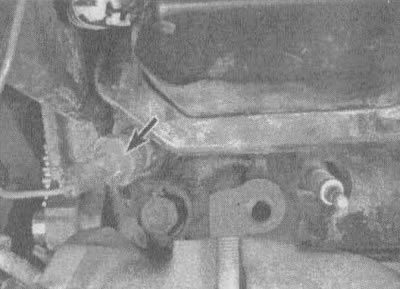
9.1 Coolant temperature sensor (indicated by the arrow) located on the left end of the rear cylinder head
2. If the light or indicator indicates engine overheating, check the coolant level in the cooling system and make sure that the wiring between the light or indicator and the temperature sensor is secure and that all fuses are making contact.
3. When the ignition key is turned and the starter operates, the overheating lamp should light up (if it is provided for by the design). When the engine starts, the light should go out.
4. If the lamp does not light, it may be burnt out, the ignition switch may be faulty, or there may be a break in the circuit. Check the circuit by touching the coolant temperature sensor wire to ground (for safety reasons, the engine must not be running). If the pointer deflects to the full scale or the lamp lights up, replace the coolant temperature sensor.
5. Once the engine starts, the lamp should go out and remain in this state until the engine overheats. If the light does not turn off, this may be due to a short circuit between the light and the coolant temperature gauge, a faulty temperature sensor, or a faulty ignition switch. Check that the coolant is of the correct type (see section 2). Plain water may have too low a boiling point to trigger the coolant overheat sensor and turn on the warning light.
6. If the coolant temperature sensor needs to be replaced, remove it from the engine and install a new one. For threads, use Teflon tape or a thin layer of sealant. Before removing the faulty sensor, make sure the engine is cool. Some coolant may be lost when the sensor is removed, so be prepared to top off the coolant level. After replacing the coolant temperature sensor, check the coolant level in the reservoir (see chapter 1, section 4).