
ChevyMan.ru
Mazda Mitsubishi Toyota Land Rover Honda Kia Nissan
English Русский
Български
Беларускі
Український
Српски
Hrvatski
Română
Polski
Slovenský
Magyar
|
Articles | Sitemap | Contacts |


Home   Aveo   Captiva   Cruze   Lacetti   Lanos   Niva   Tahoe   Others  
Cruze 1 (2008-2016)
  • Home
  • Cruze
  • J300 (2008-2016)
  • General information
  • Maintenance
  • Checking the level and adding fluid to the brake master cylinder reservoir

Checking the level and adding fluid to the brake master cylinder reservoir (Chevrolet Cruze J300)

            0

You will need: brake fluid D0T-4, a clean rag.

Helpful Hints: There is a fluid level sensor in the brake master cylinder reservoir, and a warning light in the instrument cluster warns the driver of an emergency drop in fluid level. However, we recommend periodically visually checking the level directly against the marks on the reservoir wall. When the level drops to the "MIN" mark, it is necessary to add fluid to the reservoir. If you have to add brake fluid to the reservoir quite often, find (see "Checking the tightness of the hydraulic brake drive") and fix the problem.


When replacing the brake fluid in the system, remember or write down the brand of fluid that will be added so that you can use the same brand when topping up.
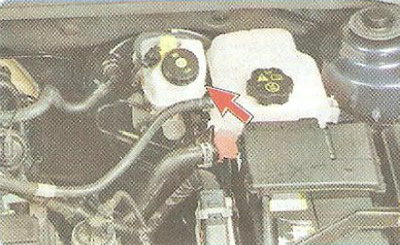

When replacing the brake fluid in the system, remember or write down the brand of fluid that will…


The reservoir is installed on the main brake cylinder on the left side of the engine compartment near the front shield.

Warning: Use caution when handling brake fluid, it is toxic.


Helpful tips: In order to avoid unexpected expenses in the future for repairing the brake system, or even the entire car, replace the brake fluid with fresh fluid in a timely manner. It is very hygroscopic and absorbs moisture from the air, which, in addition to causing corrosion of brake system parts, lowers the boiling point of the fluid itself, which can lead to brake failure during frequent, intensive braking. Do not reuse the fluid drained from the system: it is contaminated, saturated with air and moisture.


If brake fluid gets on wires, plastic or painted body parts, it can cause damage, so always put clean rags under it when pouring. If liquid gets on these parts, wipe them off immediately with a clean rag.
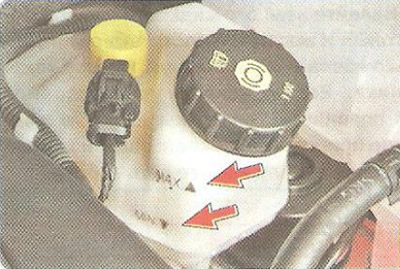

If brake fluid gets on wires, plastic or painted body parts, it can cause damage, so always put…


1. Check the brake fluid level in the reservoir. It should be between the "MIN" and "MAX" marks on the reservoir body.
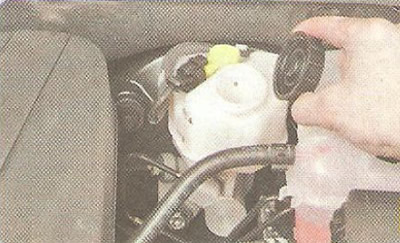
1. Check the brake fluid level in the reservoir. It should be between the «MIN» and «MAX» marks on…


2. If the fluid level is below the "MIN" mark, unscrew the tank cap and remove it.

Warning: A gradual decrease in the brake fluid level without any leaks most likely indicates that the brake pads need replacing. Check the condition of the brake pads (see "Checking the degree of wear of brake pads and discs"). Failure to replace brake pads in a timely manner leads to costly repairs (replacement of brake discs, calipers).


Pay special attention to the condition of the master and slave clutch cylinders. They can also be the cause of a decrease in the brake fluid level in the reservoir.

Pay special attention to the condition of the master and slave clutch cylinders. They can also be…


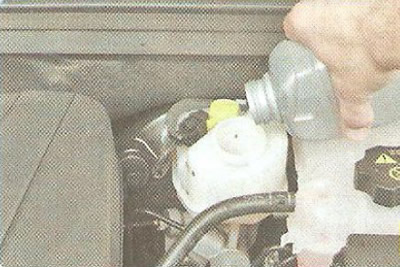
3. Add brake fluid up to the "MAX" mark.
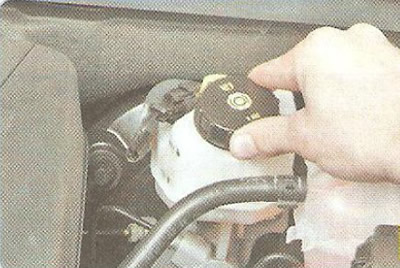
3. Add brake fluid up to the «MAX» mark.


4. Screw the cap back on the tank and wipe off any spilled liquid with a clean cloth.

The article was checked: Vladimir Romannikov
This article is available at russian, bulgarian, belarusian, ukrainian, serbian, croatian, romanian, polish, slovak, hungarian

Share information:

Previous articles
Cruze 1: Maintenance
Next articles

Checking the level and adding coolant
Checking the level and adding oil to the lubrication system
Checking the wheels
Safety Rulestechnics
Vehicle maintenance regulations
Checking the level and adding fluid to the power steering reservoir
Checking the level and adding fluid to the washer reservoir
Checking external lighting fixtures
Tightening torques for critical threaded connections
Lubricants, lamps and candles


See similar articles on the topic of Chevrolet cars:
Checking the level and adding brake fluid to the brake system and clutch reservoir Chevrolet Aveo T300 (2012-2018)
Checking the level and refilling the fluid Chevrolet Captiva 1 (2006-2018)
Checking the fluid level in the brake and clutch hydraulic reservoir Chevrolet Lacetti 1 (2002-2009)
Checking the fluid level in the windshield washer reservoir Chevrolet Lanos T150 (2002-2009)
Brake master cylinder Chevrolet Niva 1 (2002-2016)
Filling the master brake cylinder reservoir Chevrolet Tahoe 2 and 3 (2000-2014)
Checking the brake fluid level Chevrolet Orlando 1 (2010-2018)
Link in different formats to this page


Visitor comments

No comments yet


How much will 14 + 15 =


Cruze 1 (2008-2016) 
  • General information
  • User manual
  • Troubleshooting
  • Maintenance
  • Power unit
  • Engine repair
  • Lubrication system
  • Cooling system
  • Exhaust system
  • Supply system
  • Control system
  • Transmission
  • Clutch
  • Car gearbox
  • Front wheel drives
  • Chassis
  • Front suspension
  • Rear suspension
  • Steering
  • Brake system
  • Body
  • Exterior (external elements)
  • Interior (internal elements)
  • Doors, covers and windows
  • Heating and air conditioning
  • Security systems
  • Electrical equipment
  • Equipment and devices
  • Power devices
  • Lighting and signaling
  • Electrical circuits


ChevyMan.ru © 2017-2026 · Mobile version · Feedback · Site search · Interesting to read · Sitemap: EN BG BY UA RS HR RO PL SK HU

Aveo 2003-2008 · Aveo 2006-2011 · Aveo 2012-2018 · Captiva 2006-2018 · Cruze 2008-2016 · Lacetti 2002-2009 · Lanos 2002-2009 · Niva 2002-2016 · Tahoe 1992-2000 · Tahoe 2000-2014 · Lumina 1 1989-1994 · Trailblazer 1 2001-2008 · Orlando 1 2010-2018 ·
🛡️ For your security and to improve our service, this site uses cookies. You can disable them in your browser.