


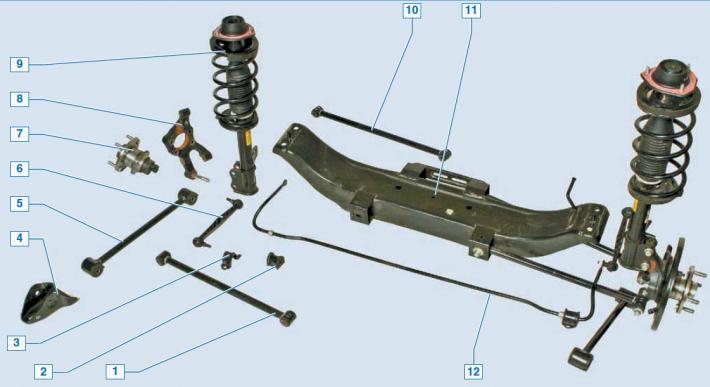
Rear suspension elements: 1 - front wishbone; 2 - rubber cushion of the anti-roll bar; 3 — anti-roll bar bracket; 4 — longitudinal arm bracket; 5 - longitudinal lever; 6 — stabilizer link lateral stability; 7 - hub assembly with bearing and wheel speed sensor; 8 - fist; 9 — shock absorber strut; 10 — rear wishbone; 11 — subframe; 12 — transverse stabilizer bar.
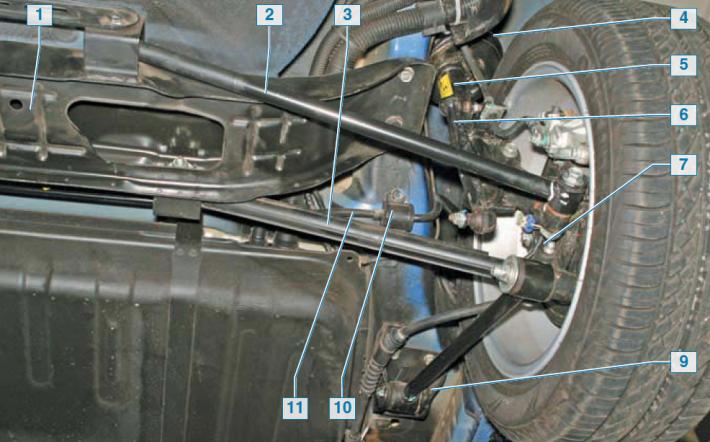
Elements of the rear suspension on the car: 1 — subframe; 2 - rear wishbone; 3 - front wishbone; 4 — shock absorber spring; 5 - telescopic stand; 6 — stabilizer link lateral stability; 7 - fist; 8 — longitudinal lever; 9 — bracket; 10 — bracket; 11 — transverse stabilizer bar
The rear suspension is independent, assembled on a subframe.
Each wheel is suspended on a longitudinal and two transverse levers, the shock absorber and spring are installed coaxially, forming a telescopic shock absorber strut that allows the rear wheel to move up and down when driving over uneven surfaces and at the same time dampen body vibrations.
The anti-roll bar reduces the roll of the vehicle.
The shock absorber strut consists of a telescopic strut in which a double-acting hydraulic gas-filled shock absorber, a cylindrical coil spring, a compression buffer and an upper rubber-metal support are installed. The spring rests on the spring cups through rubber pads. The shock absorber rod is connected to the upper support, which is attached to the rear wheel arch with three nuts. Due to its elasticity, the support allows the strut to swing during suspension movements and dampens vibrations when driving over small bumps.
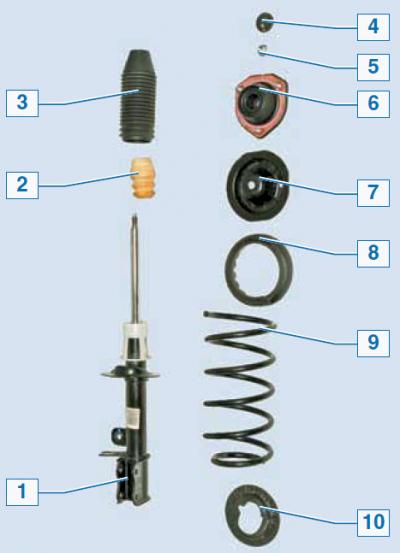
Shock absorber strut elements: 1 - telescopic stand; 2 — compression stroke buffer; 3 - protective cover; 4 - plug; 5 — rod mounting nut; 6 - upper support of the rack; 7 - upper spring cup; 8 - Upper spring gasket; 9 - spring; 10 - lower spring gasket
A bracket is welded to the lower part of the strut body for attachment to the forged rear suspension knuckle.
The cylindrical belt of the hub enters the socket of the knuckle, and its flange is bolted to the flange of the knuckle.
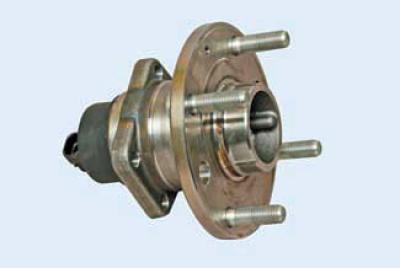
The hub is a non-separable unit with a bearing and a wheel speed sensor for the anti-lock braking system.
The braking forces during vehicle movement are perceived by the longitudinal levers, and the forces in the direction perpendicular to the longitudinal axis of the vehicle are perceived by the transverse suspension arms.
To ensure the mobility of the levers in the joints with the body and knuckles, silent blocks are pressed into the lever eyes. The front end of the longitudinal lever is attached to the bracket fixed to the body, and the rear end is attached to the knuckle eye. Each transverse lever is attached to the knuckle eye at one end, and to the subframe fixed to the body at the other.
The bolt for fastening the front wishbone to the subframe has an eccentric collar and an eccentric washer, and the hole in the subframe for the bolt is oval. When the bolt is turned, the position of the lever relative to the subframe changes, thereby adjusting the wheel alignment.
To increase lateral stability and reduce the roll angles of the car, a lateral stability stabilizer is installed. The stabilizer bar in its middle part is fastened with clamps through rubber split cushions to the body. The rods of the stabilizer struts are made of polymer material, and ball joints are made at the ends of the rods. The stabilizer struts connect the ends of the stabilizer bar with the bodies of the telescopic struts.
[Original version of the article on the website: chevyman]