


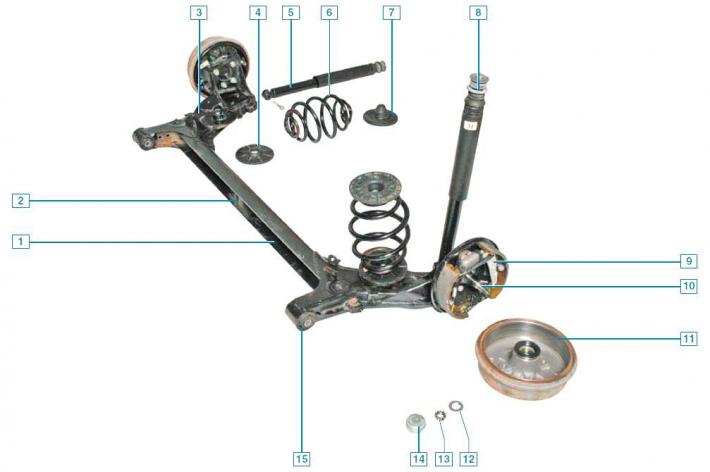
Rear suspension elements: 1 — beam; 2 - rubber cushion; 3 — beam lever; 4 - lower spring gasket; 5 — shock absorber; 6 - spring; 7 - Upper spring gasket; 8 — cushions and washers for the upper shock absorber mount to the body; 9 — rear wheel brake mechanism; 10 — rear wheel journal; 11 — brake drum assembly with rear wheel bearings; 12 - thrust washer; 13 - Crown nut; 14 - protective cap; 15 — silent block of the beam lever
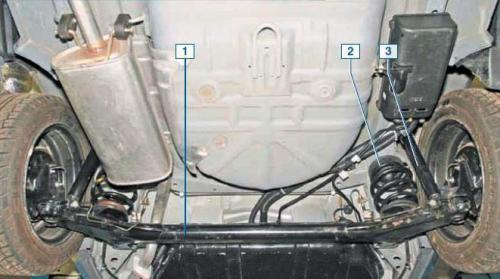
Rear suspension: 1 — rear suspension beam; 2 - spring; 3 - shock absorber
The rear suspension is semi-independent with an elastic beam and longitudinal arms, pivotally mounted on the body, with barrel springs and double-acting telescopic shock absorbers.
To increase lateral stability and reduce roll angles, a lateral stability stabilizer is installed inside the beam, the ends of which are secured to the suspension arms with bolts and nuts.
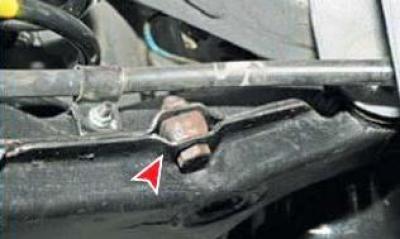
The anti-roll bar is attached to the suspension arm with a bolt and nut.
A rubber cushion is installed in the middle part of the stabilizer to eliminate rod vibration.
The main load-bearing element of the suspension is a beam consisting of longitudinal levers and a connector welded together.
At the rear, brackets for mounting shock absorbers and flanges for mounting rear wheel trunnions and brake shields are welded to the suspension arms.
Silent blocks are pressed into the lever lugs at the front.
The rubber mass of the silent block is vulcanized to the collars.
When pressing the silent block into the lever, it must be strictly oriented.
A bolt passes through the inner ring of the silent block, connecting the lever to the body bracket.
The elastic elements of the suspension are helical barrel springs.
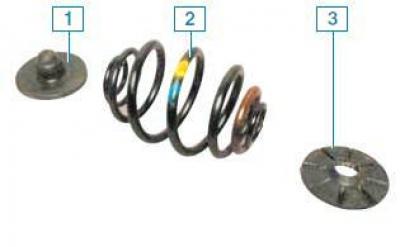
Rear suspension spring: 1 - Upper spring gasket; 2 - spring; 3 - lower spring gasket
A plastic cover is glued to the second turn from the bottom.
The upper end of the suspension spring rests through a rubber gasket on a platform welded to the body side member, and the lower end rests through a rubber gasket on a bracket welded to the beam arm.
The rubber gasket at the upper end of the spring also acts as a compression buffer.
A rubber-metal hinge is pressed into the lower eye of the shock absorber, through the central sleeve of which a bolt passes, securing the shock absorber to the suspension arm.
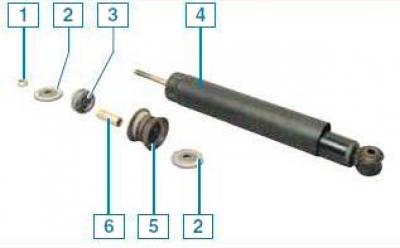
Rear shock absorber: 1 - rod mounting nut; 2 - washer; 3 - top cushion; 4 — shock absorber; 5 - lower cushion; 6 - spacer sleeve
The shock absorber rod is attached to the body via two rubber cushions (one at the bottom of the support, the other at the top) and two metal washers.
A spacer sleeve is installed between the cushions on the shock absorber rod.
The role of the rear wheel hub is performed by a brake drum in which two tapered roller bearings are installed.
The outer bearing rings are installed in the drum with a slight interference fit.
The inner rings of the bearings are mounted on the trunnion (axle) of the rear wheel — with a small gap.
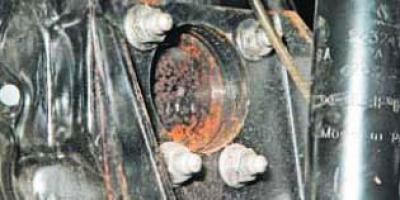
The rear wheel axle is secured with four nuts through the brake shield to the rear suspension beam flange
The rear wheel alignment angles are designed by the manufacturer and are not adjustable.
Rear wheel alignment angles for a vehicle with a half-full fuel tank and a 70 kgf load on the front seats:
- – camber: from –2°10' up to -1°10';
- – toe-in: –10'±40' (–1±4 mm).
If the measured angle values do not correspond to the established ones, it is necessary to check the condition of the suspension.
Information taken from the official website: CHEVYMAN.RU