


We check the condition of the brake pipes. The pipes must be securely fastened in the holders and must not have dents, mechanical damage, deep corrosion, or traces of brake fluid leakage.
There should be no cracks, breaks or abrasions on the brake hoses.
We check the condition of each hose by creating fluid pressure in the brake system. To do this, the assistant must press the brake pedal with force and hold it during the inspection. The appearance of rubber swelling or brake fluid leakage from the hose and its tips is not allowed. If damage is detected, replace the hoses as a set.
We check the condition and degree of wear of the brake pads and discs of the front and rear wheels.
To check, remove all the wheels one by one.
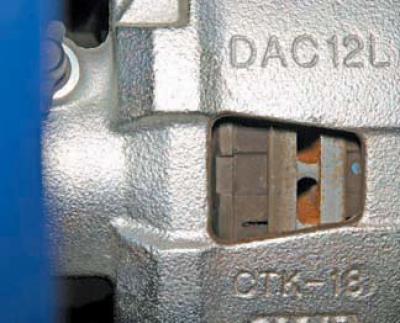
Through the window of the front wheel brake caliper we evaluate the thickness of the brake pads.
We replace the brake pads of the front wheels with a set if the thickness of any of the pads (friction lining with the base of the shoe) reached the maximum permissible value –– 7.0 mm (see Replacing the front brake pads).
Turning the brake disc, we inspect its working surfaces on both sides. There should be no cracks or deep grooves on the working surfaces of the disc.
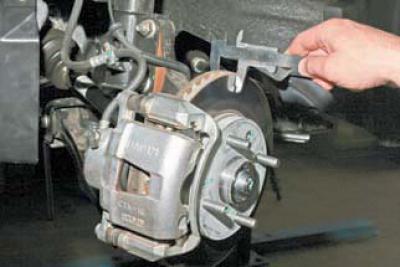
We measure the thickness of the disk with a caliper, which should be at least 22.0 mm. At the same time, in different parts of the disk it should not differ by more than 0.1 mm.
If, as a result of wear, a high flange has formed on the maximum diameter of the disc, which prevents an accurate measurement, we remove the flange using a file or other method, or measure the thickness of the disc with a micrometer.
We replace the brake disc with defects in the working surfaces or extreme wear.
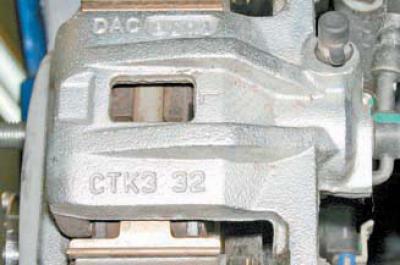
Through the window of the rear wheel brake caliper we evaluate the thickness of the brake pad linings.
We replace the brake pads of the rear wheels with a set if the thickness of the friction lining (excluding the base of the shoe) any of the pads has reached the maximum permissible value –– 2.0 mm (see Replacing the brake pads of the rear wheels).
By analogy with the brake discs of the front wheels, we measure the thickness of the rear discs with a caliper, which should be at least 8.0 mm. At the same time, in different parts of the discs it should not differ by more than 0.1 mm.
We replace the brake disc with defects in the working surfaces or extreme wear.
Check the functionality of the parking brake. The full stroke of the parking brake lever should be 7-8 teeth (clicks) of the sector ratchet device. If necessary, adjust the parking brake (see Adjusting the parking brake).