


On the chassis parts (wheels, suspension arms and springs, anti-roll bars, shock absorbers) and transmissions (front wheel drive shafts) there should be no deformations, cracks or other mechanical damage that affects the shape and strength of the parts.
Hanging the wheels one by one (the car must be securely fixed on the stand), we check the condition of the bearings of their hubs.
Use only factory-made stands.
The wheel should rotate smoothly by hand, without jamming or knocking.
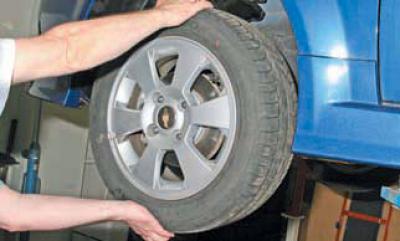
Taking hold of the wheel in a vertical plane, we alternately sharply pull the upper part of the wheel towards ourselves, and the lower part away from ourselves, and vice versa.
We make sure there is no play (knocking). If there is play, ask the assistant to press the brake pedal. If the play disappears, then the hub bearing is faulty, and if the knock remains, then most likely the suspension parts are worn out.
The front and rear wheel hub bearings are not adjustable and must be replaced if there is any play.
To check the serviceability of the ball joints, insert a powerful screwdriver between the suspension arm and the steering knuckle, while protecting the ball joint cover from damage.
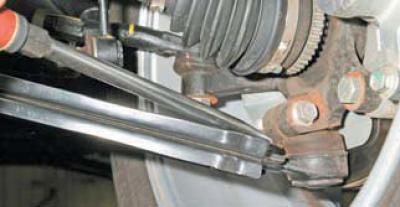
By pressing the lever with a powerful screwdriver, we monitor the movement of the ball joint housing relative to the steering knuckle.
If there is play in the ball joint, replace it.
We check the ball joint of the other wheel in the same way.
We check the condition of the ball joint protective covers.
We replace ball joints with torn or cracked covers.
To check the front silent blocks of the front suspension arms…
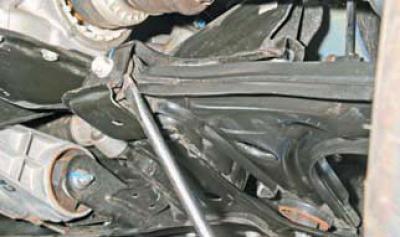
…insert a powerful screwdriver between the lever eye and the subframe… …and try to move the lever eye relative to the subframe in different directions. If the lever eye moves without significant effort, then the lever silent block is badly worn or damaged and must be replaced.
Tears, cracks and swelling of the rubber bushing of the silent block are unacceptable.
We check the condition of the rear silent blocks of the front suspension arms.
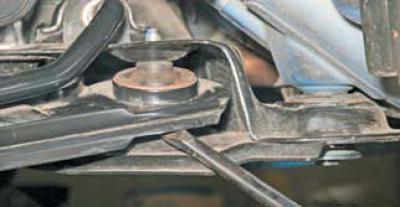
We insert a powerful screwdriver between the subframe and the lever eye… …and try to move the lever eye relative to the subframe in different directions. If the lever eye moves without significant effort, then the lever silent block is badly worn or damaged and must be replaced.
Tears, cracks and swelling of the silent block rubber are unacceptable.
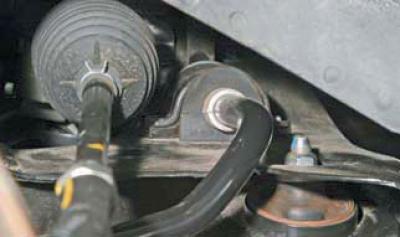
We inspect the front suspension anti-roll bar cushions.
If any tears, cracks or severe deformation are found on the rubber cushions, they must be replaced.
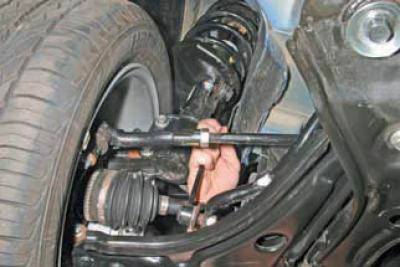
We check the ball joints of the stabilizer struts by moving the struts by hand in different directions.
If there is play in the ball joints, replace the stabilizer struts.
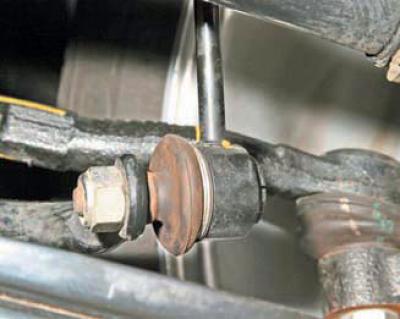
We check the condition of the protective covers of the ball joints of the stabilizer struts.
We replace racks with torn or cracked covers.
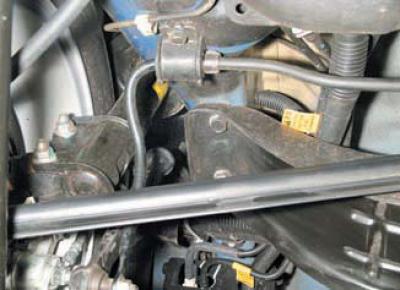
We inspect the rear suspension stabilizer bar cushions.
If any tears, cracks or severe deformation are found on the rubber cushions, they must be replaced.
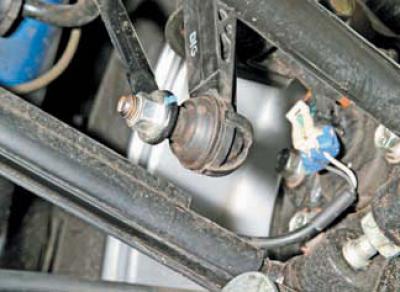
We check the ball joints and protective covers of the rear suspension stabilizer struts in the same way as the front suspension struts.
If there is play in the ball joints and defects in the covers, we replace the stabilizer struts.
To check the condition of the rear suspension arm silent blocks…
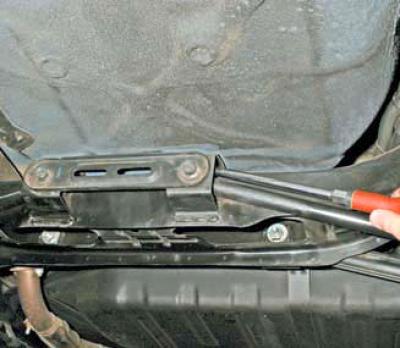
…we insert a powerful screwdriver alternately between the subframe and the lugs of the transverse levers and try to move them in different directions…
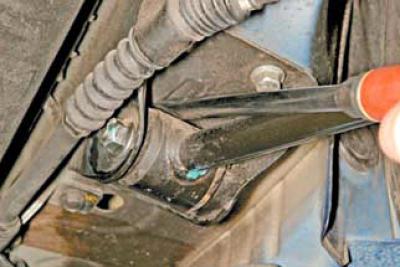
…then we insert a screwdriver alternately between the brackets that attach the longitudinal arms to the body and the eyes of the arms and try to move them in different directions.
If the lever lugs move freely, without effort, then the silent blocks are badly worn or damaged and the levers need to be replaced.
We check and, if necessary, tighten the fastening elements of the front and rear subframes to the body.
We check the condition of the springs, telescopic struts and shock absorbers of the front and rear suspensions.
We examine the telescopic racks one by one..
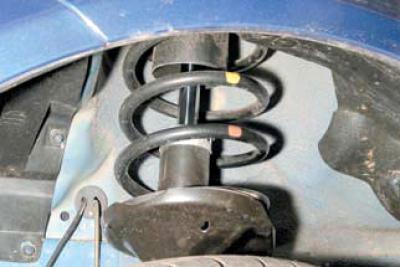
front…
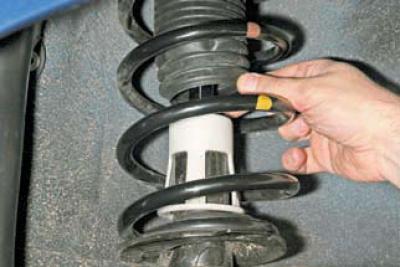
…and the rear wheels.
The suspension springs must not have any damage. Ruptures, cracks in the protective covers and severe deformation of the rubber bushings, cushions and compression buffers of the shock absorbers are unacceptable. Fluid leakage from the shock absorbers is not allowed. Minor "sweating" of the shock absorber in its upper part while maintaining its characteristics is not a malfunction.
If the rubber element of the upper support of the telescopic stand is subsided or damaged, the support must be replaced.
Rotate and turn the front wheels alternately (with the front of the car raised)…
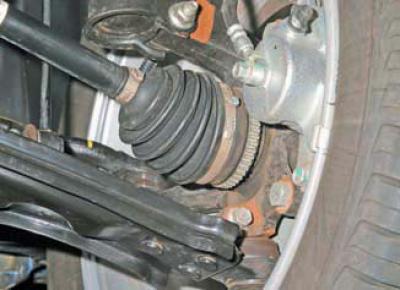
…we inspect the protective covers of the outer…
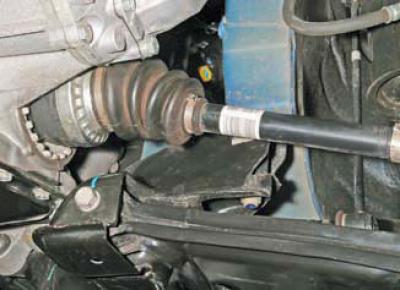
…and the internal joints of the front wheel drives, we check the reliability of their fastening with clamps.
Covers that are cracked, torn or have lost elasticity must be replaced.
We check for oil leaks from the gearbox through the seals of the internal drive joints. If there is a leak, we replace the seals.
When the car is moving, a faulty exhaust system can produce sounds and knocks, which are mistakenly attributed to defects in the operation of the wheel suspension. Therefore, it is advisable to inspect the exhaust system together with checking the chassis.
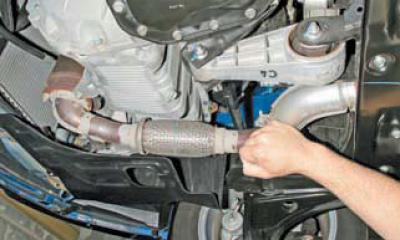
We check the metal compensator on the intermediate pipe, suspension cushions, knock with our hand on the exhaust system in different places, swing it and make sure that it does not make rattling sounds and does not knock on the body and parts of the rear suspension.
[The article is reprinted from the website «ChevyMan»]