


1. We prepare the vehicle for maintenance and repair and install it on an inspection pit or overpass.
2. Remove the engine crankcase protection.
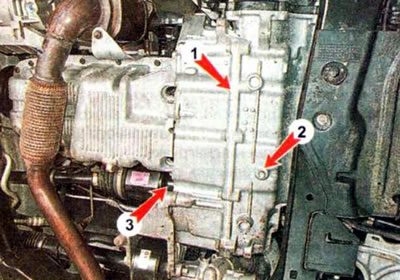
3. Inspect the gearbox from all sides, make sure there are no leaks of working fluid at the joints of the crankcase parts 1 and from under the drain plug 2, as well as through the right front wheel drive oil seal 3...
...and the left front wheel drive oil seal.
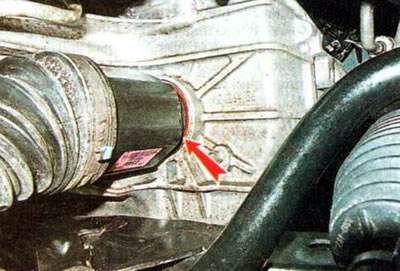
Note: In a properly functioning gearbox, the working fluid level should be constant. However, if leaks are detected on the gearbox housing, further inspection of the automatic transmission is required to identify and replace faulty seals. It should be taken into account that leaks from the bottom of the gearbox housing can be caused by wear of the rear crankshaft oil seal, but at the same time, as a rule, the outer surface of the engine oil pan is also covered with oily liquid.
4. Turn on the ignition and press the brake pedal, moving the selector lever in turn to all positions, to make sure that the gearbox control drive is working properly. Then return the selector lever to position P ("park").
Recommendation. Difficulties in switching gearbox operating modes may be caused by incorrect adjustment of the selector drive, large play in the drive, or a selector malfunction. If necessary, adjust the drive, replace the faulty drive cable.
5. Start the engine. We switch the selector in turn to all positions, making sure that the gearbox control system is working properly. We set the selector lever to position N ("neutral"). We release the brake pedal, but the car should not start moving.
6. Check the operation of the gearbox while driving. To do this, first moving with acceleration and then with deceleration with the D mode on, we make sure that the gear shifting is smooth (both upward and downward), in the absence of crunching, knocking and other extraneous sounds during gearbox operation, as well as spontaneous gear disengagement when the load changes.
7. Switch the automatic transmission mode selector to manual mode. We repeat the test, sequentially switching all gears in manual mode using the selector lever.
8. Repeat the check by moving the selector lever to position R.
Note: Jerks when shifting gears while the vehicle is moving, engaging gears with a shock, delays when shifting gears, increased noise during gearbox operation may indicate wear of bearings or clutch gears (in this case, as a rule, the working fluid has a burnt smell) and other gearbox faults. Elimination of such faults requires the removal and disassembly of the gearbox. Therefore, such work should be performed at a specialized service station.