


1. We prepare the car for maintenance and repair, install it on an inspection ditch or overpass.
2. From underneath the vehicle, inspect the gearbox from all sides, make sure there is no oil leakage through the differential cover seal 1, from under the drain plug, or through the seals of the left 2 and right 3 wheel drives.
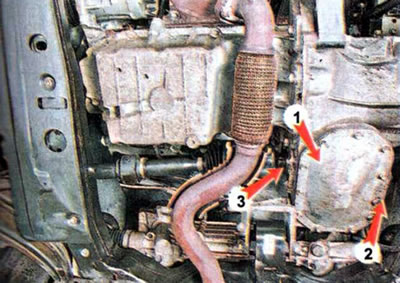
3. If an oil leak is detected, check the transmission oil level in the gearbox housing and, if necessary, bring the oil level up to normal.
Note: Oil leaks most often occur due to wear of the wheel drive seals. The malfunction must be corrected.
4. Before checking the technical condition of the gearbox, make sure that the clutch release drive is in good working order and correctly adjusted.
5. Press the clutch pedal, engage all gears in turn, and check that they engage and disengage clearly. If necessary, we check the parts of the gear shift mechanism drive and replace faulty parts. If the drive is in good condition, then the gearbox itself probably needs to be repaired.
6. Set the gear shift lever to neutral and start the engine by pressing the clutch pedal several times, listen to the sound of the gearbox. A loud noise (hum) that appears when the clutch pedal is released and disappears when it is pressed may indicate wear of the bearings.
7. Check the operation of the gearbox while driving. To do this, first moving with acceleration and then with deceleration, we shift gears up and then down. We check the clarity of gear engagement and disengagement while driving and the operation of the synchronizers. We make sure that there are no crunches, knocks or other extraneous sounds when the gearbox is operating, as well as spontaneous gear disengagement when the load changes. Knocking noises when engaging and changing gears can be caused by worn synchronizer locking rings.