


The pads also need to be replaced when replacing the brake disc, when the linings are oiled or have deep grooves, cracks and chips on them, and also if the linings separate from the base of the pads.
The front brake pads must be replaced only as a set - all four pads.
Replacing the pads of only one brake mechanism may cause the vehicle to pull to the side when braking.
If the fluid level in the brake hydraulic drive reservoir is at the MAX mark, then before installing new pads, use a syringe or rubber bulb to pump out some of the fluid from the reservoir so that when the piston is pressed into the working cylinder of the brake mechanism, the fluid does not flow out from under the reservoir cap.
We remove the front wheel.
By inserting a mounting blade or a screwdriver with a wide blade through the hole in the caliper between the base of the outer pad and the caliper and resting it on the caliper…
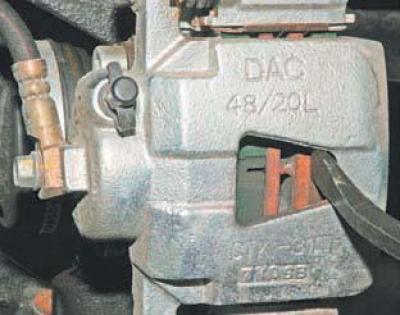
…we move the caliper, pressing the piston into the cylinder.
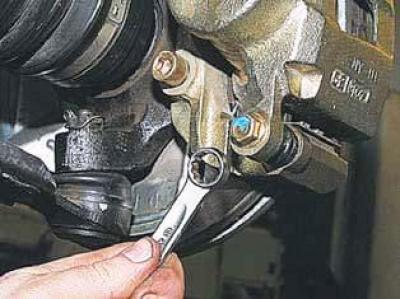
Using a 14 mm open-end wrench, unscrew the lower bolt securing the guide pin to the caliper.
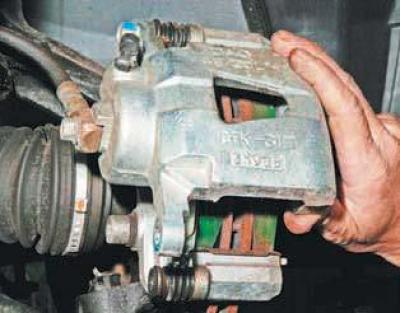
We lift the caliper by turning it around the axis of the upper guide pin.
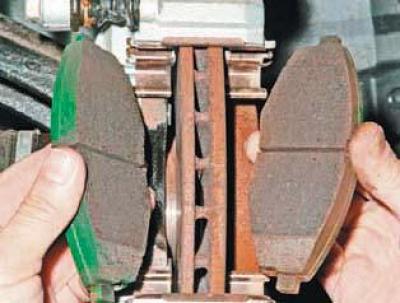
We remove the brake pads from their guide.
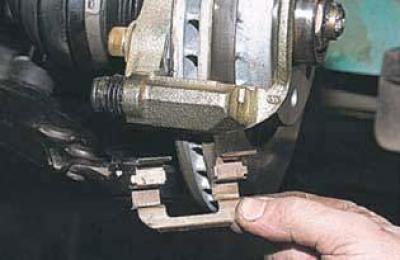
We remove two spring clamps of the brake pads.
Using a metal brush, we clean dirt and corrosion from the seating areas of the pads in their guide.
Before installing new pads, check the condition of the protective covers of the guide pins.
We replace a torn or lost elastic cover.
For this…
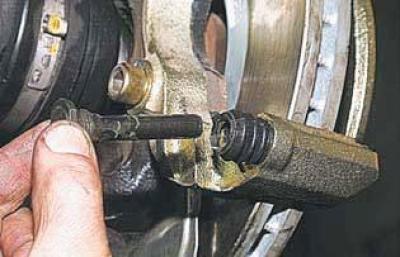
…we remove the guide pin from the hole in the shoe guide…
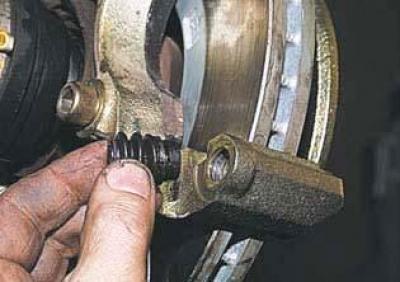
…and a cover.
Before installing the pin, put a little plastic grease into the hole in the shoe guide and apply a thin layer of grease to the surface of the pin.
Before installing new brake pads, it is necessary to move the piston as far into the cylinder as possible.
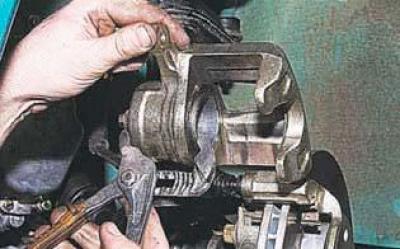
To do this, use sliding pliers to push the piston into the cylinder.
We install new brake pads into the pad guide and lower the caliper.
We replace the pads on the other side of the car in the same way.
After replacing the pads, press the brake pedal several times to set the gaps between the pads and the discs.
We check the fluid level in the tank and, if necessary, bring it up to normal.
During operation, the surface of the brake disc becomes uneven, as a result of which the contact area of the new, not yet worn-in pads with the disc decreases.
Therefore, during the first 100 km of driving after replacing the pads, until the new pads have been worked in, be careful, as the braking distance of the car may increase.