


Checking functionality
If there are any doubts about the efficiency of the starter, it is necessary to check it on the stand.
The electrical circuit diagram for testing the starter on the stand is shown in Figure 7-17. The connecting wires to the current source, ammeter and contact bolt of the starter traction relay must have a cross-section of at least 16 mm.
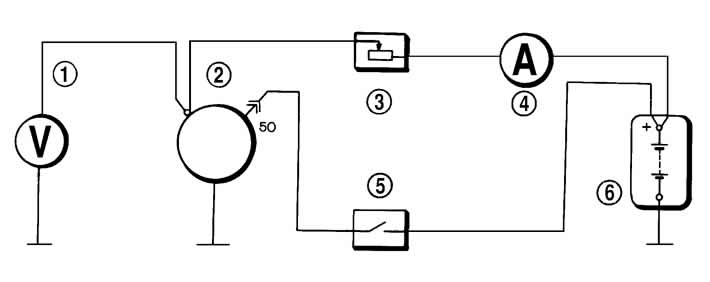
Figure 7-17. Wiring diagram for testing the starter on the bench:
1 - voltmeter with a scale limit of at least 15 V;
2 - starter;
3 - rheostat 800 A;
4 - ammeter with 1000 A shunt;
5 - switch;
6 - battery.
The starter temperature during testing should be (25±5)°C, and the brushes should be well ground to the commutator.
By closing switch 5, with the current source voltage at 12 V, turn on the starter three times with different braking conditions. For example, with braking torques of 3, 6 and 12 Nm (0.3; 0.6 and 1.2 kgf·m). The duration of each starter activation should be no more than 5 s, and the intervals between activations should be no less than 5 s.
If the starter does not rotate the stand's ring gear or its operation is accompanied by abnormal noise, then disassemble the starter and check its parts.
Full braking test
Brake the stand's toothed ring gear, turn on the starter and measure the current, voltage and braking torque, which should be no more than 700 A, no more than 5 V and no less than 13.72 Nm (1.4 kgf·m), respectively. The starter engagement time should be no more than 5 s.
If the braking torque is lower and the current is higher than the specified values, then the reason for this may be an interturn short circuit in the armature winding or a short circuit of the winding to ground.
If the braking torque and current consumption are lower than the specified values, the cause may be oxidation and contamination of the commutator, severe wear of the brushes, brushes sticking in the brush holders, loosening of the brush terminals, oxidation or burning of the contact bolts of the traction relay.
When fully braking, the starter drive shaft should not turn; if this happens, the freewheel clutch is faulty.
To troubleshoot, disassemble the starter and replace or repair damaged parts.
No-load test
Disengage the stand's toothed ring gear from the starter pinion. Turn on the starter and measure its current consumption and the starter drive shaft speed, which should be no more than 80 A and 3000 min⁻¹, respectively, with a voltage of 11.5-12 V at the starter terminals.
If the current strength and the rotation speed of the drive shaft differ from the specified values, the reasons may be the same as in the previous test.
Checking the traction relay
Install between the limiting ring 13 (see figure 7-15) and a 11.5 mm thick gasket with the gear and turn on the relay. The relay turn-on voltage when the gear rests on the gasket should not exceed 8 V at an ambient temperature of (20±5)°C. If the voltage is higher, this indicates a faulty relay or drive.
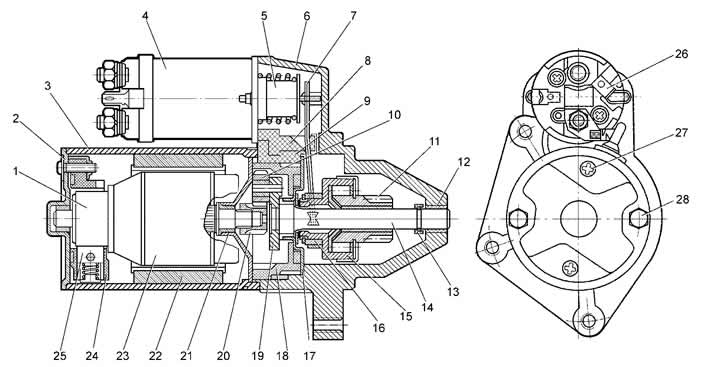
Figure 7-15. Starter 57.3708:
1 - collector;
2 - back cover;
3 - stator housing;
4 - traction relay;
5 - relay anchor;
6 - drive side cover;
7 - lever;
8 - lever bracket;
9 - sealing gasket;
10 - planetary gear;
11 - drive gear;
12 - lid insert;
13 - limiting ring;
14 - drive shaft;
15 - overrunning clutch;
16 - ring of the branch;
17 - drive shaft support with insert;
18 - internal gear;
19 - driver;
20 - central gear;
21 - armature shaft support;
22 - permanent magnet;
23 - anchor;
24 - brush holder;
25 - brush;
26 - output "50" of the traction relay;
27 - brush holder mounting screws;
28 - tie rod with nut.
(The text of the article was obtained from the website: ChevyMan.ru)