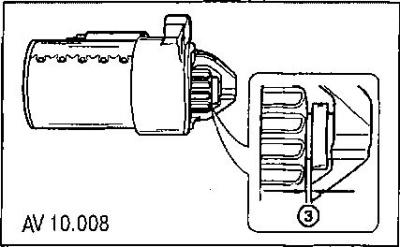
Contents: Tightening the fasteners during… ↧ Checking the starter's functionality ↧ Evaluation of the inspection results ↧
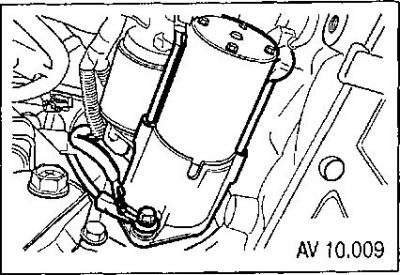
The starter is attached to the gearbox housing with two screws.
Tightening the fasteners during installation
Starter mounting screws - torque 43 Nm.
Nuts for fastening wires to the starter relay - torque 15 Nm.
Checking the starter's functionality
Checking the pull-in relay
To check the pull-in relay, disconnect the output from the starter winding from the relay contact. When applying voltage to the disconnected relay, the consumed current should be within 12-20 A.
Note: To prevent overheating and damage to the pull-in relay, perform the test for as short a time as possible.
Checking the starter motor
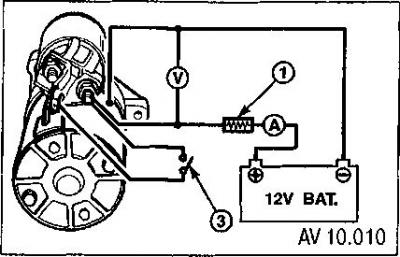
When 10 volts are supplied to the starter without mechanical load, the current consumption should be between 59 and 79 A, while the rotation speed should not be lower than 2600 rpm.
Evaluation of the inspection results
Low speed combined with high current is a sign of:
- increased friction due to tight, dirty or worn bearings;
- bent shaft anchor; shorted anchor;
- shorted inductance windings. No rotation at high current consumption are signs of:
- direct short circuit in terminals, windings or "seized" bearings.
No rotation at zero current are signs of:
- power supply circuit break,
- breakage of the anchor coils,
- breakage of brush springs,
- wear of brushes,
- high resistance between the collector plates, or
- other reasons why the contact between the brushes and the commutator is broken.
Low RPM combined with low current is a sign of:
- high internal resistance.