


Caring for the body consists of following a few simple rules.
Never remove dust and dirt with a dry cloth, otherwise scratches may appear on the paintwork of the car body. It is better to wash the car before the dirt dries with a low-pressure stream of water using a soft sponge. In summer, wash your car outdoors in the shade. If this is not possible, then immediately wipe the washed surfaces dry, since as water droplets dry in the sun, stains appear on the surface of the car body. In winter, after washing your car in a warm room, wipe the body and door seals dry, otherwise when the remaining drops freeze, the seals will freeze to the body and cracks will form on the paintwork.
Chips and scratches on the paintwork...
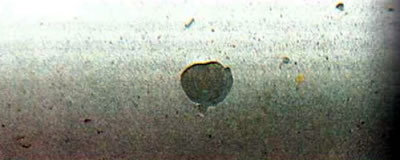
...chips on the bottom are usually associated with mechanical impact of foreign objects during normal operation of the car.
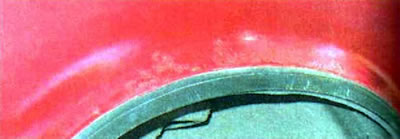
Traces of corrosion on welded joints and body part junctions are usually superficial in nature and can be removed with polishing pastes at the initial stage. However, if measures are not taken in a timely manner to eliminate defects in the protective decorative coating, this will lead to the development of corrosion underneath it, peeling and swelling of the coating.
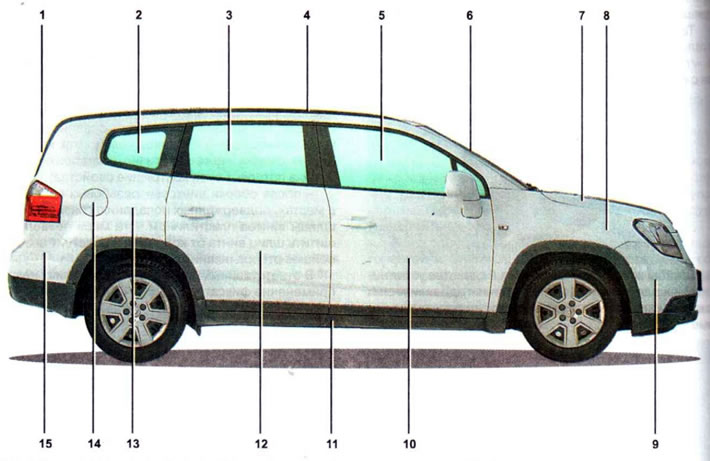
The main elements of the car body: 1 - luggage compartment door; 2 - fixed side glass of the body; 3 - rear door glass; 4 - roof; 5 - front door glass; 6 - windshield; 7 — hood; 8 - front wing; 9 - decorative trim for front bumper; 10 - front door; 11 — threshold; 12 - back door; 13 - rear wing; 14 — fuel tank filler cap; 15 - decorative trim for rear bumper
During vehicle operation, the underbody coating is exposed to gravel, sand and salt. As a result of this impact, the bottom coating wears off and the exposed metal begins to rust. Therefore, regularly monitor the condition of the underbody coating and promptly restore damaged areas.
To maintain the shine of painted surfaces of the car (especially for vehicles stored outdoors) polish them regularly using polishing pastes with coloring pigment. Such pastes hide microcracks and pores that have appeared during operation in the paint coating and prevent the occurrence of corrosion under the paint layer.
To ensure that the car body surface retains its shine for a long time, try not to leave the car in the sun for a long time, and also do not allow acids, aggressive solvents, brake fluid and gasoline to come into contact with the car body surface.
Wipe the area under the fuel filler flap with a clean cloth before and after refueling to prevent gasoline from staining the paintwork.
The car interior also needs regular cleaning. If the body is the "face" of the car, then the interior is part of your home, by which, as we know, people judge the owner.
The dirtiest elements of the interior are the mats, gels and rubber mats in your car, so they need to be washed periodically, it is better to combine this with washing the car body. Then they can be washed with shampoo. Just be sure to dry them before placing them on the floor of the car. If you use pile or textile rugs, they must be vacuumed, and in case of heavy contamination, cleaned with special preparations for cleaning upholstery, as well as the floor covering, ceiling upholstery and seats. Before using the cleaner, it is recommended to vacuum the pile and fabric surfaces of the interior. All these operations are described in detail in the section "Car care".
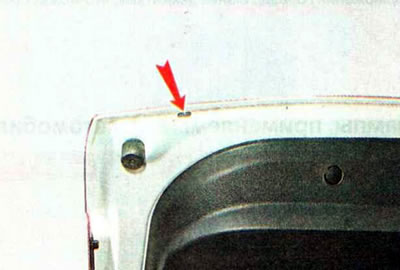
In the car body, in the cavities of the thresholds and doors, special drainage holes are made for water drainage. Over time, drainage holes can become clogged with dirt, preventing water from draining and potentially leading to severe corrosion.
Therefore, it is necessary to periodically (for example, twice a year - in autumn and spring) clean the drainage holes.
Warning! Perform the operation carefully to avoid damaging the paintwork of the car body.
Using a thin slotted screwdriver, a small diameter hard wire (1.2-2 mm) or another similar device, clean the lower drainage holes of the front and rear doors.
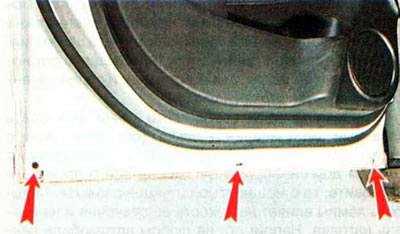
We clean the holes in the luggage compartment door in the same way.
[Original version of the article on the website «chevyman»]