


There are several types of faults that differ in their external signs:
- failure of vehicle equipment and units;
- deterioration of vehicle performance parameters;
- the appearance of extraneous sounds: noise, knocking, creaking;
- occurrence of vibration;
- leakage and increased consumption of technical fluids;
- the appearance of a foreign smell or smoke.
Equipment failure can be detected by the indicator lamp of the corresponding unit or system lighting up on the instrument panel...
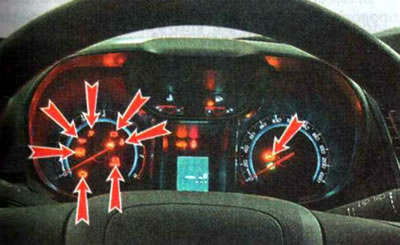
...or when this equipment does not turn on or does not work properly.
The deterioration of operating parameters can be assessed without special equipment, relying only on your own feelings and the readings of the vehicle's control instruments.
By ear, based on the nature or location of the extraneous sound and depending on where it comes from, you can determine the faulty part or unit. For example, based on the frequency with which a creaking sound occurs, one can judge which unit of the assembly it comes from. If the frequency is quite high and the sound is produced by friction against a part rotating at high speed. If the frequency changes depending on the speed of the car, it could be a wheel, a wheel drive, a brake disc. There may be different reasons for the creaking sound, from a simple wire caught on a suspension part and rubbing against the wheel disk, to worn brake pads. In the case of brake pads, the squeak will change depending on the intensity of braking or will occur only during braking and disappear completely when the brake pedal is released. The cause of creaking or knocking sounds that occur periodically when driving over uneven surfaces should be sought in the parts of the front or rear suspension. The tone of the sound can be used to judge whether the noise is caused by metal rubbing against metal or by a rubber part.
To identify the source of the noise in the chassis, very often you have to resort to outside help. After all, when driving a car, it is sometimes difficult to determine even the direction from which a sound is coming; when you are outside, it is easier to do this.
If the source of the extraneous noise is an element rotating at a high speed (hub bearing, coolant pump, generator or electric fan, drive belt roller, etc.etc.), it produces a continuous noise, more like a whistle, which increases with increasing rotation speed or with increasing load. It is not easy to identify such an element on the engine; the general increased noise of the running engine makes it difficult to identify the source of the extraneous sound. In this case, a technical stethoscope is used.
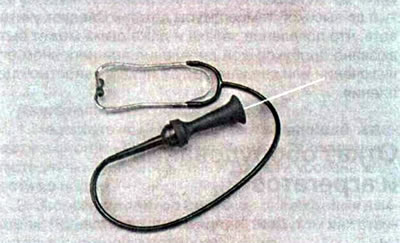
How to use it is shown when checking the technical condition of the engine.
The defective part can be identified by traces of leaks of technical fluid. And not only by drops on units and parts, but also by traces of spilled liquid in the place where the car was parked. Depending on which unit the drops of liquid were found under, you can understand which unit or which vehicle system requires a more thorough inspection. Similar conclusions can also be drawn based on the type of liquid spilled. Increased consumption of any technical fluid, even if a careful inspection does not reveal the location of its leak, also indicates the presence of a malfunction.
The most dangerous is a fuel leak, since even the smallest leak of gasoline can lead to a fire. The presence of even an imperceptible gasoline leak can be easily determined by smell.
Of course, various odors that are in no way related to a vehicle malfunction can penetrate into the car's interior. Therefore, it is necessary to pay attention to those that arise after switching on or during operation of any equipment. The smell can also be used to determine short circuits in wiring or burnt-out electrical equipment. The listed faults may be accompanied by the appearance of smoke. In this case, before troubleshooting, you must remove the terminal from the negative terminal of the battery to de-energize the electrical equipment.
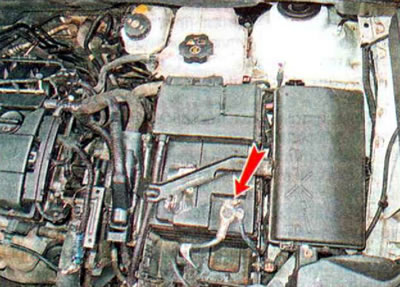
The appearance of smoke can also be caused by the ingress of flammable materials (oils, rags) on parts heated to high temperatures. It should be taken into account that the appearance of a smell and even smoke can be caused by clutch slippage when it is not fully engaged or is associated with another clutch malfunction.
(The original article is on the website: ChevyMan)