


1. Open the expansion tank cap.
2. Fill the hydrometer with enough cooling liquid to make the float float. We determine its density using the float scale.
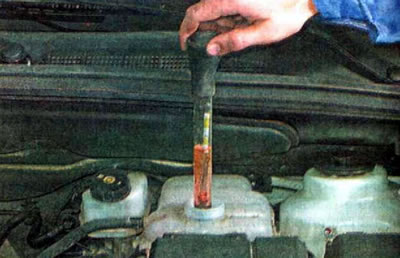
Note: The hydrometer is a float with a scale. Depending on the density of the liquid, the float is immersed to different depths and by the scale value near which the liquid level is located, you can determine its density in kg/m³. Knowing the density, you can determine the concentration of antifreeze according to the table. Sometimes, to simplify measurements, the minimum permissible temperature in°C is indicated on the scale instead of the density values. It is convenient to use a universal hydrometer, which has two scales for checking the density of the coolant and battery electrolyte, but it must be thoroughly washed after measurements so that the electrolyte does not get into the coolant and vice versa.
Density and concentration of antifreeze
| Antifreeze density, kg/m³ at 20°C | Concentration of ethylene glycol in antifreeze, % of volume | Minimum ambient temperature at which the engine can be operated°C |
| 1 050 | 30 | -10 |
| 1 058 | 35 | -15 |
| 1 067 | 40 | -20 |
| 1 074 | 45 | -25 |
| 1 082 | 50 | -30 |
| 1 090 | 55 | -35 |
| 1 098 | 60 | -45 |
Antifreeze is often sold as a concentrated liquid that must be diluted with distilled water before use. The required concentration of antifreeze in accordance with the temperature range at which the vehicle is operated can be determined from the table.
It is necessary to dilute the antifreeze before pouring it into the cooling system, since this is the only way to ensure precise compliance with the specified ratios of antifreeze and distilled water. Before checking the density, the prepared antifreeze must be mixed well.
3. Using the table, we determine the concentration of the antifreeze and the minimum temperature at which it can be used based on its density.
Note: Do not try to increase the ethylene glycol concentration excessively. When it increases above 70%, the freezing temperature of the antifreeze begins to decrease again and at 100% ethylene glycol it will be only 12.9°C.