


To do this, install the thermostat on a stand, lowering it into a tank with water or coolant. From below into the main valve 2 (figure 2-66) support the indicator leg bracket.
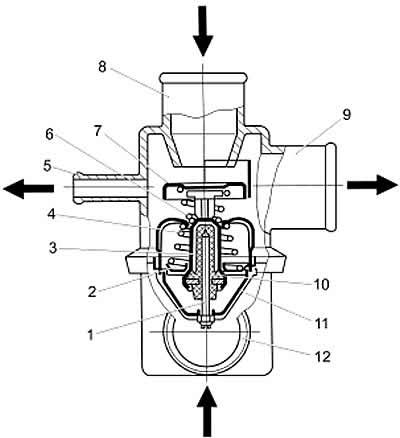
Figure 2-66. Thermostat:
1 - piston;
2 - main valve;
3 - solid heat-sensitive filler;
4 - main valve spring;
5 - outlet pipe to the throttle pipe;
6 - bypass valve spring;
7 - bypass valve;
8 - inlet pipe from the engine;
9 - outlet pipe to the pump;
10 - rubber insert;
11 - piston holder;
12 - radiator inlet pipe;
D - fluid inlet from engine;
P - liquid inlet from radiator;
H - liquid outlet to the pump.
The initial temperature of the liquid in the tank should be 73-75°C. Gradually increase the temperature of the liquid by about 1°C per minute with constant stirring so that it is the same throughout the volume.
The temperature at which the main valve stroke is 0.1 mm is taken as the temperature at which the valve starts to open.
The thermostat must be replaced if the main valve opening temperature is not within (80±2)°C or the main valve stroke is less than 6.0 mm.
The simplest check of the thermostat can be done by touch directly on the car. After starting a cold engine with a working thermostat, the lower radiator hose should heat up when the liquid temperature indicator arrow is approximately 3-4 mm from the red zone of the scale, which corresponds to 80-85°C.
(The material was created based on information from the website: ChevyMan.ru)